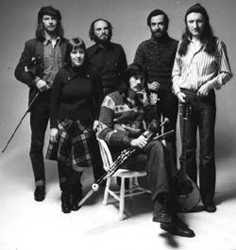
With St. Patrick's Day this weekend, I thought it would be a good time to write about traditional Irish music. In particular, I decided to look at the history of the greatest of the traditional Irish bands,
The Bothy Band. The Bothy Band only produced three studio albums and one live album in their short history, but all traditional Irish music that has come since bears their influence.
A handful of developments helped to make the Bothy Band possible. First, while groups like
The Clancy Brothers and
The Dubliners were popularizing the Irish singing tradition in the sixties,
The Chieftains began revitalizing the instrumental tradition, especially with regards to the fiddle and the uilleann pipes. Second, the band
Planxty incorporated a number of Eastern European influences into their sound, most notably modal chord structures and a Greek plucked instrument called the bouzouki, when they emerged onto the scene in the early seventies. Perhaps the most important influence, though, was the growing cultural impact of rock and roll, which had begun to leave its mark on other musical styles as well. At least a few rock musicians in England were aware of Irish music; for example, The Beatles took a day off from recording
Abbey Road so that The Chieftains had a place to record their second album. A couple of bands took their interest in the traditional music and folklore of the British Isles a bit further, though.
Fairport Convention and
Steeleye Span used fiddles and performed a lot of traditional material in a style that was always more rock than folk. These two bands have never had a huge following among rock audiences, but their repuation in folk circles remains enormous. Indeed, Mícheál Ó Domhnaill (guitar and vocals) cited Fairport's 1970 LP
Full House, and the playing of their guitarist
Richard Thompson, as major influences on the development of his style. So with a handful of bands incorporating folk music into their rock arrangements, it made sense that somebody would come up with the idea of bringing the energy and spirit of rock and roll into traditional music.
The impetus for the formation of The Bothy Band came from bouzouki player
Dónal Lunny, famous in traditional Irish circles as a former member of Planxty. He was already developing a reputation for wanting to work with just about everybody in the scene, and he assembled a backing band to accompany an accordionist he was working with on some radio broadcasts. This group originally included
Paddy Keenan on uilleann pipes and
Matt Molloy on flute. Soon Ó Domhnaill and his sister Tríona Ní Dhomhnaill (clavinet and vocals), both from the band Skara Brae, had joined up as well, and a new band had clearly started to take shape. By late 1975, legendary fiddler
Tommy Peoples had been recruited, and the sextet were ready to record their debut album.

The energy level of the playing on
The Bothy Band 1975 had not been heard on any traditional Irish recording that preceded it. The band members were all masters at their particular instrument, and the notes always rang clean and true no matter how fast they were being played. Lunny and Ó Domhnaill provided a driving rhythm for the lead instruments to work with, and Tríona provided some balance to the band's sound with songs like
"Pretty Peg." The genre of Irish traditional music had been reinvented overnight.

Unfortunately, there was no money to be made from Irish music at the time, and the long touring with little reward took it's toll. Peoples left, and
Kevin Burke quickly stepped in to take his place. Peoples' reputation as a fiddler is impeccable, but I feel that Burke's style meshed better with the group. As America celebrated its 200th birthday in July 1976, The Bothy Band recorded the definitive Irish album,
Old Hag You Have Killed Me. Once again the playing was superb, but the band showed real growth in its arrangements. The title tune, a three part jig, starts out simply with the melody played on clavinet, but simply soars once the second part begins. The opening tune "Music in the Glen" features a funky clavinet riff on the third parts that evokes Stevie Wonder more than anything Irish. "Sixteen Come Next Sunday" combines some exquisite guitar/bouzouki interplay underneath Tríona Ní Dhomhnaill's sweet vocals. But the most noteworthy track was a short, ninety-second piece of a capella Scottish mouth music that Ó Domhnaill brought to the band and sang lead on. "Fionnghuala," with its frenetically alliterative, oddly harmonized chorus, sounds quite literally like nothing else, and stands as one of the genre's all-time classic recordings.

1977's
Out of the Wind, Into the Sun didn't quite match the same heights as its predecessor, but remained quite solid nonetheless. The band continued to push the envelope on a couple of tracks. "The Maids of Mitchelstown" begins by alternating between two distinct melodies that fit the same chord structure, and ends with the two melodies being played simultaneously. On the second part of the set of bagpipe jigs "The Pipe in the Hob/The Hag on the Churn," Ní Dhomhnaill plays a driving bass line on clavinet while Keenan crunches out the melody and Molloy and Burke produce some strident, outside-the-box harmonies. Despite the band's creativity remaining firmly intact, the money just wasn't coming in, and the band began to unravel. The following year saw the release of a live album
After Hours, recorded in Paris, but The Bothy Band never returned to the studio, and played their last show in 1979.
The band members have all kept busy over the years, especially Lunny. Lunny was part of the band
Moving Hearts in the eighties, and has an enormous resumé of credits as a producer and guest musician. He has worked with some top Celtic acts, including Ireland's
Altan and Scotland's
Capercaillie, but he's helped add an Irish flavor to plenty of rock records as well.
Elvis Costello's Spike,
Mark Knopfler's Golden Heart, and
Loreena McKennitt's The Mask and the Mirror all feature Lunny on bouzouki. His most noteworthy session work, I think, has been with
Kate Bush. Songs like "Night of the Swallow" off
The Dreaming, and "Jig of Life" and "Hello Earth" off
Hounds of Love, are groundbreaking, genre-bending recordings that benefited enormously from Lunny's contributions. Ironically, these particular songs sold me on Irish music well before I knew who Donal Lunny was or heard of The Bothy Band. Of the remaining members, only Matt Molloy has reaped any huge commercial reward for his playing; he took up an offer to join The Chieftains in 1980, and has been playing with them ever since. Paddy Keenan relocated to Boston and tours periodically. If you'd like to see the best player at his particular instrument in an intimate setting at a local pub, Keenan is well worth checking out. Burke has played in the band Patrick Street, and has toured on his own and as part of the Celtic Fiddle Festival. Mícheál Ó Domhnaill and Tríona Ní Domhnaill have had many projects between them, and played together in the bands Relativity and Nightnoise. Regrettably, Ó Domhnaill
died suddenly of a fall in his house last July.
Much contemporary Irish music aims for fast playing and energetic live shows. Bands like Altan and
Lúnasa are great to see live, but haven't made albums that do their concerts justice. While I obviously never got the chance to see The Bothy Band perform live -- I've seen all of them, Tommy Peoples included, play separately -- their greatness on record keeps them at a level above all the Irish bands that have followed. It also ensures that everybody can still enjoy them today, as they were in their prime.


