It's not easy getting older -- especially when a reminder of youth moves in next door. This is the central idea, and source of conflict, with Neighbors, a comedy that's alternating thoughtful and juvenile.
Mac and Kelly Radner (Seth Rogen and Rose Byrne) are a married couple who are reluctant to grow up. They're the first of their friends to have a house and a kid (six-month-old daughter Stella), they miss going out, and they consider taking Stella to a rave when they can't get a babysitter. Their pride is their new house, which they sunk all their money into, and they hope to get a cool gay couple as neighbors. What they get instead is a fraternity next door.
Teddy (Zac Efron) is the president of Delta Psi, and he and his second in command Pete (Dave Franco) are determined to make it onto their wall of fame with a legendary party. Mac and Kelly and Teddy try bonding -- Mac and Kelly want to seem cool so Teddy will "keep it down" if things get too loud, Teddy thinks if they're friends early the frat can get away with more stuff later -- but after some hurt feelings (Teddy doesn't keep it down, so Mac calls the cops) they wind up in a virtual war. Mac and Kelly want to get Delta Psi its three strikes so it's shut down, while Teddy and his friends work at making things miserable for Mac and Kelly while building to their epic party.
Neighbors is a mostly familiar and often funny take on opposites going against each other. Seth Rogen gets to do his usual stoner humor, but Rose Bryne is terrific as the warring mother who doesn't want to be the responsible one and who can be just as juvenile and wily as her husband. Zac Efron does well, although I suspect he was cast as much for his near-perfect body as for his comic timing. The movie has plenty of gross-out gags (a dildo fight, a found condom), but there's also a generational issue: Mac and Kelly want to feel young even while needing a good night's sleep, while Teddy sees getting on his fraternity's wall as a lifetime achievement, even though Pete reminds him that they're graduating in a few weeks and it'll all be behind them.
Neighbors isn't consistently funny, but i\t has more than enough laughs to be entertaining. And the generational issues and comic opportunities for Rose Byrne make it a little better than the average comedy.
Overall grade: B
Reviewed by James Lynch
5.17.2014
5.15.2014
Asa Akira, INSATIABLE
Many books about pornography tend to be either cautionary tales about how the industry destroys people, or shameless self-promotion. The title Insatiable: Porn -- A Love Story should tell you which direction Asa Akira's biography leans, but this atypical book manages to be a honest, unapologetic look at one star's life, highs and lows together.
Insatiable isn't organized chronologically (except for one chapter that's Asa's journal entries for a year) or by subject. Instead, the book bounces around like Asa's randomly remembering things and chatting about them. There's plenty of discussion of sex -- from what she enjoys personally and professionally, common tricks and signifiers of the adult industry (baby wipes are a giveaway), and her brief jobs as a hooker and dominatrix -- but there's also what she does outside the bedroom or studio. The chapter "Craigslist" is more about the death of an ex-boyfriend than answering an ad of Craigslist, "Food Porn" is actually about breaking a diet with pizza, and high school stories involve drugs and shoplifting. And the sexual and non-sexual sides come together often, such as when Asa learns an ex-boyfriend is shooting gay porn in the studio next to hers, or her letter to a future child that is both empowering and graphically describes the threesome where she met her child's father. And there are haikus too!
Insatiable: Porn -- A Love Story is a different sort of read. Asa is likable -- often funny, usually explicit, and sometimes sad -- and passionate about her life and career. The book's lack of organization does prevent it from building momentum or direction, but the stories are interesting and show a life that's far from perfect but perfect for her. Asa Akira provides readers with a blunt, positive look at the life of a woman in the adult entertainment industry, and Insatiable is worth checking out.
Overall grade: A-
Reviewed by James Lynch
Insatiable isn't organized chronologically (except for one chapter that's Asa's journal entries for a year) or by subject. Instead, the book bounces around like Asa's randomly remembering things and chatting about them. There's plenty of discussion of sex -- from what she enjoys personally and professionally, common tricks and signifiers of the adult industry (baby wipes are a giveaway), and her brief jobs as a hooker and dominatrix -- but there's also what she does outside the bedroom or studio. The chapter "Craigslist" is more about the death of an ex-boyfriend than answering an ad of Craigslist, "Food Porn" is actually about breaking a diet with pizza, and high school stories involve drugs and shoplifting. And the sexual and non-sexual sides come together often, such as when Asa learns an ex-boyfriend is shooting gay porn in the studio next to hers, or her letter to a future child that is both empowering and graphically describes the threesome where she met her child's father. And there are haikus too!
Insatiable: Porn -- A Love Story is a different sort of read. Asa is likable -- often funny, usually explicit, and sometimes sad -- and passionate about her life and career. The book's lack of organization does prevent it from building momentum or direction, but the stories are interesting and show a life that's far from perfect but perfect for her. Asa Akira provides readers with a blunt, positive look at the life of a woman in the adult entertainment industry, and Insatiable is worth checking out.
Overall grade: A-
Reviewed by James Lynch
5.11.2014
GAUNTLET OF FOOLS
What could be more foolhardy than a sword and sorcery dungeon crawl, where adventurers wander through an unexplored dungeon fighting monsters? How about reckless boasts beforehand? Gauntlet of Fools, from Indie Board and Cards, uses this element of deliberate foolishness to change the typical dungeon crawl -- only the change isn't that much.
The players in Gauntlet of Fools are adventurers out to get the most gold from killing dungeon monsters before dying. At the start of the game, Heroes (made of pairs of Class and Weapon cards) are laid out, equal to the number of players. Class cards have a character's name, Defense, Class Ability (which is either automatic or requires discarding a Class Token to use), and Class Tokens. Weapon cards have the weapon's name, # of Attack Dice (rolled each combat), Weapon Ability (which is either automatic or requires discarding a Weapon Token to use). These Class and Weapon cards are considered linked and can't be rearranged.
Players then choose their Heroes -- but they can also boast! Boasts (shown below) are disadvantages each Hero has, from Hopping on One Leg to suffering from a Hangover. Why boast? Because after you choose a Hero, another player can steal that Hero from you if they add a new Boast to it. So a player can select an unmodified Hero and risk having it stolen, or give it a Boast to make it less likely to be stolen (but also weakening it). After all Heroes are chosen, it's off to the Dungeon!
In the Dungeon, the Encounter deck is flipped over one card at a time. Most cards are Monsters, and each player is considered to be fighting the monster individually. Monsters have an Attack Strength, Defense, Damage, Treasure, and sometimes Special Damage or Special Treasure. Players roll their Attack Dice (and decide whether or not to use Attack or Character tokens) and compare the results with the monster. If the player's Attack Dice (modified by any Boasts, bonuses, or penalties) equal or are greater than the Monster's Defense, the player kills the monster and gets its treasure (usually Gold); if not, the player gets nothing. At the same time, the Monster's attack value is compared to the player's Defense (with any modification). If the Monster's value is higher, the Hero suffers damage (usually one Wound); if the Hero's defense is higher, they Dodged the monster and take no damage.
After each encounter, players check their Wounds. A Hero with four or more Wounds is dead and done adventuring -- but not necessarily the loser! When all Heroes have died, the players compare their gold and the player with the most gold wins!
I like Gauntlet of Fools, but the Boasting mechanic isn't quite what I thought it would be. While the Boasts are nicely goofy, the Heroes aren't so different that players will get into a "Boasting War" to keep stealing a desired Character-Weapon combo from each other. And with that out of the way, the mechanics work as a fairly routine dungeon crawl (although knowing when to spend Character or Weapon tokens can make the difference between living and dying -- or, more importantly, getting gold or getting nothing). Gauntlet of Fools is a decent game that's fun for a quick run-through before a bigger game. It's just not much to, er, boast about.
Overall grade: B-
Reviewed by James Lynch
The players in Gauntlet of Fools are adventurers out to get the most gold from killing dungeon monsters before dying. At the start of the game, Heroes (made of pairs of Class and Weapon cards) are laid out, equal to the number of players. Class cards have a character's name, Defense, Class Ability (which is either automatic or requires discarding a Class Token to use), and Class Tokens. Weapon cards have the weapon's name, # of Attack Dice (rolled each combat), Weapon Ability (which is either automatic or requires discarding a Weapon Token to use). These Class and Weapon cards are considered linked and can't be rearranged.
Players then choose their Heroes -- but they can also boast! Boasts (shown below) are disadvantages each Hero has, from Hopping on One Leg to suffering from a Hangover. Why boast? Because after you choose a Hero, another player can steal that Hero from you if they add a new Boast to it. So a player can select an unmodified Hero and risk having it stolen, or give it a Boast to make it less likely to be stolen (but also weakening it). After all Heroes are chosen, it's off to the Dungeon!
In the Dungeon, the Encounter deck is flipped over one card at a time. Most cards are Monsters, and each player is considered to be fighting the monster individually. Monsters have an Attack Strength, Defense, Damage, Treasure, and sometimes Special Damage or Special Treasure. Players roll their Attack Dice (and decide whether or not to use Attack or Character tokens) and compare the results with the monster. If the player's Attack Dice (modified by any Boasts, bonuses, or penalties) equal or are greater than the Monster's Defense, the player kills the monster and gets its treasure (usually Gold); if not, the player gets nothing. At the same time, the Monster's attack value is compared to the player's Defense (with any modification). If the Monster's value is higher, the Hero suffers damage (usually one Wound); if the Hero's defense is higher, they Dodged the monster and take no damage.
After each encounter, players check their Wounds. A Hero with four or more Wounds is dead and done adventuring -- but not necessarily the loser! When all Heroes have died, the players compare their gold and the player with the most gold wins!
I like Gauntlet of Fools, but the Boasting mechanic isn't quite what I thought it would be. While the Boasts are nicely goofy, the Heroes aren't so different that players will get into a "Boasting War" to keep stealing a desired Character-Weapon combo from each other. And with that out of the way, the mechanics work as a fairly routine dungeon crawl (although knowing when to spend Character or Weapon tokens can make the difference between living and dying -- or, more importantly, getting gold or getting nothing). Gauntlet of Fools is a decent game that's fun for a quick run-through before a bigger game. It's just not much to, er, boast about.
Overall grade: B-
Reviewed by James Lynch
5.08.2014
Old 97's, MOST MESSED UP
Fans of the band Old 97's may feel a little old knowing that the band's been making music for 20 years now, but that hasn't slowed Old 97s down at all. Most Messed Up is a high-energy blast of their country-rock sound filled with joy, regret, booze, pills, profanity, and wry humor -- and it's their best album since Too Far to Care.
Most Messed Up opens with "Longer Than You've Been Alive," a rambling look at the band's history ("most of our shows have been triumphs of rock/although some night I might have been checking the clock"). From there it's on to the women who got away ("Give It Time," "Guadalahara"), the women who stayed ("Wheels Off") and the mix of women and booze ("Let's Get Drunk and Get It On," "Wasted"). There are songs about our common experiences ("This Is the Ballad") and the title track and album closer, "Most Messed Up," a curse-filled bad-boy track which proudly and drunkenly proclaims "I'm so far gone, I can't ever get down/I am the most messed up motherfucker in this town."
Most Messed Up skips any slow or sentimental songs, going always for volume and bar songs instead. Rhett Miller's almost-breaking voice fits these tunes perfectly, whether sounding joyful or on the edge of passing about. The band's twanging guitar and bass all work well together, and the results are a great almost-mess of life in bars and with the wrong women and the right booze. Most Messed Up is a terrific album, back to the basics of what made Old 97's such a great sound from the start.
Overall grade: A
Reviewed by James Lynch
Most Messed Up opens with "Longer Than You've Been Alive," a rambling look at the band's history ("most of our shows have been triumphs of rock/although some night I might have been checking the clock"). From there it's on to the women who got away ("Give It Time," "Guadalahara"), the women who stayed ("Wheels Off") and the mix of women and booze ("Let's Get Drunk and Get It On," "Wasted"). There are songs about our common experiences ("This Is the Ballad") and the title track and album closer, "Most Messed Up," a curse-filled bad-boy track which proudly and drunkenly proclaims "I'm so far gone, I can't ever get down/I am the most messed up motherfucker in this town."
Most Messed Up skips any slow or sentimental songs, going always for volume and bar songs instead. Rhett Miller's almost-breaking voice fits these tunes perfectly, whether sounding joyful or on the edge of passing about. The band's twanging guitar and bass all work well together, and the results are a great almost-mess of life in bars and with the wrong women and the right booze. Most Messed Up is a terrific album, back to the basics of what made Old 97's such a great sound from the start.
Overall grade: A
Reviewed by James Lynch
5.03.2014
THE AMAZING SPIDER-MAN 2
Spider-Man returns to swing and deal with angst in The Amazing Spider-Man 2, the latest Marvel summer blockbuster. This reboot of the Spider-Man franchise adds more villains and more drama but isn't all that satisfying.
It's high school graduation for Peter Parker (Andrew Garfield) and Gwen Stacy (Emma Stone), and the course of their love never could run smooth. Peter is in love with her but is afraid her being around him could get her hurt (reinforced by his imagining her dead father -- to whom Peter promised he'd stay away from Gwen -- staring at him), while Gwen is considering a scholarship to Oxford, taking her far away from Peter. And there's still the mystery of why Peter's parents Richard and May Parker (Campbell Scott, Embeth Davidzt) vanished, and what Aunt May (Sally Field) is doing to keep Peter provided for.
But superheroes need super villains, and ASM2 introduces two (technically three, but the last one is barely in the movie). Max Dillon (Jaime Foxx) is a mousy, angry nerd who idolizes Spider-Man. When an accident gives him electrical powers, he becomes Electro -- and his hero worship turns to hatred when he feels like Spider-Man is stealing all of his attention. Meanwhile, Peter's old friend Harry Osborn (Dane DeHaan) has just returned, inherited Oscorp, and found out that he's dying of the same degenerative disease that killed his father. And Harry thinks the cure lies in Spider-Man's blood.
While ASM2 has more interesting villains than its predecessor, it also has some of the same annoyances. The action often relies on a combination of slow-motion and freeze-frame shots, which is meant to show speed but gets distracting at times. While Stone is spirited as the smart, spirited love interest with a mind of her own, Garfield always seemed more like a sullen cool kid than the nerd Peter Parker was supposed to be. Jamie Foxx is fun as the uber-fan of Spidey, but most of that vanishes under a deeper voice and glowing blue makeup. And Dane DeHaan is fine as Harry, though his villainous transformation happens so late in the movie it's almost unnecessary. (The final villain could have been left out entirely.) And the conspiracies seem to exist solely to keep churning out sequels.
The Amazing Spider-Man 2 has some exciting sequences, but the same problems as the last time (not to mention some glaring absences of subtlety) make it a movie that can be entertaining and then forgotten almost immediately.
Overall grade: B-
Reviewed by James Lynch
It's high school graduation for Peter Parker (Andrew Garfield) and Gwen Stacy (Emma Stone), and the course of their love never could run smooth. Peter is in love with her but is afraid her being around him could get her hurt (reinforced by his imagining her dead father -- to whom Peter promised he'd stay away from Gwen -- staring at him), while Gwen is considering a scholarship to Oxford, taking her far away from Peter. And there's still the mystery of why Peter's parents Richard and May Parker (Campbell Scott, Embeth Davidzt) vanished, and what Aunt May (Sally Field) is doing to keep Peter provided for.
But superheroes need super villains, and ASM2 introduces two (technically three, but the last one is barely in the movie). Max Dillon (Jaime Foxx) is a mousy, angry nerd who idolizes Spider-Man. When an accident gives him electrical powers, he becomes Electro -- and his hero worship turns to hatred when he feels like Spider-Man is stealing all of his attention. Meanwhile, Peter's old friend Harry Osborn (Dane DeHaan) has just returned, inherited Oscorp, and found out that he's dying of the same degenerative disease that killed his father. And Harry thinks the cure lies in Spider-Man's blood.
While ASM2 has more interesting villains than its predecessor, it also has some of the same annoyances. The action often relies on a combination of slow-motion and freeze-frame shots, which is meant to show speed but gets distracting at times. While Stone is spirited as the smart, spirited love interest with a mind of her own, Garfield always seemed more like a sullen cool kid than the nerd Peter Parker was supposed to be. Jamie Foxx is fun as the uber-fan of Spidey, but most of that vanishes under a deeper voice and glowing blue makeup. And Dane DeHaan is fine as Harry, though his villainous transformation happens so late in the movie it's almost unnecessary. (The final villain could have been left out entirely.) And the conspiracies seem to exist solely to keep churning out sequels.
The Amazing Spider-Man 2 has some exciting sequences, but the same problems as the last time (not to mention some glaring absences of subtlety) make it a movie that can be entertaining and then forgotten almost immediately.
Overall grade: B-
Reviewed by James Lynch
FREE COMIC BOOK DAY
There's an old saying "You can;t get any cheaper than free," and that certainly explains the appeal of Free Comic Book Day. Begin in 2002, this event (holiday?) happens on the first Saturday of May since 2002, and it certainly draws a crowd.
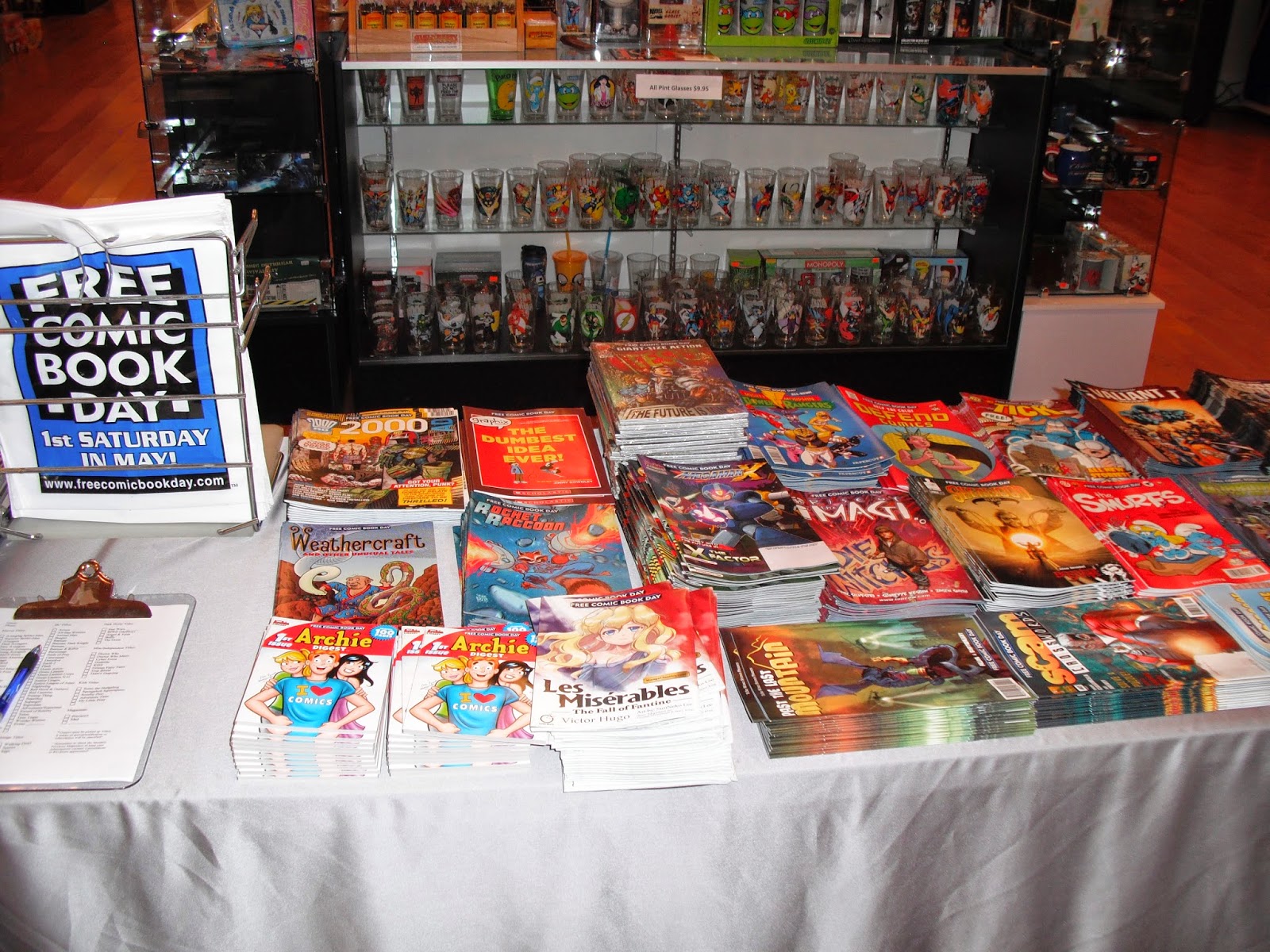
The premise of Free Comic Book Day is simple: Several publishers print up comics to be given away during the day (with the words "Free Comic Book Day" appearing on the cover), and participating comic book stores have these books available to whoever wants them. Stores can limit people to one copy of each title, and at least one store bags the free books and then staples the bag shut, so the customer can browse or shop through the rest of the store.
Free Comic Book Day is designed to get more people interested in comics -- or at least into the store -- and it succeeds at both of these goals. There are a wide variety of free comics available from a wide variety of publishers. You'll find the big names from Marvel and DC, but you'll also find independent comics like Mouse Guard, Atomic Robo, and Grimm Fairy Tales. The Guardians of the Galaxy can be found on the table next to Archie, the Simpsons, Judge Dredd, the Mighty Morphin' Power Rangers, Street Righter, The Tick, and many others. Some stores have their own promotions as well: Apocalypse Comics, shown below, had a Spider-Man bouncy castle and "superheroes" kids could pose with; I left before the wrestlers arrived. (Honest.)
So for anyone who loves comics -- or just wants to see what's new or appealing in comics -- Free Comic Book Day is a great opportunity to snag some free comics (legally) and read away!
Jim Lynch
The premise of Free Comic Book Day is simple: Several publishers print up comics to be given away during the day (with the words "Free Comic Book Day" appearing on the cover), and participating comic book stores have these books available to whoever wants them. Stores can limit people to one copy of each title, and at least one store bags the free books and then staples the bag shut, so the customer can browse or shop through the rest of the store.
Free Comic Book Day is designed to get more people interested in comics -- or at least into the store -- and it succeeds at both of these goals. There are a wide variety of free comics available from a wide variety of publishers. You'll find the big names from Marvel and DC, but you'll also find independent comics like Mouse Guard, Atomic Robo, and Grimm Fairy Tales. The Guardians of the Galaxy can be found on the table next to Archie, the Simpsons, Judge Dredd, the Mighty Morphin' Power Rangers, Street Righter, The Tick, and many others. Some stores have their own promotions as well: Apocalypse Comics, shown below, had a Spider-Man bouncy castle and "superheroes" kids could pose with; I left before the wrestlers arrived. (Honest.)
So for anyone who loves comics -- or just wants to see what's new or appealing in comics -- Free Comic Book Day is a great opportunity to snag some free comics (legally) and read away!
Jim Lynch
5.02.2014
The Pixies, INDIE CINDY
The Pixies were a massively influential alternative rock band, inspiring everyone from Nirvana and grunge to Sugar and Bob Mould with their bass-electric guitar combos, wailing lead singer, and odd and dark lyrics. But their last studio was in 1991 (Trompe le Monde), followed by solo projects by lead singer Frank Black/Black Francis and bassist Kim Deal (and her new band the Creatures). But the Pixies have (mostly) returned with Indie Cindy, their latest album that is a bit more mellow but still very welcome.
On this album Kim Deal has been replaced by Ding on bass, but the rest of the band is here: Frank Black singing and playing guitar, David Lovering on drums, and Joey Santiago on lead guitar. The band's signature sound is present, from the loud intro "What Goes Boom" through the steady pounding of "Bagboy" There's also the bizarre lyrics, from a romance with aliens in "Andro Queen" ("for what's missing I'll sacrifice my flesh/only kissing you is so hard in this wild thresh") to the shouted refrain of "Bagboy:" "Cover your breath! Polish your teeth!").
But Indie Cindy also feels a bit more... mellow and nostalgic. The songs aren't as stark or brash as previous Pixies tunes, and "Ring the Bell" and "Jaime Bravo" actually have a mellow feel to them. There's missing the Garland in "Ring the Bell," while the title track could be the band acknowledging how much alternative music has moved on from them in the present ("Indie Cindy, be in love with me/I beg for you to carry me").
Indie Cindy doesn't all fit together perfectly (many songs were released as singles before the album) but it's a good return for a great band -- and a reminder that alternative music can be messy and confusing as well as original and loud.
Overall grade: B+
Reviewed by James Lynch
On this album Kim Deal has been replaced by Ding on bass, but the rest of the band is here: Frank Black singing and playing guitar, David Lovering on drums, and Joey Santiago on lead guitar. The band's signature sound is present, from the loud intro "What Goes Boom" through the steady pounding of "Bagboy" There's also the bizarre lyrics, from a romance with aliens in "Andro Queen" ("for what's missing I'll sacrifice my flesh/only kissing you is so hard in this wild thresh") to the shouted refrain of "Bagboy:" "Cover your breath! Polish your teeth!").
But Indie Cindy also feels a bit more... mellow and nostalgic. The songs aren't as stark or brash as previous Pixies tunes, and "Ring the Bell" and "Jaime Bravo" actually have a mellow feel to them. There's missing the Garland in "Ring the Bell," while the title track could be the band acknowledging how much alternative music has moved on from them in the present ("Indie Cindy, be in love with me/I beg for you to carry me").
Indie Cindy doesn't all fit together perfectly (many songs were released as singles before the album) but it's a good return for a great band -- and a reminder that alternative music can be messy and confusing as well as original and loud.
Overall grade: B+
Reviewed by James Lynch
SMASH UP: SCIENCE FICTION DOUBLE FEATURE
The game Smash Up relies on different factions from fiction and fantasy, battling to control bases. With two expansions -- Awesome Level 9000 and The Obligatory Cthulhu Set -- I was concerned that Alderac Entertainment Games might start putting out weaker groups for the sake of more expansions. Fortunately, Science Fiction Double Feature continues the fun and the high standard that makes Smash Up so much fun.
Science Fiction Double Feature provides players with four new factions (and bases based on each faction). Time Travelers are a bunch of buddies from 1974 (hence the matching track suits) who can redo events. Cyborg Apes have lots of Actions that modify them to make themselves tougher or more protected. Super Spies plan ahead by looking at and reorganizing the cards they'll draw. And Changelings are pinking humanoids that copy the strength and abilities of the other factions in the game.
These new factions strike the balance between being very useful in different ways, and not being so overpowering they make previous factions obsolete. There's also a good sense of humor throughout the expansion: Several Time Traveler cards reference "The Time Warp" from The Rocky Horror Picture Show, many Super Spies actions parody James Bond movie titles, and one Cyborg Ape has the same name as the leader of the Jammers, the cybernetic apes from the ccg Shadowfist.
Science Fiction Double Feature does what it should: Give Smash Up players more options and more fun without making the previous options weaker. It's astounding! (Sorry, couldn't help myself.)
Overall grade: B+
Reviewed by James Lynch
Science Fiction Double Feature provides players with four new factions (and bases based on each faction). Time Travelers are a bunch of buddies from 1974 (hence the matching track suits) who can redo events. Cyborg Apes have lots of Actions that modify them to make themselves tougher or more protected. Super Spies plan ahead by looking at and reorganizing the cards they'll draw. And Changelings are pinking humanoids that copy the strength and abilities of the other factions in the game.
These new factions strike the balance between being very useful in different ways, and not being so overpowering they make previous factions obsolete. There's also a good sense of humor throughout the expansion: Several Time Traveler cards reference "The Time Warp" from The Rocky Horror Picture Show, many Super Spies actions parody James Bond movie titles, and one Cyborg Ape has the same name as the leader of the Jammers, the cybernetic apes from the ccg Shadowfist.
Science Fiction Double Feature does what it should: Give Smash Up players more options and more fun without making the previous options weaker. It's astounding! (Sorry, couldn't help myself.)
Overall grade: B+
Reviewed by James Lynch
4.29.2014
@MIDNIGHT
So, if there was a show that was nothing but funny people sitting around telling jokes, would it be a good show for making us laugh, or a bad show for having no real creativity? This is the dilemma of @midnight, the latest show from Comedy Central that jumps on a trend -- this time, the Internet.
Hosted by Chris Hardwick, @midnight is a gameshow with loose rules and no prize. Each episode has three comedians and/or actors competing to "win the Internet" (meaning bragging rights as the funniest person online until the next show -- meaning no actual prize). Competitors guess which of three online items are true (sometimes all are true) or most popular, write fake promotions, comment on videos, and create their own hashtags and bad ideas. Contestants get points for correct answers (or just for making Hardwick laugh), and near the end the person with the fewest points is eliminated (bathed in a red light). In the final competition, For the Win (FTW -- read it backwards if you don't get the joke), the last two players have to write something about a topic. Hardwick reads both answers, and whoever wrote the one that gets the most applause wins the Internet/
@midnight is both enjoyable and frustrating. Not since Whose Line Is It Anyway? has there been a game show where the points and competition matter so little, considering there's no prize. It's like a bunch of friends hanging out, making funny comments, and getting carried away with how funny they are. (It also seems like the competitors get the topics and info beforehand, as there never seem to be any failed jokes.) Fortunately for the show, the comics are pretty funny, letting the goofy and bizarre jokes fly free and fast. The show gets some celebrities to do readings, such as Walter Goggins reading a Craigslist ad for an unpaid human pinata, or Joe Manganiella -- who played a werewolf on True Blood -- reading an Amazon review for the three wolf moon t-shirt. And Thomas Lennon's fake Buzzfeed suggestion "16 Squirrels Who Look Like Radiohead" led to that being created:
@midnight isn't innovative or creative, but it's a chance to listen to some comics making pretty good jokes at the expense of the Internet. If you're still up when The Colbert Report ends, it's worth sticking around for (unless you're tired).
Overall grade: B-
Reviewed by James Lynch
Hosted by Chris Hardwick, @midnight is a gameshow with loose rules and no prize. Each episode has three comedians and/or actors competing to "win the Internet" (meaning bragging rights as the funniest person online until the next show -- meaning no actual prize). Competitors guess which of three online items are true (sometimes all are true) or most popular, write fake promotions, comment on videos, and create their own hashtags and bad ideas. Contestants get points for correct answers (or just for making Hardwick laugh), and near the end the person with the fewest points is eliminated (bathed in a red light). In the final competition, For the Win (FTW -- read it backwards if you don't get the joke), the last two players have to write something about a topic. Hardwick reads both answers, and whoever wrote the one that gets the most applause wins the Internet/
@midnight is both enjoyable and frustrating. Not since Whose Line Is It Anyway? has there been a game show where the points and competition matter so little, considering there's no prize. It's like a bunch of friends hanging out, making funny comments, and getting carried away with how funny they are. (It also seems like the competitors get the topics and info beforehand, as there never seem to be any failed jokes.) Fortunately for the show, the comics are pretty funny, letting the goofy and bizarre jokes fly free and fast. The show gets some celebrities to do readings, such as Walter Goggins reading a Craigslist ad for an unpaid human pinata, or Joe Manganiella -- who played a werewolf on True Blood -- reading an Amazon review for the three wolf moon t-shirt. And Thomas Lennon's fake Buzzfeed suggestion "16 Squirrels Who Look Like Radiohead" led to that being created:
@midnight isn't innovative or creative, but it's a chance to listen to some comics making pretty good jokes at the expense of the Internet. If you're still up when The Colbert Report ends, it's worth sticking around for (unless you're tired).
Overall grade: B-
Reviewed by James Lynch
4.23.2014
THE GRAND BUDAPEST HOTEL
Nostalgia has a way of brightening up the past, so director Wes Anderson's stylized technique perfectly matches the trip down memory lane that is The Grand Budapest Hotel.
This movie is a story within a story within a story. We first see a student at a memorial to an author. We then go back to 1985, where the author (Jude Writer) is staying at at the old, fading Grand Budapest Hotel in the fictional country of Zubrowka. He is intrigued by Zero Moursafa (F. Murray Abraham), a rich man who insists on staying at this hotel. Zero then tells his own story, going back to 1935 -- and the glory days of the Grand Budapest.
Young Zero (Tony Revolon) is a bellboy at the Grand Budapest, and his boss, mentor, and friend is M. Gustave (Ralph Fiennes), the concierge at the Grand Budapest. Gustave insists on culture and civility, providing for his guests and quoting poetry (though inclined to curse when surprised or speaking privately). He also sleeps with a lot of elderly hotel guests. This last trait has him in the will of an elderly woman who dies under mysterious circumstances and leaves him a priceless painting called Boy with Apple. This gift angers the woman's eldest son Dmitri (Adrien Brody) and Jopling (Willem Dafoe), an assassin and sociopath working for Dmitri. Gustave swipes and hides the painting, is framed for murder, and goes on the run with Zero. There are a number of odd characters along the way: Henckles (Edward Norton), a law officer after
Gustave; Agatha (Saoirse Ronan), a baker and Zero's sweetheart; and a number of characters played by Wes Anderson regulars like Bill Murray, Owen Wilson, Jeff Goldblum, Jason Schwartzman and Tom Wilkinson.
The Grand Budapest Hotel is delightfully artificial. The characters all speak and move very self-awarely, which may be the lens of the elderly Zero thinking fondly of the good old days. Ralph Fiennes is very fun as the M. Gustave, making him an eccentric character who believes first and foremost in manners and politeness even amid the craziness surrounding him. The rest of the cast does well (even if some come and go in minutes), and Anderson keeps things going at a zany pace. The deliberate artificiality can be a bit distracting at times, but The Grand Budapest Hotel is as enjoyable and frothy a treat as Agatha's pastries.
Overall grade: B
Reviewed by James Lynch
This movie is a story within a story within a story. We first see a student at a memorial to an author. We then go back to 1985, where the author (Jude Writer) is staying at at the old, fading Grand Budapest Hotel in the fictional country of Zubrowka. He is intrigued by Zero Moursafa (F. Murray Abraham), a rich man who insists on staying at this hotel. Zero then tells his own story, going back to 1935 -- and the glory days of the Grand Budapest.
Young Zero (Tony Revolon) is a bellboy at the Grand Budapest, and his boss, mentor, and friend is M. Gustave (Ralph Fiennes), the concierge at the Grand Budapest. Gustave insists on culture and civility, providing for his guests and quoting poetry (though inclined to curse when surprised or speaking privately). He also sleeps with a lot of elderly hotel guests. This last trait has him in the will of an elderly woman who dies under mysterious circumstances and leaves him a priceless painting called Boy with Apple. This gift angers the woman's eldest son Dmitri (Adrien Brody) and Jopling (Willem Dafoe), an assassin and sociopath working for Dmitri. Gustave swipes and hides the painting, is framed for murder, and goes on the run with Zero. There are a number of odd characters along the way: Henckles (Edward Norton), a law officer after
Gustave; Agatha (Saoirse Ronan), a baker and Zero's sweetheart; and a number of characters played by Wes Anderson regulars like Bill Murray, Owen Wilson, Jeff Goldblum, Jason Schwartzman and Tom Wilkinson.
The Grand Budapest Hotel is delightfully artificial. The characters all speak and move very self-awarely, which may be the lens of the elderly Zero thinking fondly of the good old days. Ralph Fiennes is very fun as the M. Gustave, making him an eccentric character who believes first and foremost in manners and politeness even amid the craziness surrounding him. The rest of the cast does well (even if some come and go in minutes), and Anderson keeps things going at a zany pace. The deliberate artificiality can be a bit distracting at times, but The Grand Budapest Hotel is as enjoyable and frothy a treat as Agatha's pastries.
Overall grade: B
Reviewed by James Lynch
4.18.2014
KING OF TOKYO
What do giant rampaging monsters and Yahtzee have in common? They are both an integral part of King of Tokyo, a silly and fun dice game.
Designed by Richard Garfield (who created Magic: The Gathering), King of Tokyo has the players taking on the sort of monsters who can be seen in Japanese monster movies wearing big rubber suits. Each player chooses a monster (the monsters have no unique benefits -- at least in the core set -- so the selection is based on fun more than strategy) and gets the monster's matching card. Victory goes to the player who reaches 20 victory points first or who reduces the other monsters to zero health.
Each turn, a player rolls the six special 6-sided dice. After the first roll the player decides which dice to keep, then rolls the rest. After the second roll the player once again decides which dice to keep, and rolls the remaining dice one last time. A player getting three of the same number gets that many victory points (three ones give one point, three twos give two points, three threes give three points) with any additional matching dice giving an extra point. Each heart rolled heals the player of one life point. Energy results give energy cubes, which can be used to buy cards (which do everything from give extra dice to take away other players' victory points to doing more damage). Three cards are always shown, and when one is bought it is immediately replaced. A player can also spend two energy cubes to discard all three cards and place three more.
But would a giant monster game be without attacks? When Tokyo is empty (at the start of the game), the first player to roll an attack becomes... King! Of! Tokyo! This is both a blessing and a curse. When a player becomes King of Tokyo, they immediately get a victory point. If a player starts their turn as the
King of Tokyo, they get two victory points. And when the King of Tokyo attacks, they deal the damage to every other player. But it's not easy being King (of Tokyo): Every other player's attack hits the King of Tokyo, and the King of Tokyo can't heal by rolling hearts. The King of Tokyo can withdraw from Tokyo after being attacked, and the player who attacked them becomes the new King of Tokyo.
King of Tokyo is easy to learn, easy to play, and tremendous fun. The game is very quick, with the different monsters jumping in and out of Tokyo almost constantly. Players gamble with every roll of the dice (Go for points? Heal up? Get energy to buy that card you really want? Maul an opponent?) and it's as frustrating to miss a combo by one die as it is glorious to make the roll you needed. The cards' artwork has a goofy feel to them, and while some card combinations work well, there's no one strategy that guarantees victory. King of Tokyo is a terrific game to teach little kids, and it's also a blast for adults to play.
Overall grade: B+
Reviewed by James Lynch
Designed by Richard Garfield (who created Magic: The Gathering), King of Tokyo has the players taking on the sort of monsters who can be seen in Japanese monster movies wearing big rubber suits. Each player chooses a monster (the monsters have no unique benefits -- at least in the core set -- so the selection is based on fun more than strategy) and gets the monster's matching card. Victory goes to the player who reaches 20 victory points first or who reduces the other monsters to zero health.
Each turn, a player rolls the six special 6-sided dice. After the first roll the player decides which dice to keep, then rolls the rest. After the second roll the player once again decides which dice to keep, and rolls the remaining dice one last time. A player getting three of the same number gets that many victory points (three ones give one point, three twos give two points, three threes give three points) with any additional matching dice giving an extra point. Each heart rolled heals the player of one life point. Energy results give energy cubes, which can be used to buy cards (which do everything from give extra dice to take away other players' victory points to doing more damage). Three cards are always shown, and when one is bought it is immediately replaced. A player can also spend two energy cubes to discard all three cards and place three more.
But would a giant monster game be without attacks? When Tokyo is empty (at the start of the game), the first player to roll an attack becomes... King! Of! Tokyo! This is both a blessing and a curse. When a player becomes King of Tokyo, they immediately get a victory point. If a player starts their turn as the
King of Tokyo, they get two victory points. And when the King of Tokyo attacks, they deal the damage to every other player. But it's not easy being King (of Tokyo): Every other player's attack hits the King of Tokyo, and the King of Tokyo can't heal by rolling hearts. The King of Tokyo can withdraw from Tokyo after being attacked, and the player who attacked them becomes the new King of Tokyo.
King of Tokyo is easy to learn, easy to play, and tremendous fun. The game is very quick, with the different monsters jumping in and out of Tokyo almost constantly. Players gamble with every roll of the dice (Go for points? Heal up? Get energy to buy that card you really want? Maul an opponent?) and it's as frustrating to miss a combo by one die as it is glorious to make the roll you needed. The cards' artwork has a goofy feel to them, and while some card combinations work well, there's no one strategy that guarantees victory. King of Tokyo is a terrific game to teach little kids, and it's also a blast for adults to play.
Overall grade: B+
Reviewed by James Lynch
4.09.2014
Kylie Minogue, KISS ME ONCE (deluxe)
Except for The Abbey Road Sessions, Kylie Minogue has always been a pop princess, mixing dance and disco to create her own songs about falling in love and hitting the dance floor. Kiss Me Once (deluxe version) follows this formula pretty closely, and it works as much as it doesn't.
Kiss Me Once is relentlessly upbeat (except for the my-man-cheated song "Sleeping with the Enemy"). Many of the songs are about love, whether it's a long-standing romance (her duet "Beautiful" with Enrique Iglesias), falling in love ("kiss me once/and you will watch me fall/kiss me twice/and I will give you my all"), or the power of true love ("If Only"). Kylie also sounds pretty randy throughout Kiss Me Once, as evidenced by several songs ("Sexy Love," "Sexercise," "Les Sex") and not-so-subtle lyrics ("Hey Hey Mr.President/I'll be your Marilyn").
As with previous albums, there are times Kylie gets overshadowed by synthesizers and electronic gimmicks that feel generic. At the same time, a lot of the songs on Kiss Me Once make it into the "fun fluff" category, where Kylie's voice shines through or she seems to be having so much fun we don't mind that she's not taking herself seriously. Kiss Me Once is a likable pop album that is far from deep or consistent, but there's a bit to enjoy. (The deluxe version has two new songs and a dvd with a music video and several behind-the-scenes features.)
Overall grade: B-
Reviewed by James Lynch
4.07.2014
BAD WORDS
Lots of comedies use an unlikable protagonist as the source of dark comedy -- and Bad Words is no exception. Starring (and directed by) Jason Bateman, this movie begins and ends with his role as a man everyone loves to hate.
Guy Trilby (Jason Bateman) is a 40-year-old proofreader with a strange plan: to win the Golden Quill Spelling Bee. While this competition is for kids, Trilby takes advantage of the loophole that the participants cannot have passed beyond the eighth grade and Trilby never graduated from grammar school. And Trilby couldn't be a worse competitor: He revels in the hatred of the parents of the other competitors, plays horrible mind games on the kids right before they take their turn, and curses and insults just about anyone who speaks to him.
Trilby is followed by Jenny Widgeon (Kathryn Hahn), a reporter (and meaningless-sex buddy for Trilby) for whom getting information from Trilby is like pulling teeth. Young Chaitanya Chopa (Rohan Chand) is an irrepressibly chipper kid and speller who decides to make Trilby his friend despite all the curses and abuse. Bernice Deagan (Allison Janney) is the director of the Spelling Bee who'll do anything to keep Trilby from winning, and Dr. Bowman (Philip Baker Hall) is the dignified creator of the Spelling Bee who warns Trilby about making a mistake by winning the Spelling Bee.
Jason Bateman is very good as both director and star of Bad Words. He makes Trilby revel in being as offensive as possible, while admitting in voiceovers that he doesn't think things through or consider consequences. Unfortunately, almost every other part of the movie falls to the wayside, existing only to react to Trilby's bad behavior. There's the ticking clock of the three-day finals, some movement towards sappiness to keep Trilby from being totally unsympathetic, and some revelations that aren't all the surprising.
Bad Words is a movie based solely around the main character's bad traits. Bateman does well with them, but the rest of the movie is almost deliberately forgettable.
Overall grade: B-
Reviewed by James Lynch
Guy Trilby (Jason Bateman) is a 40-year-old proofreader with a strange plan: to win the Golden Quill Spelling Bee. While this competition is for kids, Trilby takes advantage of the loophole that the participants cannot have passed beyond the eighth grade and Trilby never graduated from grammar school. And Trilby couldn't be a worse competitor: He revels in the hatred of the parents of the other competitors, plays horrible mind games on the kids right before they take their turn, and curses and insults just about anyone who speaks to him.
Trilby is followed by Jenny Widgeon (Kathryn Hahn), a reporter (and meaningless-sex buddy for Trilby) for whom getting information from Trilby is like pulling teeth. Young Chaitanya Chopa (Rohan Chand) is an irrepressibly chipper kid and speller who decides to make Trilby his friend despite all the curses and abuse. Bernice Deagan (Allison Janney) is the director of the Spelling Bee who'll do anything to keep Trilby from winning, and Dr. Bowman (Philip Baker Hall) is the dignified creator of the Spelling Bee who warns Trilby about making a mistake by winning the Spelling Bee.
Jason Bateman is very good as both director and star of Bad Words. He makes Trilby revel in being as offensive as possible, while admitting in voiceovers that he doesn't think things through or consider consequences. Unfortunately, almost every other part of the movie falls to the wayside, existing only to react to Trilby's bad behavior. There's the ticking clock of the three-day finals, some movement towards sappiness to keep Trilby from being totally unsympathetic, and some revelations that aren't all the surprising.
Bad Words is a movie based solely around the main character's bad traits. Bateman does well with them, but the rest of the movie is almost deliberately forgettable.
Overall grade: B-
Reviewed by James Lynch
4.04.2014
CAPTAIN AMERICA: THE WINTER SOLDIER
Captain America is back in action -- and dealing with a lot more than just super-powered villains -- in Captain America: The Winter Soldier. This movie adds a bit more nuance and thinking to the superhero formula, without shying away from some pretty intense action.
The Winter Soldier opens with Steve Rogers/Captain America (Chris Evans) working with S.H.I.E.L.D., helping Nick Fury (Samuel L. Jackson) and Natasha Romanoff/the Black Widow (Scarlett Johansson) take down some terrorists. But Fury had his own agenda, and Captain America is getting tired of secrets and being lied to. In addition, Fury and S.H.I.E.L.D. official Alexander Pierce (Robert Redford) are about to launch Project Insight, which will send three heavily-armed Helicarriers in the air to protect (and strike) anytime there's trouble. Fury thinks this will stop problems before they start, while Cap thinks it's creating fear, not freedom.
Then things get complicated. When Fury is looking into Project Insight, he's ambushed by heavily-armed men and managed to drop a flash drive off with Cap before heading to the hospital. Soon Cap is branded a traitor by Pierce, and the all-American hero is fleeing from S.H.I.E.L.D. while trying to uncover the truth and figure out who can be trusted. Along the way he's joined by Sam Wilson/the Falcon (Anthony Mackie), a fellow soldier who apparently has unlimited access to a high-tech flying outfit. There are surprises and twists, old enemies, a threat to millions of people, and the Winter Soldier (Sebastian Stan), a powerful assassin with a robotic left arm.
The Winter Soldier joins The Avengers as one of Marvel's best superhero movies. The cast is terrific, especially Chris Evans as the hero who finds himself adrift not in the modern world's technology and society but in its duplicity and scheming. There are plenty of appearances from characters in past movies (Cobie Smulders as a S.H.I.E.L.D. agent, Garry Shandling as a senator) and references to other Marvel comics to make fans of the comics happy, while providing enough information for folks who know this universe through the movies alone not to feel lost.
Not all of the twists in the story are surprising (as in many movies, politicians are not to be trusted), but The Winter Soldier manages to combine action, suspense, and mystery into a movie that could have been just more good guys in colorful costumes hitting bad guys in colorful costumes. The Winter Soldier is a very entertaining superhero movie for adults.
Overall grade: A-
Reviewed by James Lynch
The Winter Soldier opens with Steve Rogers/Captain America (Chris Evans) working with S.H.I.E.L.D., helping Nick Fury (Samuel L. Jackson) and Natasha Romanoff/the Black Widow (Scarlett Johansson) take down some terrorists. But Fury had his own agenda, and Captain America is getting tired of secrets and being lied to. In addition, Fury and S.H.I.E.L.D. official Alexander Pierce (Robert Redford) are about to launch Project Insight, which will send three heavily-armed Helicarriers in the air to protect (and strike) anytime there's trouble. Fury thinks this will stop problems before they start, while Cap thinks it's creating fear, not freedom.
Then things get complicated. When Fury is looking into Project Insight, he's ambushed by heavily-armed men and managed to drop a flash drive off with Cap before heading to the hospital. Soon Cap is branded a traitor by Pierce, and the all-American hero is fleeing from S.H.I.E.L.D. while trying to uncover the truth and figure out who can be trusted. Along the way he's joined by Sam Wilson/the Falcon (Anthony Mackie), a fellow soldier who apparently has unlimited access to a high-tech flying outfit. There are surprises and twists, old enemies, a threat to millions of people, and the Winter Soldier (Sebastian Stan), a powerful assassin with a robotic left arm.
The Winter Soldier joins The Avengers as one of Marvel's best superhero movies. The cast is terrific, especially Chris Evans as the hero who finds himself adrift not in the modern world's technology and society but in its duplicity and scheming. There are plenty of appearances from characters in past movies (Cobie Smulders as a S.H.I.E.L.D. agent, Garry Shandling as a senator) and references to other Marvel comics to make fans of the comics happy, while providing enough information for folks who know this universe through the movies alone not to feel lost.
Not all of the twists in the story are surprising (as in many movies, politicians are not to be trusted), but The Winter Soldier manages to combine action, suspense, and mystery into a movie that could have been just more good guys in colorful costumes hitting bad guys in colorful costumes. The Winter Soldier is a very entertaining superhero movie for adults.
Overall grade: A-
Reviewed by James Lynch
3.30.2014
Shakira, SHAKIRA (Target Deluxe Edition)
Shakira has changed. On her self-titled new album Shakira, the Colombian singer is less inclined to shake her hips and more inclined to think about love -- and deal with bad boys.
Shakira seems divided between romance as a positive and a negative. There are traditional love songs about dating when she's famous ("Spotlight"), a long-standing love ("23"), reassuring a skeptical love ("That Way"), or finding support from a love ("The One Thing").
More of the songs, though, seem to have Shakira wishing, to paraphrase Brokeback Mountain, she knew how to quit him. The first single "Can't Remember to Forget You" has her wanting to leave but being drawn back by romantic memories. Titles like "You Don't Care About Me" and "Cut Me Deep" are pretty self-explanatory, with lyrics like "You don't care about me/If you did you would let me go" and "You cut me deep/Your words are like steel/And now I can't sleep/'Cause I'll never heal." Even the reassuringly positive song "Broken Record" has her tiring of repeating her love: "I need you to believe in my love/I feel like a broken record/And I told you 700 times/I don't need to keep looking -- my search is over."
Musically, Shakira has a nice variety. Shakira's voice is as distinctive as ever, handling tender melodies and upbeat tunes equally well. Most of the songs are ballads and pop songs, with a few forays into dance ("Dare (La La La)") and reggae on "Cut Me Deep" (until the song veers off in a strange direction of drawn-out words); and unlike her last studio album Sale el Sol, Shakira's latest only has a few songs in Spanish.
Overall, Shakira is a little too balanced: There aren't any bad songs, but not a lot of them stand out afterwards. That said, Shakira is enjoyable to listen to and a step up from a lot of the music that permeates the top 40 music scene now. And the Target deluxe edition (disclaimer: I work for Target -- but I play for the Mets. No I don't) has three extra songs, though one is just "Dare (La La La)" sung in Spanish.
Overall grade: B
Reviewed by James Lynch
Shakira seems divided between romance as a positive and a negative. There are traditional love songs about dating when she's famous ("Spotlight"), a long-standing love ("23"), reassuring a skeptical love ("That Way"), or finding support from a love ("The One Thing").
More of the songs, though, seem to have Shakira wishing, to paraphrase Brokeback Mountain, she knew how to quit him. The first single "Can't Remember to Forget You" has her wanting to leave but being drawn back by romantic memories. Titles like "You Don't Care About Me" and "Cut Me Deep" are pretty self-explanatory, with lyrics like "You don't care about me/If you did you would let me go" and "You cut me deep/Your words are like steel/And now I can't sleep/'Cause I'll never heal." Even the reassuringly positive song "Broken Record" has her tiring of repeating her love: "I need you to believe in my love/I feel like a broken record/And I told you 700 times/I don't need to keep looking -- my search is over."
Musically, Shakira has a nice variety. Shakira's voice is as distinctive as ever, handling tender melodies and upbeat tunes equally well. Most of the songs are ballads and pop songs, with a few forays into dance ("Dare (La La La)") and reggae on "Cut Me Deep" (until the song veers off in a strange direction of drawn-out words); and unlike her last studio album Sale el Sol, Shakira's latest only has a few songs in Spanish.
Overall, Shakira is a little too balanced: There aren't any bad songs, but not a lot of them stand out afterwards. That said, Shakira is enjoyable to listen to and a step up from a lot of the music that permeates the top 40 music scene now. And the Target deluxe edition (disclaimer: I work for Target -- but I play for the Mets. No I don't) has three extra songs, though one is just "Dare (La La La)" sung in Spanish.
Overall grade: B
Reviewed by James Lynch
Subscribe to:
Posts (Atom)


