5.21.2016

XCon World 9

It's May in Myrtle Beach, South Carolina, which means it's getting hot, it's getting humid, and XCon World is back!  The annual convention, for all things wonderfully geeky, returned for its ninth annual appearance.

As with previous years, XCon World 9 has its share of positives and negatives.  As shown by the photos here, there were numerous cosplayers, covering characters from comic books (Harley Quinn and Deadpool were the most popular characters), movies and television shows, anime, television shows, post-apocalyptic mutants, video games, Pokemon, and more.  (A robotic Dalek and R2-D2 could also be seen zipping around the convention floor.)

The general area was expanded since I was last there, and that provided plenty of opportunities for both shopping and browsing.  Lots of artists and authors were selling and promoting their own works.  Local stores and groups were present, offering everything from toys from the 1980s and 1990s to posters, comics, t-shirts, jewelry, and medieval weaponry.

There were celebrities there as well.  While South Carolina may not attract the biggest names, XCon World 9 had former Power Ranger Michael Copon, Brian Krause (from Charmed and Mad Men), and several supporting actors.

As with previous years, though, there were problems.  The convention lacked private areas for lectures or events, so all held events had to compete with the substantial noise pollution through the convention.  The scheduled events were fairly light in both number and tone, making most of them pretty easy to ignore.  And without more events, making the rounds of the convention floor only took an hour or two before repetition set in.
 XCon World 9 is enjoyable, but down in South Carolina it's almost a default event due to the general lack of other science fiction and fantasy conventions.  I'll be going next year -- and I'll be hoping it improves.
 Written By James Lynch


5.15.2016

THE DARKNESS

It's time for some boringly routine horror once again.  The Darkness shifts locations early but goes over some very familiar terrain.

The Darkness opens with the Taylor family vacationing at the Grand Canyon.  While parents Peter (Kevin Bacon) and Bronny (Radha Mitchell) are haning out with another couple, teen daughter Stephanie (Lucy Fry) and autistic boy Michael (David Mazouz) are exploring some trails with a friend.
Michael falls through a thin patch in the ground, leading to some underground tunnels.  These lead to a cave where Michael finds five oval stones with symbols etched on them -- and behind them five animal-human hybrids are painted on the wall.  Stephanie and Michael rejoin their parents, and it's back to the suburbs.
Back at their home, weird (but predictable, if you've ever seen a horror movie) things start happening.   Faucets start running uncontrollably.  Wild animals appear in the house (and the dog next door won't stop barking).  Black handprints show up on walls and people.  And while the rest of the family has their own problems -- Peter might be having another affair, Bronny struggles with alcoholism, Stephanie deals with anorexia -- Michael claims his invisible friend Jenny is doing everything he's blamed for.
Not familiar enough?  How about objects flying around, people having nightmares relating to the plot, and the elderly foreign woman (and her teenage daughter) who try and dispel the spirits?  These are all here.  What's not here is anything new.  While the cast is okay, there's not much in either scares or human interest -- and I've seldom seen a horror movie where the ending fizzles out so much.  The Darkness may not be Mystery Science Theater 3000-level bad, but it is boring, predictable, and tedious -- three things you don't want in any movie.

Overall grade: D
Reviewed by James Lynch

5.12.2016

CODENAMES

How do two vying secret agencies turn locating their agents into a party game?  By making it a party game involving clues to identify words!  Codenames is a pretty fun, simple game about pressing your luck and carefully identifying your agents while avoiding the opponent's agents, the innocent bystanders, and the dreaded assassin.

The players in Codenames are split into two teams: red and blue.  One spymaster for each team sit at the same side of a table, with the rest of the team sitting at the other side of the table.  Twenty-five cards with words on them are laid out in a five-by-five grid on the table.  These cards have the same word facing two directions, so the word can be read by the spymasters and teammates on opposite sides of a table.  (The cards also have different words on their back, so after a game the cards can be flipped over for a new game instead of immediately being discarded.)
The spymasters get to see the key, which shows which spaces on the table are agents belong to each team.  There are nine agents for the team that goes first, eight agents for the other team, seven innocent bystanders (colored white or beige), and one assassin (colored black).

Each turn, the spymaster gives a clue to their team to identify their agents.  The clue is a single word (which cannot match a word on the table) and a number (matching the possible cards the clue relates to).  So if a team's agents include bark, oak, and branch, a spymaster could give the clue "tree-3."

After the spymaster gives the clue, their team gets to guess, choosing a word they all agree matches the clue.  If they pick one of their agents, the spymaster covers the word with their agent card and the team can guess again (up to the number the spymaster selected, plus one; after that, their turn ends).  If they pick an innocent bystander, their team's turn ends and the other spymaster goes.  And if they pick the assassin, their team immediately loses.   If the assassin isn't selected, the first team to identify all their agents wins!

I really enjoy Codenames.  While this has a certain simplicity common to party games, it also has some very nice touches.  The team that has the benefit of going first also has the drawback of one additional agent than the other team.  The presence of the assassin, who means instant loss for a team, keeps the spymaster very careful with their clue and the rest of the team wary of guessing blindly.  And as agents are guessed their cards are covered up, making it easy to tell what words are left and how close a team is to victory.  Codenames is a nice and elegant take on the word-guessing game,

Overall grade: B+
Reviewed by James Lynch

5.07.2016

CAPTAIN AMERICA: CIVIL WAR

Marvel superheroes usually focus on the good guys fighting the bad guys, but in Captain America: Civil War a new element is added to that formula: the question of responsibility and the issue of guilt.  This elevates this superhero movie from a simple black vs. white situation to a philosophical disagreement -- that leads to hero battling hero.

Following the events of The Avengers: Age of Ultron, the Avengers have been busy battling evil, both in America and abroad.  However, when their latest battle results in collateral damage and civilian casualties, the team comes under much stricter government scrutiny.  U.S. Secretary of State Thaddeus Ross (William Hurt) informs the team that the U.N. is about to pass the Sokovia Accords, which will create a governing body to determine when the Avengers can and can't act in the signing countries.

The team is divided about signing on with these accords.  Captain America/Steve Rogers (Chris Evans) is against them, believing that such regulation could prevent the team from acting when it should.  On the other side, Iron Man /Tony Stark (Robert Downey Jr.) is in favor of signing, thinking that the team can guide the process from there -- and if they're not accountable, the heroes are no better than the bad guys.
In the midst of this, Colonel Helmut Zemo (Daniel Bruhl) is manipulating almost everyone involved; he also seems focused on obtaining information about a Hydra mission, conducted back in 1991 by the brainwashed Winter Soldier/Bucky Barnes (Sebastian Stan).  When the Winter Soldier is implicated in a bombing in Vienna that disrupts the Sokovia Accords signing, Captain America becomes a criminal by focusing on helping his friend.  Sides are drawn, and soon the heroes are divided against each other.  And the Black Panther/T'Challa (Chadwick Boseman) wants to kill the Winter Soldier, since T'Challa's father was killed in the explosion.
Captain America: Civil War manages to blend action, plotting, humor, and debates/discussions very well.  All of the main characters from previous Avengers movies are here (except Thor and the Hulk), and this movie adds Ant-Man/Scott Lang (Paul Rudd) and introduces a teenage Spider-Man/Peter Parker (Tom Holland) to the mix.  The movie is a little bit long, and the ultimate evil plot seems more than a bit convoluted, but this is another Marvel movie that is quite thrilling -- with added consideration about the consequences of one's actions, intended and unintended.

Overall grade: A-
Reviewed by James Lynch

4.28.2016

OBJECTS OF DESIRE by Rita Catinella Orrell and Jason Scuderi

Sometimes two things are combined that had never been put together before but seem like a perfect match in retrospect.  The latest example of this: sex toys and the coffee table book.  Objects of Desire: A Showcase of Modern Erotic Products and the Creative Minds Behind Them, written by Rita Catinella Orrell and designed by Jason Scuderi, provides a visual and written journey through the current world of a very wide range of sexual items.

The subjects of Objects of Desire are beautifully photographed: often on a solid background, sometimes partially or fully submerged for waterproof goods, infrequently worn by a model.  These objects are usually showcased over two or four pages and include the date they were made/released, what they're made of, the manufacture's website, and several paragraphs describing their origin, use, and appeal.  Categories for the book's subjects include Remote- and App-Controlled Toys, Kegel Exercises, Vibrators, Fashion and Jewelry, Cock Rings & Anal Toys, Male Strokers, Dildos and Harnesses, Light BDSM, and In a Category of Their Own.

The items featured in Objects of Desire are impressively varied.  For every item whose sexual purpose is glaringly obvious, there's another that can be "hidden in plain sight" as artwork or jewelry.   There are things made of hand-carved wood and technical marvels that include wireless connectivity, data storage, and even artificial intelligence.  While this book isn't a historical trip or comprehensive guide to this ever-growing area, it certainly showcases the beauty, functionality, and artistry of these devices.
But there's more than just item descriptions.  Scattered through Objects of Desire are interviews with sex toy designers, company business owners, artists, and several sex bloggers (which is my new dream job).  These folks talk about their favorite and least favorite items (toxic materials and crude designs are almost universally hated), customer/reader inquiries, sources of inspirations, trends, and more.  There are also a "foreplay" (forewords), preface,and introduction -- plus where to get (most of) the objects in the book, along with other resources for learning more about this area.
Sex toys have evolved from crude novelty gifts and basic devices.  Objects of Desire highlights the results of this evolution, and the material here -- whether terrific photography or informative descriptions and discussions -- makes for a wonderful treat.
Overall grade: A+
Reviewed by James Lynch


4.25.2016

ELVIS & NIXON

The most requested photograph from the White House is the one showing Elvis Presley and Richard Nixon shaking hands.  But what led to that odd historic moment?  Elvis & Nixon is a quiet yet effective comedy about that might have led to the historic meeting between two seemingly opposite people.
In late 1970, an aging Elvis Presley (Michael Shannon) is growing concerned about America's counterculture, whether it's hippies, drug use, Communism, or Beatlemania.  Deciding he needs to get personally involved, Elvis recruits his friend Jerry Schilling (Alex Pettfyer) and they travel to the White House, requesting a meeting with Richard Nixon.  Elvis' plan: to become a "Federal-Agent-at-Large" and to go undercover, infiltrating and arresting people in the counterculture.
Having the most famous singer in the world going undercover may be ludicrous, but Nixon aides Egil "Bud" Krohl (Colin Hanks) and Dwight Chapin (Evan Peters) see this as an opportunity for Nixon to improve his likability in almost every demographic.  Unfortunately, Richard Nixon (Kevin Spacey) just doesn't want to entertain a musician in the Oval Office.  But Elvis and his friends aren't going to accept "no" for an answer, and the two famous people may have more in common than anyone would have guessed...
It would have been easy for Elvis & Nixon to be a simple set of celebrity impersonations, but director Liza Johnson brings out the humanity and desires of the main characters.  Michael Shannon makes Elvis both welcomer and prisoner of his fame, casually accepting women swooning all around him while wishing he could just enjoy a regular life.  (That may be why he desired to go undercover.)  Kevin Spacey has less screen time as the not-yet-disgraced President, yet he manages to make Nixon brilliant and domineering -- yet somehow turned around when he meets Elvis, who casually expects to get and do what he wants.

The humor here is quieter, but it's effective: Elvis' omnipresent guns, Bud and Chapin struggling to make the meeting happen, even Nixon's surprised and surprising response to the person who may be better known than the President.  Elvis & Nixon is an enjoyable, offbeat and plausible imagining of what might have led to this historic meeting.

Overall grade: B+
Reviewed by James Lynch


4.18.2016

THE MUNCHKIN BOOK edited by James Lowder

Back in 2000, Steve Jackson Games released a non-collectible card game called Munchkin that parodied both power gamers and the sword & sorcery/D&D genre.  Designed by Steve Jackson and illustrated by John Kovalic, this game exploded in popularity, resulting in numerous new core sets and expansions, merchandising ranging from t-shirts and toys to a plush Duck of Doom (which I have) -- and becoming SJ Games' best selling line of games.  This year the anniversary of Munchkin continues with several core sets getting Guest Artist Editions -- and the publication of The Munchkin Book.  Edited by James Lowder, this book is a celebration of essays about Munchkin from a variety of perspectives.  And while there are no promo cards, each chapter is preceded by a new optional rule.

The essays in The Munchkin Book focus almost exclusively on the original Munchkin game.  As one might expect, several folks involved with Munchkin weigh in.  Steve Jackson shares numerous, er, numbers involved with Munchkin.  John Kovalic shares his favorite illustrations from the core sets he drew.  SJ Games CEO Phil Reed is interviewed by Matt Forbeck.  And Andrew Hackard discussed developing a Munchkin game with the hypothetical Munchkin Baroque.
Other essays here vary greatly, from mathematical game theory ("To Backstab or Not to Backstab") to straight-up comedy (discussing the comedy in "Screw You, Pretty Balloons" or arguing from the dungeon-dwelling monsters' perspective in "Monster Grievances"), playing with little kids ("From Candy Land to Munchkin"), Munchkin charity and conventions ("The Charity Rule") and even mixing romance with Munchkin. ("Flirting 101")

The Munchkin Book is an enjoyable celebration of this wonderful game.  While not all of the essays work well (applying mathematical theories to a lighter game like this feels bathetic, and mixing romance with this cutthroat game seems quite doomed), most of them have a zeal and fun feel that exude the joy of being a gamer, playing this game.  If you like Munchkin, it behooves you to check out The Munchkin Book.

Overall grade: B+
Reviewed by James Lynch

4.15.2016

MYSTERY SCIENCE THEATER 3000: 25th Anniversary Edition


Anniversary editions for movies and shows often include extra material, looks back, and other additional materials to celebrate.  Mystery Science Theater 3000: 25th Anniversary Edition follows in this tradition by having more movies, and a terrific documentary, plus the series' usual features and extras.

As is standard for the MST3K dvd releases, the 25th Anniversary Edition has two episodes featuring Joel Hodgson (Moon Zero Two, The Day the Earth Froze) and two featuring Mike Nelson (The Leech Woman, Gorgo).  There are also extras for these episodes, such as Leonard Maltin "apologizing" for his episode, Mary Jo Pehl discussing life after MST3K, and theatrical trailers for the movies featured.  The movies are appropriately terrible, and the jokes at their expense are quite funny.

So what makes this edition different?  First, there are two extra episodes included in this set: the cop movie that looks like a TV cop show Mitchell, and the horror movie about a head in a lasagna tray The Brain that Wouldn't Die.  These episodes are not just funny, but they're also the last episode with Joel and the first starring Mike, nicely showing the transition from the first to last host.
Second is the documentary Return to Eden Prairie: 25 Years of Mystery Science Theater 3000.  Spread over three discs, this documentary has interviews with the show's cast, producers, directors, and behind-the-scenes folks.  There are also lots of clips from early episodes, including the very first episode ever!  It's fascinating to see and hear how the show has evolved through the years.
While I wish the MST3K dvd collections would include full seasons, Mystery Science Theater 3000: 25th Anniversary Edition is the next best thing.  More episodes!  More special features!  A documentary with lots of interviews and rare clips!  This is a wonderful collection for any MST3K fan.

Overall grade: A
Reviewed by James Lynch


4.08.2016

THE TO DO LIST dvd

There are plenty of teen comedies that revolve around sex -- but what about one where the "teens" are in their 20s and 30s, and where the movie may or may not be a parody of teen movies, and the decade when it's set?  The To Do List is a comedy that spends as much time spoofing the teen comedy genre as telling jokes.

Set in Boise, Idaho in 1993, The To Do List revolves around Brandy Klark (Aubrey Plaza), who just graduated from high school with complete academic honors -- and the reputation as a control freak and a virgin.  She's not interested in partying or boys, until her friends take her to a kegger and she becomes infatuated with Rusty Waters (Scott Porter), a musical good-looking hunk who barely noticed Brandy.  Of course,  Brandy has a nice, geeky friend named Cameron (Johnny Simmons) who Brandy considers just a friend and lab partner.

Brandy writes up a "scam list" of sexual activities to do with assorted people, leading up to her losing her virginity to Rusty.  There's also Brandy's summer job at a pool, run by stoner Willy (Bill Hader) and working with Rusty and Cameron.  There's Brandy's older, obnoxious, sexually experienced older sister Amber (Rachel Bilson), her conservative father Judge Klark (Clark Gregg) and far more liberal mother (Connie Britton).  There are numerous cameos by talented comedic actors, including Christopher Mintz-Plasse, Andy Samberg, Donald Glover, and Jack McBrayer.  There are Brandy's numerous sexual experiments, a prank duel with a stuffy rival pool, and fights between Brandy and her friends.
Did I mention that this movie is set in the early 1990s?  The soundtrack could be a greatest hits collection of songs from the 1990s, characters talk about watching Beaches on VHS, and there's plenty of grunge and Pearl Jam music.
It's hard to know what to make of The To Do List.  This isn't a parody along the lines of Not Another Teen Movie, but it does revel in so many cliches of the teen movie that is comes quite close to parody.  Aubrey Plaza is nicely weird and uptight as the lead, but the cliches are hard to ignore and get tiresome after a short while.  There are some funny moments, but overall The To Do List is a bit disappointing.  (The DVD has several extras, including deleted scenes, commentary, and thoughts from director Maggie Carey.)
Overall grade: C-
Reviewed by James Lynch

4.04.2016

SPYFALL

Spies have a way of hiding and ferreting out information -- and it turns out, they make the foundation for a really fun party game.  Spyfall from Cryptozoic Entertainment is a quick, easy, fun card game involving listening, bluffing, and planning.

Spyfall begins with 30 sets of location cards in plastic bags, with the game logo on top and the Spy card showing on the bottom.  The first player takes out the cards, game logo on top, and takes out the Spy card and a number of cards (all the same location) equal to the number of players minus one.  The cards are shuffled and dealt out, then every player looks at and then hides their card.  A timer (not provided, but most iPods and cell phones have stopwatches) starts the eight-minute round, and the game begins!

The Non-Spy players want to figure out who the Spy is and successfully accuse them.  The Spy wants to either figure out where they are, avoid being found out, or successfully accuse someone else of being the Spy.  During the game, a player asks another player a question, and that player can answer in any manner they like.  This means asking "Are you the Spy?" is pointless -- a player will simply deny it -- but asking things related to the location ("How many times a year do you go here?"  "How dangerous is this place?"  "What's the most interesting thing you've brought home from here?") can help to establish whether a player is or isn't a Spy (as well as possibly giving information to the Spy about where everyone is).  The player who was asked a question then asks another player a question (not the one who just asked them something), and so on. (A slightly more advanced version has players taking on the role listed on the bottom of the locations,)
During the eight-minute round, each player can stop the timer and accuse a player of being the Spy.  Everyone but the accused player gets to vote, and if the voters unanimously agree the accused player is the Spy, that player flips over their card.  If the accused is the Spy, the non-Spy players win; if not, the Spy wins.  If the vote isn't unanimous, the timer is restarted and the game continues.  Also, if the Spy thinks they know the location, they can reveal themselves as the Spy and guess the location.  If they guess correctly, they win; if not, they lose.
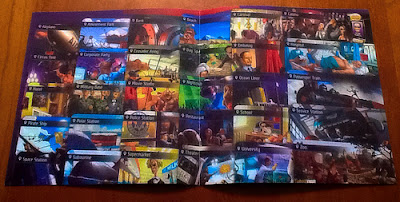
After the eight minutes are up, each player gets an opportunity to accuse someone of being the Spy, and everyone but the accused votes (just like during the round).  If the Spy is found, the non-Spy players each get a point, with the one who accused the Spy getting two points.  The Spy gets four points if they either guess the location during the eight minutes or someone else is successfully accused of being the Spy; the get two points if they aren't discovered at the end of the game.

Spyfall works very well.  The rules are pretty simple, and the speed of the game means it's easy to get numerous rounds played in a very short round.  Since everyone is trying to figure something out -- non-Spies trying to figure out who's the Spy, the Spy trying to figure out the location -- everyone has to listen to the questions and answers even when it's not their turn, keeping everyone involved throughout the game.  Whoever is the Spy has to improvise and bluff while figuring out the location, while other players have to be careful and not jump the gun when accusing others.

It would be nice if there were reference cards with the locations for people to look at, but passing around the instruction book seemed to work well.  Spyfall is a lot of fun, keeping all the players thinking, listening, asking and answering.

Overall grade: B+
Reviewed by James Lynch

4.02.2016

THE ART OF RICHARD LUONG

The game Cthulhu Wars pits various factions of the Lovecraftian mythos against each other for world domination -- and naturally, it also requires miniatures for the Great Old Ones, minions, monstrosities, and other entities in the game.  Artist Richard Luong has done plenty of art based on the creatures and worlds of H.P. Lovecraft and so was recruited to design the miniatures and cover for Cthulhu Wars.  The process and artwork is featured in the Kickstarter-funded book The Art of Richard Luong.

I was a bit surprised to find that this art book is all about Luong's work in Cthulhu Wars.  The early chapters feature Luong's two-page, full-color painting of each main entity for the factions in Cthulhu Wars; after that are black-and-white images of the miniatures (front and back) for each faction, accompanied by Luong's notes for designing the miniatures.

The later parts of the book feature sketches from Luong, assorted artworks, and the final miniatures that resulted from Luong's designs and notes.

Luong's artwork is quite remarkable, capturing the horror, scale, and otherworldly nature of the denizens of this game world battled over by eldritch entities.  I'm a little disappointed that this work didn't feature more of Luong's work; it could have more accurately been called "The Art of Cthulhu Wars."  But the artwork featured here is excellent, as is the insight into the designs for all of the figures.  (Seeing the final result is a big plus as well.)  The Art of Richard Luong is a must-have for fans of Cthulhu Wars -- or for Lovecraftian art in general.

 Overall grade: A
Reviewed by James Lynch