9.30.2010

LET THEM EAT CHEESECAKE and SECOND SLICE

Doing pin-up art well is tricky. It's not enough to just have an attractive woman; there has to be posing, clothing (or a stylish lack thereof), and something original that makes it stand out as not just another pretty person. Olivia de Berardinis has been doing pin-up art for years, her work has appeared everywhere from Playboy to the covers of Heavy Metal, and some of her best work is collected in the two coffee table books Let Them Eat Cheesecake and Second Slice.
Olivia has produced work using everything from pencils to watercolors to airbrushing, and the results are always stunning. Eschewing straight nudity, Olivia's characters are dressed in everything from glamorous lingerie to nothing but tattoos. The subjects vary from the historic to science fiction (love her Zebra Lady paintings!) to, well, cheesecake. No matter the source, the result is amazing.

Olivia's subjects include those who model for her (including Pamela Anderson and Julie Strain) to people from old films and photographs (such as Bettie Page and Josephine Baker.) Olivia captures many different traits in her paintings -- sexiness, playfulness, serenity, toughness, exoticism -- and no matter what Olivia seeks to portray, the results are always spectacular.
Let Them Eat Cheesecake and Second Slice each have an index with the paintings' title, model, and often comments from Olivia on the work or the model. The first book has an introduction from High Hefner, while the second has comments from Olivia on her technique and creative process.
Both Let Them Eat Cheesecake and Second Slice are extraordinary collection of beautiful works from possibly the greatest pin-up artist ever. (The occasional comments on specific paintings are also pretty nice.) These volumes are each amazing, and the two together are ideal.
Overall grades: A+ (for both)

Reviewed by James Lynch

9.25.2010

CATFISH

How has technology affected our relationships? What can we really know about another person online? These are issues addressed in Catfish, a movie (inaccurately promoted as a thriller) about virtual relationships and the real world.

Nev Schulman is a 24-year-old professional photographer living in NYC. His brother Ariel and roommate Henry Joost are shooting a documentary about Nev and an unusual fan: Abby, an eight-year-old girl living in Michigan who saw Nev's photos online and mails him painted versions of them. Nev and Abby correspond through Facebook, and soon Nev is gets to know the rest of Abby's family -- her mother Angela and her stepsister Megan -- through Facebook and phone calls. Nev and Megan even begin to have a romantic relationship.

Soon, though, Nev and his friends start finding lies being told by Megan and Angela (starting with a song Megan posts as hers that was actually taken off of YouTube). And so, on the way back from an assignment, Nev, Ariel and Henry decide, on the way home after a photo shoot, to make an unannounced visit to Abby's home to find out what is true.

Catfish (the title comes from what someone says near the end of the movie) is a reflection of our life in the age of technology. From the movie's starting point (Abby saw Nev's photos thanks to the Internet) to the guys getting around through Google Earth and their car's GPS, these people rely on their gadgets without even thinking about it. This would seem to make their lives easier -- they can "look" around the country without leaving their Manhattan apartment -- but it also makes deception quite simple.

Of course, no one is faultless here. During Nev and Megan's relationship Nev copies her picture and pastes it to his photo to show what they would look like "together" -- even though they never met.

For some reason, Catfish was promoted as a thriller, suggesting everything from Hitchcock to a horror movie. (The movie comes close to the latter comes close during a late-night visit to a house.) Trailers also suggest some dramatic surprise not to be revealed. None of that is the case. This is a simple drama, shot in documentary style, about some nice guys whose online friends lead to a real-world mystery.

Overall grade: B
Reviewed by James Lynch

9.18.2010

Weezer, HURLEY

First, if you were wondering: The new Weezer album Hurley has nothing to do with the character Hurley from Lost, the actor Jorge Garcia who plays Hurley, or Lost in general. His presence starts and ends with the album's title and cover. The rest of Hurley is familiar territory for Weezer -- only somewhat disappointing.

This offering from Weezer has songs about nostalgia ("Memories"), rebellious losers ("Trainwrecks"), crushes on women (too many to list), and flat-out anger ("Unspoken"). But while The Red Album had lots of quirkiness and Raditude had a more flat-out rock feel, Hurley is all over the place -- and not in a good, experimental way. The album's closer "Time Flies" is a mess, both in lyrics ("time flies, when you're having fun/time flies, when you live on the run") and an oddly rough sound. "Where's My Sex?" is like an oddly unfunny version of King Missle's "Detachable Penis." And like the last album, the bonus tracks on the deluxe version aren't that good (except for "Represent (Rocked Out Mix").

There are some pretty good tracks on Hurley -- the opening two songs and "Smart Girls" -- but overall this album is very hit or miss. Weezer is good enough that a lesser offering from them isn't terrible, but I hope things improve from them next time.

Overall grade: C+
Reviewed by James Lynch

9.17.2010

EASY A

In Mother Night Kurt Vonnegut warned, "We are what we pretend to be, so we must be careful about what we pretend to be." This is a theme, sort of, in the teen comedy movie Easy A.

The framework of Easy A is high school student Olive (Emma Stone) making a webcast about the truth of what happened with her reputation. Olive is smart, clever, attractive, and -- since the movie needs her to be an underdog -- unnoticed and an outcast. Not wanting to admit to her foul-mouthed friend Rhiannon (Alyson Michalka) that Olive spent the weekend alone getting hooked on the song "Pocket Full of Sunshine," Olive makes up a story about a fling with a college man who took her virginity. This is overheard by ultra-religious Marianne (Amanda Bynes), and before you can say "texting" the rumor is all over school.

Things get more complicated when Olive pretends to have a very public romp with closeted gay friend Brandon (Dan Byrd) so he'll stop getting harassed. Soon everyone wants to have a pretend fling with Olive (usually paying her with gift cards), Marianne's religious clique is trying to get her kicked out of school, and Olive decides to strike back by dressing risque and adding something inspired by The Scarlet Letter. Of course there's the cute boy Todd (Penn Badgley) who Olive may have a crush on.

I'm not sure what universe Easy A is set in, but it's certainly not this one. This universe has a high school where one person having sex becomes the talk of the entire school and the principal threatens a student with expulsion for saying a dirty word. That would be fine is Easy A were more amusing, but...

Easy A doesn't do anything particularly creative or amusing with its premise. Much like Ellen Page in Juno, Emma Stone is an always-cool character whose every utterance is clever and often dripping with sarcasm or irony, which becomes grating qickly; there's also no transformation from geek to beauty, so it's hard to buy her near-immediate change in social status. The movie talks about romatic '80s movie cliches -- and works them all in. Amanda Bynes has a thankless role as the one-dimensional woman (albeit of the first mean Christian clique since Saved). And while Patricia Clarkson and Stanley Tucci are fun as Olive's free-spirited parents, the movie largely wasted Thomas Hayden Church, Lisa Kudrow, Fred Armisen and Malcolm McDowell in small roles.

Easy A is more about honesty than promiscuity, but it's neither inspired nor terribly funny. There are some decent moments here and there (like a painfully bad faked sex noises) but Easy A certainly doesn't earn an A.

Overall grade: C
Reviewed by James Lynch

The Pyrates (1983) and The Reavers (2007) - George Macdonald Fraser


George Macdonald Fraser is quite an accomplished writer. In addition to the Flashman novels, for which he is most famous, he wrote the only screen adaptation of The Three Musketeers worth watching (although the less said about The Return of the Musketeers the better), a book of serious history and more. He also wrote two books, nearly twenty-five years apart, which are a whole different kettle of fish. In The Pyrates and The Reavers, GMF discards any pretense of historical accuracy and jams together history, Hollywood's take on history, and any old other thing that takes his fancy into a comic mish-mash.

The Pyrates is set in the glory days of piracy that never existed. A cast of characters, each more stereotypical than the next, romp through a plot that never even comes within spitting distance of plausibility. Anachronism dot the prose like blueberries in a muffin which has quite a lot of blueberries in it. It's glorious. Here's a small taste:
Sentries stood outside the strongroom, but the long stone tunnel to the watergate lay deserted, and from the sea-steps outside the fitful light of the torches shone on empty water to the little harbour entrance. Above on the battlements other sentries lolled - those dispensable sentries of fiction who doze at their posts in their ill-fitting uniforms, mere cannon-fodder to be knocked on the head or smothered by agile assailants, or at best wake up too late to fire a warning shot and yell, "Turn out the ... ugh!" If the commandant had lined the walls of that lonely fortress with entire force, instead of boozing and stuffing and throwing his wig aside in the carouse, all might have been well, but of course he didn't. They never do.


The Reavers
, through written later, is set earlier in the days of Good Queen Bess. Well, inasmuch as it could be said to be set anywhen since the liberties with history are just as cavalier as in The Pyrates. (To be fair, he didn't actually put any Cavaliers in The Reavers, although he might have done .) The plot is lifted almost straight from The Man in the Iron Mask, if that plot had been executed by a bunch of incompetent and mostly incomprehensible Scottish border raiders in the pay of dastardly Spanish agents.

The two are much of piece. Overall The Pyrates is the better book, with a lighter and yet more convoluted touch. The Reavers suffers a bit from the late 20th Century references which are occasionally amusing but sometimes seem a bit forced, such as a computerized scrying cauldron. Fraser does have a good time with his reivers, though, and the dialects and turns of speech he gives them are worth the price of admission. (A lovely ballad contains the following verses,
Then up and spake bold Trouserless Will:/"Sir Prising gi'e the map tae me,/ Wi' my reading specs/ I'll find the X,/ So good King James shall oor prisoner be."/ "O, tak' the map bold Trouserless Will,/ And your skeely specs fu' well tae see,/ My dochter's hand/ And a gowd hat-band/ Ye shall hae for this service done tae me."
You get the idea.)

Both are chock full of unrealistically super-human heroes, improbably full-figured women foul and fair, charming rogues and the like. Don't take these books as representative of GMF's work as a whole, but do take them, please. And enjoy.

Overall Grade: Pyrates A, Reavers B-

9.12.2010

CARCASSONNE

The medieval French city of Carcassonne is ripe for development -- perfect for your followers to build roads, construct castles, inhabit cloisters, and work the fields. Too bad others have the same idea. This is the basis for Carcassonne, a strategic and clever tile game.

Each player starts with seven followers (plus one used to keep track of points on the scorepad). On a player's turn they first draw a random tile and place it adjacent to a tile or tiles on the board; placed tiles must continue features, so a road must connect to another road, a castle segment to another castle segment, etc. A player can put a peasant on a road, castle, farm, or cloister as long as another player doesn't have someone on that feature.

Next is scoring. If a road is completed (two if its sides end at a castle or intersection), the player gets their follower back and gets a point for each tile in the road. If a castle is completed (fully sealed on all sides), the player gets their follower back and gets two points for each castle tile, plus two points for each pennant on the castle tiles; a two-piece castle only scores two points, but the player gets their follower back immediately. If there are tiles on all eight sides around a cloister, the player gets their follower back and scores nine points. Followers stay on farms for the whole game -- but they score three points for each complete castle on the field at the end of the game. When the game ends (no more tiles to choose from), players score the aforementioned farms, plus: one point per tile for an incomplete road; one point per castle tile and pennant for an incomplete castle; and one point for each tile around a cloister, plus one for the cloister itself.

Players can also join, or even steal, roads, castles, and fields from competitors. A player can't directly put a follower on a feature an opponent already has -- but if they put their own follower on a nearby tile and then manage to connect them later, they share the points. If one player manages to get a majority of followers on a feature, they get all the points for that feature! Large castles often attract multiple followers trying to join.

It's also possible to block another player by placing a tile that makes it harder, or even impossible, for them to complete a road, castle, or field. This not only costs them points but also leaves them with fewer followers to use.


I really enjoy Carcassonne. Limiting the number of followers each player has makes resource management very easy (do I have any followers left?) and important (do I risk committing all my followers, or do I pass on using them in case another opportunity opens up?). Players compete not through attacks and die rolls but by tile placement for blocking and trying to get a majority on a road, castle, or field. (For players who want different versions of the game there are numerous expansions that include different tiles and followers.) Carcassonne is very easy to learn, pretty quick to play, and a whole lot of fun.

Overall grade: A-
Reviewed by James Lynch
(who, as of this review, has played 2,576 games of Carcassonne online -- and won 69% of them!)

9.11.2010

HELLCATS

It must be amazingly easy to get a show or movie based on cheerleaders made: hot teens in skimpy outfits dancin' and shakin' it. Add in two teen/'tween stars and you have Hellcats, the new cheerleading show on the CW. And it's not bad.

Marti (Alyson Michalka, of the 'tween band Aly and AJ) is a pre-law student at Lancer University in Memphis, a big football school. She and her cool friend Dan (Matt Barr) look down on cheerleaders ("football groupies"). Marti even gets in a near-fight with cheerleader Savannah (Ashley Tisdale, of the High School Musical movies and Phineas and Ferb), who's extremely proud of and focused on being a cheerleader: "We bench press twice our body weight and run a seven-minute mile." When Marti loses her law scholarship, she has to turn to "unconventional scholarships" -- and wouldn't you know it, there's a scholarship for cheerleading with the Hellcats, the football team's cheerleaders!

Of course, this wouldn't be a teen show without both drama and big stakes. Marti needs to both stay in the squad or get kicked out of college, plus her cheerleader partner Lewis (Robbie Jones) flirts with her. Cheerleader Alice (Heather Hemmens), whose injury opened the door to Marti joining the Hellcats, is the bitchy enemy out to sabotage Marti -- and the team, if necessary. Marti's mom Wanda (Gail O'Grady) is an embarrassment to her daughter. And Coach Vanessa (Sharon Leal) is told that the Hellcats have to qualify for the Nationals or they won't be competing anymore -- plus her old boyfriend Red Raymond (Jeff Hephner) may be the new football coach.

Hellcats essentially reverses the formula of Bring It On (which Marti watched to prepare for tryouts), with the outsider who comes around as the star and the die-hard believer as the supporting cast. There's lots of techno and club music for the routines (which will probably be on a soundtrack album if the show takes off) and plenty of highly energetic choreographed routines. This show also has two nice teen leads. Alyson Michalka strikes a nice balance as the somewhat cool, somewhat cynical student who has to do what she once mocked -- and may like it. Ashley Tisdale may have the more perky, wholesome character, but she also gets some attitude ("You can make up for your appalling rudeness with hard word and perseverance") and is a nice foil/friend to Alyson's character. The rest of the cast is the CW's typical world of young and beautiful people.

Hellcats may be fluff, but it's enjoyable fluff. This isn't must-see television but it's a diverting little show with two good leads. Plus, y'know, hot stars in cheerleading outfits doing elaborate routines.

Overall grade: B-
Reviewed by James Lynch

9.05.2010

MACHETE

While the debate over illegal immigration in America can get heated, I doubt it'll be decided by the slaughter of dozens of people. Then again, maybe that's the point of Machete: a return to the grindhouse films of old, where social commentary was part of deliberate and extreme excess.

At the start of Machete, we see Machete (Danny Trejo) working as a Federale in Mexico. Evil drug kingpin Torrez (Steven Seagal, Mexican villain with a samurai sword) kills Machete's family and leaves him to die in a burning building. We then jump ahead three years, and Machete is now an illegal alien and day laborer in America. He's hired to kill someone, gets framed for attempted murder, and... it's payback time!

The plot isn't as important as the bad guys and good guys. The villains, all intertwined in a plot involving murder, corruption, and a giant electrified border fence between Mexico and Texas, include: the aforementioned Torrez; Booth (Jeff Fahey), a scheming businessman who set up Machete; Senator McLaughlin (Robert DeNiro), campaigning against immigrants; and Lt. Stillman (Don Johnson), a vigilante border patrol leader.

The good guys and gals are as loyal and good (and Mexican or Latin American) as the villains are selfish and evil (and white). Luz (Michelle Rodriguez) runs a taco truck -- and possibly the Network, which supports immigrants. Sartana (Jessica Alba) is the pro-authority immigration agent who soon finds herself working against the bad guys. Padre Benito del Toro (Cheech Marin) is Machete's brother, a priest who's also good with a shotgun. And there's a literal army of immigrants ready... to follow Machete!

Machete began as a fake trailer between the features in Grindhouse, and it both has and lacks the excesses of the original: Machete has no annoying deliberate missing scenes or scratchy film, but it also lacks its own wild trailers for other fake films (that apparently can get made). Machete also has amazingly over-the-top characters, the sort of caricatures that were popular in the original grindhouse flicks. Machete glowers through the movie, killing villains in gory and creative ways, gettin' down with just about every woman he meets (always to the same porno music), and inspiring all Latinos and Latinas to unite! The female stars all beauties who kick ass, the villains do everything from shoot pregnant women to lust after their daughters, and the body count just rises and rises.

Machete does have some social commentary about immigration, but it's as subtle as Machete lopping off limbs with his title weapon. This movie is more of a gory joke, seeing how much exploitation they can squeeze into a movie. Sexy nurses with uzis? Check! Lindsay Lohan as a wasted nympho? Check! Bad guys killed with gardening equipment? Check! There's no depth to any character in the movie, but the actors clearly have fun hamming it up. Machete is a simple movie in many ways, but it's a fun way to turn your off brain and find out how much more ridiculous a movie can become -- by choice.

Overall grade: B
Reviewed by James Lynch

9.04.2010

Kuunkuiskaajat (Magnum Music, 2010)


For most of the past decade, Susan Aho and Johanna Virtanen have sung together in the Finnish folk group Värttinä. With that band on an extended break, Aho and Virtanen took the opportunity to record on their own as a duo called Kuunkuiskaajat ("Moonwhisperers" in English). While their sound is a bit scaled back relative to Värttinä, Kuunkuiskaajat bring the same catchy fun to their self-titled debut recording.

If it wasn't already hard enough to discuss Kuunkuiskaajat without making frequent references to Aho and Virtanen's other band, most of their supporting cast have a connection to Värttinä as well. Bassist/producer Tom Nyman, guitarist Tommi Viksten, and drummer Anssi Nykänen all contributed to Värttinä albums in the early nineties, before either singer joined the band. Petri Hakala, the renowned Finnish mandolinist who guests on the album, also played briefly with Värttinä. Lyricist Timo Kiisken had collaborated previously with Aho on a couple of songs off Värttinä's album 2003 iki, and he contributes to all the songs on this record.

This isn't a bad thing, though, if you happen to like Värttinä and you've been waiting a while for some new music from them. In general, Kuunkuiskaajat is quieter than a typical Värttinä recording; with one less voice and one or two less instruments to work with, Aho and Virtanen don't aim for the big, energetic sound that characterizes most Värttinä albums. They maintain the folk/pop hybrid as a base for their sound, but then go in more subtle directions with it. A couple of the songs, particularly "Loputon Tie," have a bit of a Jazz Age feel that reminds me in a good way of bands like Paris Combo or The Ditty Bops. The tango-influenced "Taivaallinen" features some nice accordion playing from Aho. The opening song "Kahden" and the single "Tyolki Ellaa" (a semifinalist at Eurovision this year) are a pair of sweet-sounding polkas, keeping a steady pace without getting too fast to divert attention from the vocal harmonies. The vocals on this record reflect the pleasant and charming side of Värttinä's style, without getting into the darker, more challenging elements that show up from time to time.

Kuunkuiskaajat is fine example of the diversity of contemporary Finnish folk music and the talent of the performers involved with it. Long-time fans of Värttinä have every reason to get the disc, which is available on line at least at Digelius and possibly elsewhere as well. People interested in the style, or simply looking for anything with good singing and good playing, will find plenty to like here as well.

Overall grade: B+

reviewed by Scott


"Työlki Ellää." Gotta love the poster in the back.

9.02.2010

The National, High Violet (4AD, 2010)


The Ohio-born and Brooklyn-based indie band The National first came to my attention in 2007 when their album Boxer was named Album of the Year by Paste Magazine. Their distinctively brooding, ambient sound, driven mostly by the deep baritone of singer Matt Berringer, struck a chord with a lot of listeners. My own reaction to Boxer wasn't quite so ecstatic, but I did think it was a pretty solid record. Now The National return with a new album called High Violet, and not much has changed. The band have taken more or less the same approach they took last time out, and continue to get rave reviews.

High Violet is one of those albums that, for better and for worse, gives listeners exactly what they expect. There are no sharp left turns here, but if you like The National's previous work you'll like this at least as much. The songs are consistently moody and mid-tempo, and the combined effect of the songs as a whole is greater than the sum of the songs taken individually. Berringer is the kind of singer who manages to establish a commanding presence despite a limited vocal range. He only occasionally tries to hit some moderately high notes, but he gets your attention anyway. More importantly, his voice and intriguingly esoteric lyrics enhance the atmosphere that bandmates Aaron Dessner (guitar, keyboards), Bryce Dessner (guitar), Bryan Devendorf (drums), and Scott Devendorf (bass) create beneath him. The songs are pretty similar, a little too similar perhaps, but they get steadily better as the album progresses. The standout track is the penultimate song "England," which features a haunting riff that sticks with you when you put the album down.

On the whole, I think High Violet is a bit better than Boxer. People who've gotten excited over their previous work probably don't need my recommendation, but if you're not familiar with The National then the new album is as good a place as any to start.

Overall grade: A-


reviewed by Scott


The National perform "England" in front of the home crowd in Brooklyn.

9.01.2010

THE LAST EXORCISM

The first-person horror movie, shown from the viewpoint of someone holding a camera, continues with The Last Exorcism. This supernatural (or is it?) chiller starts strong and works its way to a terrible ending.

The Reverend Cotton Marcus (Patrick Fabian) is well liked, charismatic, has a wife and kids, runs a successful ministry, even performs exorcisms -- and he's a self-proclaimed fraud. Some time ago he lost his faith, treating his religious work as a job instead of a calling -- and exorcisms as a way to provide psychological relief to people believing they're possesses (plus making a lot of money from it).

The movie-within-this-movie happens when Marcus is outraged over the harm and deaths caused by exorcisms. Marcus' solution: get a two-person film crew to follow and film him when he gets a request to perform an exorcism, so he can show the tricks of his trade.

The request comes from Louis Sweetzer (Louis Herthum), who believes his 16-year-old daughter Nell (Ashley Bell) is possessed. Louis is an extremely conservative Christian who lives in the middle of nowhere in Louisiana on a farm with Nell and his teenage son Caleb (Caleb Landry Jones). Livestock have been mutilated, Nell has been covered in blood with no memory of what happened, and so Louis turns to Marcus for an exorcism. As one might expect from a horror movie, things don't go according to plan...

There's a lot to like early on in The Last Exorcism. The movie has a lot of ambiguity about what is happening. Is Nell possessed? Is she crazy? Has her father gone off the deep end, willing to chain her to keep her out of trouble? Are Nell's pictures showing the deaths Marcus and his people foreshadowing, or just another sign of madness? Patrick Marcus makes a great protagonist as the reverend, an honest fraud who still tries to go good. And the movie actually has a musical score, so unlike other fake horror documentaries this one lets you relax and enjoy it as a movie instead of pretending it could really have happened.

But the ending... Apart from numerous painful contortions on the part of Ashley Bell, not to mention no authorities getting involved (even after a trip to the hospital), the conclusion of this movie is simply terrible. Of all the possibilities presented early in the movie, The Last Exorcism goes a route that's both silly and unbelievable. I haven't seen a horror movie fall away from a strong start so badly since Jeepers Creepers. Fortunately, the ending doesn't ruin all that came before it; unfortunately, it really does hurt what could have been a fine scare.

Overall grade: C-
Reviewed by James Lynch

8.30.2010

BEYOND HEAVING BOSOMS

Ah, the romance novel: omnipresent in book stores, often mocked, covers featuring heated embraces, plots that seem repeated over and over. Or are they? Sarah Wendell and Candy Tan, co-creators of Smart Bitches, Trashy Books blog , provide a fan's overview, critique, and love affair of romance novels with Beyond Heaving Bosoms: The Smart Bitches' Guide to Romance Novels.

As may be appropriate to its subject, Beyond Heaving Bosoms approaches the romance novel with more than a little humor. There are numerous references to the heroine's "Magic Hoo Hoo" and the hero's "Wang of Mighty Lovin.'" You'll learn about "Cringe-Worthy Plot Devices We Know and Love." If there's a possible pun or double entendre, odds are there'll be a footnote verifying that it is a pun or meant "that way." And several games let readers create their own romance novel.

Along with the silliness is a pretty good overview of the romance novel genre. After a brief description of Old Skool and New Skool romance novels (Old Skool having a disturbing amount of rapist heroes; a whole chapter is devoted to this), Wendell and Tan get into the inner workings of the genre: types of heroines (Smart-Mouthed Cynic, Ingenue, Too Stupid to Live) and heroes (more anatomy than personality); fun and/or painful plots; why it's not chick porn, and why the sex is so hot; why their covers suck; and the possible future of the genre. The authors put plenty of their opinions into these commentaries, and they also have interviews with several romance novel authors and even a male romance cover model (sorry, not Fabio).

Beyond Heaving Bosoms is an informative and irreverent read. I would have preferred a little more analysis of the subgenres in romance novels (When did single parents become big in romance novels? How varied is the quality in serial series like Harlequin? What new trends became big, or faded away, in the New Skool?), and the numerous games at the end (romance novel board game! romance novel Mad Libs! romance novel Twist-A-Plot!) got a bit too silly and took up far too much space. Even with those, Beyond Heaving Bosoms contradicts some cliches about romance novels while admitting to and embracing others -- and has a bitchin' time doing it.

Overall grade: B
Reviewed by James Lynch

8.29.2010

Vilma Timonen Quartet, Forward (Kanteleen Ääniä, 2009)


Finland's Vilma Timonen Quartet combine jazz with traditional folk music centered around Finland's most distinct instrument, the kantele. The kantele is a string instrument which can be plucked or strummed, and sounds like a harp with a bit more reverberation. It comes in several different forms, and Vilma Timonen is particularly a master of the 10 and 15 string kanteles. The quartet's 2007 CD VTQ was almost exclusively instrumental, leaning towards darker and heavier styles of jazz. By contrast, their new album Forward features both songs and instrumentals, and the music is more accessible on the whole.

Having met Timonen and guitarist/trumpeter Topi Korhonen several years ago through the Maine Kantele Institute, I know how good a singer Timonen is, and I felt the first album suffered somewhat from the lack of vocals. Happily, Timonen employs her voice quite liberally on Forward. Two songs in particular, the aggressive "Kokko" and the dreamlike waltz "Marraskuura," are the best tracks on the album. Bassist Ape Antilla and drummer Mikko Hassinen provide a rock solid backbone underneath Timonen and Korhonen's interweaving strings. Stylistically speaking, Forward mixes some upbeat, groove-oriented tunes like "Getting Your Hopes Up" in with the kind of impressionistic pieces that characterized much of their debut.

Indeed, the good variety on this album makes it a significant step forward (no pun intended) for the band. They seem to have found the right combination of melody and muscle, with the vocals adding a beneficial extra dimension. Vilma Timonen Quartet are four very talented musicians, and with Forward they seem to be hitting their best stride.

Overall grade: A-


reviewed by Scott


Segments from a recent live performance of VTQ in Finland

8.27.2010

SEX AT DAWN

What if the world of sexual relations and practices, if the interaction between men and women, was not what it is now? What if the practices of the past, ignored or denied, influence us today? These are some of the areas covered in Sex at Dawn: The Prehistoric Origin of Modern Sexuality by Christopher Ryan and Cacilda Jetha.

The main area challenged in Sex at Dawn is the "standard narrative" that throughout history males and females meet, assess each other's mate value, become monogamous, and then each look for signs of infidelity in the other while seeking opportunities for infidelity for themselves. Much of this is what the authors describe as "Flintstonization:" projecting current beliefs, trends, and practices onto the past.

What evidence is there against ancient monogamy? Ryan and Jetha provide an abundance of sources, but their two main ones are bonobos (polygamous apes that are very close genetically to humans) and foraging societies (the standard before the advent of agriculture) where "sharing is not just encouraged; it's mandatory." Sex at Dawn goes through: the assumptions of and problems with the standard narrative, the development and effects of love, lust, and sex in prehistory; a part dealing not with sex but false assumptions (led by Malthus) about the horrific life of ancient humans; fairly recent sexual sex and society; and how this affects humans today.

Sex at Dawn is a very impressive trip through both history and the distortions and assumptions of history. The authors provide extensive branches of research -- historical, social, psychological, anthropological -- to create a full picture of the full view of human (and pre-human) sexuality. Far from being dry and boring, Sex at Dawn is colloquial and engaging. Quotes are here from Darwin to the Kama Sutra to Stephen Colbert; there's also a lot of humor here, as one can gather from chapters like "On Gettin' Funky and Rockin' Round the Clock" and "The Pervert's Lament." The authors are convincing, taking on some very widely-held social and scientific assumptions about sex, gender and racial traits, and evolution. And they don't romanticize their findings, even while promoting.

My only quibble is that at the opening of Sex at Dawn the authors assert that this work isn't an assault on the status quo, but by the end they have quite a few suggestions that do just that. With that in mind, Sex at Dawn is a fascinating and intelligent look (or new look) at human sexuality -- and how its past impacts our present.

Overall grade: A
Reviewed by James Lynch

8.26.2010

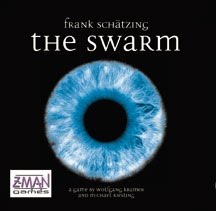
THE SWARM

There's something in the ocean, and it's up to you to find it with ships and researchers. But there are also dangers in the sea. This is the premise of The Swarm, a decent but flawed combination of strategy and puzzle game for two to four players.

The board of The Swarm has swarm tiles, face down, on the ocean spaces and land tiles along the four sides of the board. Each player stars with a research station and one researcher. A research point track runs along the sides of the board, a turn order area shows the order of play, and action cards are placed along the side.

First, players use research points (which ultimately determine the winner) to buy action cards. The card at the left costs zero, the next one costs one research point, the next costs two, and so on. At the right of these cards are two special cards, a Research Station, and finally turn order cards (that determine the turn order for the next turn; they also let the player choose one of four special cards). Cards are purchased one at a time, and as they are bought the remaining cards are pushed left, so ultimately remaining cards cost nothing. And each player has a Wild Card that can be used once per turn

After all the cards have been bought, players play their action cards. The Research Station card lets a player place a Research Station, with a researcher, on a land space on the board. The Ship card lets a player place a ship next to a Research Station, then move their ship(s) a total of three spaces; as a ship moves over a face-down swarm tile the player takes that tile and places it in front of them. Danger cards let players place or move a Whale, Tsunami, or Crab to damage players through their Ships or Research Stations. Most important is the Researcher card, who lets a player add a researcher to a research station -- or place swarm tiles.

Players put swarm tiles on the board so their links (each has two to four links) connect with either a research station or a ship. A player can only place a number of swarm tiles equal to the number of researchers they have in play. Players earn research points for two- and three- link tiles, and at the end of the round players score research points based on their longest connected system. A player also puts their colored tokens ("buoys") on a placed tile, and other players can only join a placed tile by adding a tile with more links, or using the special "Golden Tile" card; these let players share the space. At the end of the game (after four turns for two players, three turns for three or four players), players also get points for connecting two, three, or four sides of the board by connected systems.

There is a good deal of strategy in The Swarm. Using the points that give victory to buy cards needed to achieve victory is an interesting mechanic. Tile placement is challenging, as creating long connected systems can be tricky; it's also impossible to truly block someone off. The Ship-Research dynamic is also challenging: You need to move lots of Ships to get the tiles for your connected systems, but you need lots of researchers to place them.

The Swarm also has its problems. The menaces aren't that menacing. If an opponent hits you with a Whale, Tsunami, or Crab, you lose research points (based on how high your score is) and the attacker gains the same number of victory points. However, since the score doesn't get very high until the end, the effect of this is minimal. There's also very little background to the game: Is the swarm alien or natural? Is it harmful, beneficial, or sentient? (The center tile is called the swarm queen.) Why is the Crab giant but the Whale and Tsunami don't destroy ships or research stations? (The novel by Frank Schatzing, on which this game is based, provides more information.)

The Swarm is more interesting than exciting, more planning than thrilling. This is one game I'll enjoy playing occasionally.

Overall grade: C+
Reviewed by James Lynch