3.25.2013

SPRING BREAKERS

From the opening slow-motion shot of teens partying and drinking in the sun and sand in their swimwear, Spring Breakers might seem like a typical teen party movie -- or, with the women flashing their breasts, a Girls Gone Wild video.  But despite the repeated shots of spring break hedonism, and the notoriety of several ex-Disney stars as sexy bad girls, Spring Breakers proves to be a memorable, surprisingly moving film.
In a dreary unnaned college, everyone is dreaming of spring break.  For religions Faith (Selena Gomez), it's a chance for a change, to see and experience something new.  For her friends Candy (Vanessa Hudgens), Brit (Ashley Benson), and Cotty (Rachel Korine), it seems to be a chance for more of the partying they enjoy in their dorms.  When the women don't have enough money for the trip Candy, Brit and Cotty rob a restaurant with mallets and spray-painted squirt guns.  Then it's on to Florida to party!

At first, spring break seems like a dream come true, from riding mopeds and hanging out to massive drinking and more drugs tna before (now it's not just weed -- it's coke). But a party the girls are at gets busted, and they wind up in jail.


Enter Alien (James Franco, unrecognizable with metal teeth, corn rows and tattoos), who bails the girls out.  Alien is seductive, dangerous presence in the vacation.  With a seductive southern drawl and careers as a rapper, DJ, and drug dealer, he seems to be the thrills and dangers the girls were after.  He describes himself as having the American Dream -- and having broken every law there is to get it.  His home is an extravagant mix of art, cash, drugs, and guns, and he seems to be living in a state of permanent vacation.  (Often through the movie his voiceover proclaims "Spring break... spring break forever.")  He even has a nemesis in Archie (Gucci Mane), a fellow drug dealer and former brother, current enemy.  What does he want with the girls -- and what do they want with him?

Spring Breakers is an unusual movie, with few long shots and many cuts of flashbacks, slow-motion, or other breaks from standard movies (or reality).  While sometimes the scenes are obvious (like the justaposition of teen hedonism with Faith's innocent description to her grandmother), others are original and striking, from the robbery shown from the point-of-view of the getaway car circling the building, to girls in pink ski masks and holding rifles to a piano version of a Britney Spears song.  Writer-director Harmony Korine has a created a vacation world that may appeal to thrill-seeking teens -- and which will terrify their parents.  The women all do well in their roles -- from innocent to wannabe gangsta to truly dangerous -- but Franco steals the show as the serpent in paradise, offering escape and pleasure and peril.

Spring Breakers may look like a typical beach movie at first, but once you get past the bikinis and partying it proves to be an original and pretty powerful movie.

Overall grade: A-
Reviewed by James Lynch

They Might Be Giants, NANOBOTS

It's time again for the two Johns to bring us some musical weirdness, as They Might Be Giants release their new album Nanobots.  This album is fairly typical for the band -- with maybe a fewer highlights than usual.

Nanobots offeres the usual mix of themes from They Might Be Giants.  There's odd romance ("Too Tall Girl"), odd sentimentality (mainly in an ode to eccentric genius Nikolai Tesla; also in "Sometimes a Lonely Way"), slightly menacing paranoia ("Stone Cold Coup D'etat"), and things that are just plain strange ("Circular Karate Chop," "Insect Hospital").  The singing is slightly nasal, and the music is fueled by synthesizers without being too upbeat or club-oriented.

While Nanobots can be entertaining at times, there aren't too many songs here that really stand out.  The music tends for more quirkiness and overly clever lyrics ("You say/stuff is way/way to go/go away"), leading to a less cohesive feel than one would like in an album.  (Scattering songs from 10-40 seconds in length through the album doesn't help either.)  They Might Be Giants have been making music since 1980, and they remain an unusual and interesting sound in today's musical landscape; but Nanobots isn't a fully satisfying release from them.

Overall grade: B-
Reviewed by James Lynch


* * *

3.18.2013

THE INCREDIBLE BURT WONDERSTONE

 Professional magic is all about illusion, enchantment, and entertainment -- all of which are missing from the new movie The Incredible Burt Wonderstone.  Worse, this film is also pretty devoid of laughs, which is pretty bad for a comedy.

Friends since they were little kids, Burt Wonderstone (Steve Carell) and Anton Marvelton (Steve Buscemi) seem to have it made as magicians, headlining together at Bally's Casino, making millions, and having their own room there.  But a decade later, their act hasn't changed, from the red velvet outfits to the corny jokes and dances.  What has is Burt: He treats Anton like garbage, lives for one-night stands with audience members and assistants (including Jane (Olivia Wilde), promoted on the spot), ignores every criticism of him, and considers himself, well, incredible.

But tastes change, and the public attention is caught by Steve Gray (Jim Carrey, doing a nice parody of Criss Angel).  Gray is almost unbalanced, doing "illusions" that seem to consist entirely of self-harm; he's also obnoxious, starring in a show called Brain Rapist, and thoroughly contemptuous of the classic magicians.  Casino owner Doug Munny (James Gandolfini) loves Gray and hates Burt's declining ticket sales.  In short order Burt ends his friendship with Anton, loses his job at Bally's, and has a cardboard cutout of himself in a cheap hotel room as he goes from one humiliating gig to another.


But there's hope in a contest for Doug's new casino (called "Doug") where the winner will get millions and a new ongoing act.  Will Burt rediscover the joy of magic?  Can he reconcile with Anton and strike up a romance with Jane?  And will the new act beat Steve Gray for the grand prize?

If this all sounds cliche, that's because it is.  Unfortunately, almost none of it is funny.  Carrell plays the same sort of oblivious clod he did in The Office, followed by a 180-degree change to the nice guy in the movie's second half.  Carrey is good with his looney facial expressions and obnoxious attitude, but it's a standard one-dimensional villain.  Buscemi is largely wasted here, and Wilde has little to do besides get exasperated with the males in the cast (and suffer through an unbelievable romantic subplot).  Alan Arkin has some fun as the cranky old magician who inspired Burt in the first place -- but the movie doesn't give him many opportunities to do anything.

As for humor and magic, they're both in short supply here.  After seeing this movie, I struggled to remember any funny lines or scenes; and there's little going on magically, especially a "big finale" that feels like a cheat, both comically and magically.  The only real magic in The Incredible Burt Wonderstone is the transformation of a solid cast into a dull thud of a movie.

Overall grade: D
Reviewed by James Lynch


3.13.2013

OZ, THE GREAT AND POWERFUL

The Wizard of Oz was a groundbreaking movie in its time, from the visuals to the psychological elements.  Its prequel Oz the Great and Powerful feels much more traditional and familiar -- but it's still entertaining.
Like its predecessor, Oz the Great and Powerful begins in a black-and-white Kansas.  Oz (James Franco) is a circus magician with a flair for the theatric, an incredible cheapness, harsh treatment of his assistant Frank (Zach Braff), and a clear womanizer.  Oz dreams of greatness, and he seems to get the chance when an escape in a hot air balloon leads him to a twister -- and the magical, colorful, fanciful world of Oz.
Upon arriving, Oz is greeted by Theodora (Mila Kunis), who believes that Oz is the great and powerful wizard prophesized to free the kindgom  from the Wicked Witch.  Oz knows he's not a wizard, but the prospect of the massive fortune in the Emerald City tempts him too much, and he's soon promoting himself as the wizard who was foretold.  Royal advisor Evanora (Rachel Weisz) has her doubts about Oz's truthfulness, Theodora seems to have fallen for the rogue's romantic charms, and Glinda (Michelle Williams) knows Oz's flaws but still believes he can save the kingdom.  Oz also has traveling companions in his quest to steal the Wicked Witch's wand: Finley (Braff again), a winged monkey pledged to serve Oz; and China Girl (Joey King), a small-but-spunky child made of fragile China.
Oz the Great and Powerful has a mix of strengths and weaknesses.  The visuals are stunning, from the magical landscape to the unusual creatures (not to mention the new-but-familiar versions of the elements from the first film).  There are also some surprises in store, such as the identity of the Wicked Witch?  At the same time, there's a pretty one-dimensional side to the characters, and while they're all decent in their roles, there's also no real depth to any characters.

Still, Oz the Great and Powerful may not be a classic but it is an enjoyable (if slight) fantasy.  This is a movie that's easy to enjoy, if easy to forget afterwards.

Overall grade: B-
Reviewed by James Lynch

The Rise and Fall and Rise of Cheapass Games

Sure, gamers love games -- but what about their cost?  In the mid-1990s, James Ernest launched his own company: Cheapass Games, a company based on the idea that games should be both fun and inexpensive.

The company philosophy was stated clearly on the back of the boxes: "We here at Cheapass Games are aware of two basic facts about board games: they cost too much, and they are at some level all the same."  The company said "generic bits and pieces" like dice, tokens, and fake money "can account for as much as 75% of a game's production cost" and they offered a solution: "Cheapass Games come packaged with the bare essentials: boards, cards, and rulebooks."  Players provided everything else -- or bought them from Cheapass Games -- and as a result, the games cost less than $10.

And Cheapass Provided a large number of unusual, fun games.  Players could take on the role of dinosaurs in Bitin' Off Hedz, fake explorers in Captain Park's Imaginary Polar Expedition, bad actors in Deadwood, sous chefs scaling a building in Devil Bunny Needs a Ham, or grave-robbing economists in Parts Unknown.  Cheapass Games even released series of related games: Players could try to kill J. Robert Lucky in an English mansion in Kill Doctor Lucky, try to rescue him from the Titanic in the prequel Save Doctor Lucky, and then save him in the distant future in Save Doctor Lucky on Moon Base Copernicus.  And long before zombies had their current coolness, players could try to end their fast-food shifts in Give Me the Brain! , put together fast food meals in Lord of the Fries, and in the prequel The Great Brain Robbery the players were zombie cowboys raiding a train filled with human brains and government cheese.  These games offered lots of variety, tremendous replayability, and a lot of fun.  After all, where else but Unexploded Cow could you use mad cows to take care of unexploded mines?

Alas, some Cheapass games didn't catch on as much as they would have hoped (like Button Men and Diceland), and eventually the company went on hiatus.  The company returned with iPhone apps, and eventually they did a 180-degree change on their philosophy: Games like Kill Doctor Lucky and Give Me the Brain! appeared again -- but with new publishers, all the "generic bits and pieces" they once decried, and with a much larger price tag.  The company is now working with Kickstarter to redo some classic games (as shown on the video below).  I have mixed feelings on their new direction: While their deluxe versions go against the explicitly-stated company policy, I'm also glad to see some great Cheapass Games back in print.

Written by James Lynch


3.11.2013

SILVER LININGS PLAYBOOK

Sometimes Hollywood gets it right, and they certainly did with Silver Linings Playbook.  This movie elegantly combines drama, comedy, and romance with a realistic treatment of mental illness.
Pat (Bradley Cooper) just got released from a Baltimore mental institution in Baltimore, and he's living at home with his parents Pat Senior (Robert DeNiro) and Dolores (Jacki Waver).  Pat is seeing his therapist, using motivational techniques ("excelsior!"), getting in shape, and trying to see the silver lining in everything.  Unfortunately, he's still not taking his medicine, he's still easily angered, and he's convinved that he can restart his marriage happily with Nikki -- even though her affair is what triggered his breakdown and she since got a restraining order against him.

Things change, maybe, when Pat meets Tiffany (Jennifer Lawrence), a friend of a friend.  Tiffany has her own share of issues and problems, from her husband's recent death to her constant abrasiveness to a bout of workplace nymphomania.  Tiffany keeps bumping into Pat when he's out jogging, and eventually she makes him an offer: She'll get a letter to Nikki -- if Pat agrees to be her dance partner in an upcoming competition.  There's also Pat Senior's obsession with the Philadelphia Eagles, his job as a bookie, and his dream of opening a restaurant; Pat's friend Ronnie (John Ortiz), who seems to a great upwardly mobile life with a great house, big job, and beautiful wife Veronica (Julia Stiles) -- but who feels tremendous pressure and stress; and for comic relief there's Danny (Chris Tucker), a buddy of Pat's from the institute who keeps showing up and getting taken back to the institute.

Silver Linings Playbook works thanks to a variety of factors.  The cast is terrific all around.  It's easy to see why Jennifer Lawrence: She makes Tiffany confrontational, vulnerable, appealing, off-putting, and with possibly as many issues as Pat has.  Bradley Cooper shines as Pat, who's "undiagnosed bipolar disorder" is thoroughly believable, as his character's laser-like focus on restoring his marriage is self-delusional and leading him to ignore Tiffany (he leaves a dinner with her early to write a letter to his ex-wife).  And the supporting cast does very well too.

What may distinguish this movie from so many others is its quite realistic treatment of mental illness -- and its frequency.  While Pat may be the only one who was in a mental institution, mental problems abound.  Pat Sr. has OCD, believed his beloved Eagles win or lose based on who's watching the game and where they sit, and was banned from Eagles games for attacking a fan.  Tiffany seems like she needs help as much as anyone else, and even Ronnie --who is upwardly mobile, bragging about having an iPod dock in every room -- stresses out and has a unique way of releasing his anger and frustration.  It's all believable, accurate, and quite a revelation for a movie to tackle this sort of subject without either making it comic or quirky.

Silver Linings Playbook does take a slightly more traditional path with its happy ending (revolving around a parlay bet), but it's a small bit of cliche in a movie that achieves so much.

Overall grade: A
Reviewed by James Lynch

3.05.2013

Joseph Campbell, THE HERO WITH A THOUSAND FACES

Heroes have existed in virtually every culture in the world, at every time in the world, in a diversity ranging from the warrior to the spiritual leader.    But what do they have in common?  What themes are shared by them -- and what do they tell us about ourselves?  In The Hero with a Thousand Faces, Joseph Campbell explores the heroic archetypes and messages through a variety of perspectives.

Campbell begins with the "monomyth" -- the common elements running through innumerable myths separated by geography and time -- and then analyzes what they share.  He explores a wide range of sources of myth, from the tales of King Arthur to Christian and Islamic beliefs to Irish folk tales to the Greek and Roman pantheons, by discussing them historically, psychologically (Freud and Jung were fairly new and very influential when this was first published), culturally, and philosophically.  In addition to the hero's journey (departure, initiation, return, resolution) Campbell also explores the beliefs on the nature of the universe -- from creation to purpose -- and how the hero shows us what the hero teaches us about, and affects, this all-encompassing force.

There are times when The Hero with a Thousand Faces can be a little dry, and there is much information to take in here.  But Campbell provides an amazing amount of source material to support his theories, and his analysis may not be agreed with by all (especially those who take their religion literally) but it is a fascinating look at the ideas that cultures return to time and again with their creation and treatment of their heroes.  The final section explores the impact (of lack thereof) of the hero in the modern, more secular, more individualistic culture; and this may make us sad for what has been lost in antiquity.

The Hero with a Thousand Faces is a fascinating, intelligent, and seminal exploration on what makes a hero -- and what that can tell us about us.  For anyone interested in mythology, anthropology, or what we have always sought, it's required reading.

Overall grade: A
Reviewed by James Lynch

2.27.2013

Aegis Bio – USB 3.0

There are plenty of reasons to own an external hard drive. Whether as a simple backup, to free up space on a full notebook drive, or for data portability between work and home, a portable hard drive is the tool of choice to offload serious data off a system hard drive. Sure, a USB flash drive on a key ring is great for convenience, but when it comes time to move hundreds of gigs of data, a mechanical hard drive can offer capacity like nothing else can.

The downside of putting sensitive data on a hard drive, and taking it out and about is that then the data is vulnerable. While Windows 8 is password protected on bootup by default, there is no such default level of protection on an external drive. Those hundreds of gigs of data, now can be accessed by anyone that finds such a drive forgotten at the local Starbucks. That external drive is now becoming somewhat less attractive.

ROBOT COMBAT LEAGUE

Some people design, build, and operate robots to battle other homemade robots; others sit down at Rock 'em Sock 'em Robots and start flailing away with their fists.  While the early show Battlebots featured the former type of mechanized combat, the Syfy Channel show Robot Combat League definitely skews towards the latter.

Hosted by WWE star Chris Jericho, Robot Combat League is a pretty straightforward mechanical battle.  Twelve two-person teams (usually one athletic person and one scientific person) are given a huge robot designed for walking and punching.  The teams practice with their robot (the scientific person sits and operates the legs, while the more athletic one wears a device on their shoulders and arms that controls the robot's upper torso).  All the teams compete in a Power-Up Challenge, and the best and worst robots then battle -- with the loser going home.  The last team/robot standing wins a trophy and $100,000.
While the idea of human-controlled giant robots slugging it sounds like the ideal playday, that's where the appeal of Robot Combat League begins and ends.  The robots are assigned randomly, which might be a problem except that the robots are apparently only cosmetically different.  We don't know if a particular robot is stronger, faster, or tougher than its counterparts, and the teams don't get to modify their warriors.  As for the combat itself, it almost feels like a parody of boxing: Judges evaluate three two-minute rounds (with 20 minutes in-between rounds for repairs), a "knockout" happens if a robot becomes unresponsive (metal bars keep the robots upright, so no falls happen), and there are sparks and hydraulic fluids everywhere.  But since the robots aren't modified, they just punch and block; there are no saws, flamethrowers, or other distinguishing weapons.
These ultimate remote-controlled toys might make a great attraction in a rich person's arcade, but the Robot Combat League is a disappointing, uncreative mess.  I'll stick with board and card games with robots, or even watch sports with humans, before tuning in to this again.

Overall grade: F
Reviewed by James Lynch

2.15.2013

Shania Twain, GREATEST HITS

Shania Twain was one of the biggest country stars of the late 1990s and early 2000s, scoring hit after hit with up-tempo tunes and slower romantic ballads.  She also proved mildly controversial, as her music seemed to be closer to top-40 pop than the country genre she aspired to -- and that she used sex appeal more than singing to push her music.  Her 2004 Greatest Hits makes the case for both sides of her career.

Greatest Hits goes in reverse chronological order -- from her albums Up!, Come on Over and The Woman in Me -- before adding four new songs.  These are her big radio hits -- no rarities, live tracks, covers, or lesser-known songs here -- and the songs show both her appeal and limits.

Almost all of the songs alternate between female-empowering, basic feel-good pop (from the woman-as-boss "Any Man of Mine" to the just-have-fun "Man!  I Feel like a Woman!") and shamelessly sentimental romance melodies (like "You're Still the One" and "From this Moment On").  The writing is very simple, going for basic rhymes ("I'm not always strong//and sometimes I'm even wrong") and odd metaphors ("you're a fine piece of real estate/ and I'm gonna get me some land").  As for the "Is she country?" question, while some of the songs have a very country feel, most of the songs here are far more pop than Grand Old Opry (with probable influence from her then-producer and husband Mutt Lange, who worked with bands like Def Leppard and Nickleback instead of country acts).

That's not to say that Greatest Hits isn't enjoyable.  Twain has a good voice, for both sentiment and excitement, and while her songs may often be guilty pleasures, they can still be fun to listen to.  While many will debate how much Shania Twain brought country and pop together -- and whether or not that's a good thing -- Greatest Hits is a pretty good showcase of the music that made Shania Twain such a star performer.

Overall grade: B-
Reviewed by James Lynch

2.05.2013

Marco Glaviano, SIRENS

Back in the 1980s and 1990s, supermodels strode forth upon the Earth like goddesses.  They could cross from one coast to the other in a few strides, adoring fans followed them by the millions, and they could destroy any who displeased them with lightning bolts from their eyes.  Okay, maybe it wasn't exactly like that -- but folks like Cindy Crawford, Paulina Porizkova, Angie Everhart, and others were household names and mainstays on magazine covers and swimsuit calendars.  Photographer Marco Glaviano captured some of the best images of the best models, and his book Sirens (first printed in 1999) is a wonderful collection of his work across these two decades.

Sirens collects a wide selection of Glaviano's work, mainly from beaches and glamour shots.  Chapters are dedicated to specific models (Crawford, Porizkova, Niki Taylor, Amber Smith, Claudia Schiffer, and a new model named Anna Nicole Smith), or themes (Behind Closed Doors, Naked Chicks on the Rocks, Goddesses of the Sand).  Glaviano also offers observations on both the models and themes.
Sirens works both as a collection of beauty and a time capsule.  These photos capture the beauty of some of the most attractive women across two decades, and it's no surprise that Glaviano has done swimsuit calendars, magazine covers, and even the Sports Illustrated Swimsuit Issue.  At the same time, the fashion world doesn't offer a lot of longevity for even its biggest celebrities, and many of the people shown here haven't been active in the fashion world for years; because of that, Sirens functions well as a nostalgic look back at some of the biggest names in beauty from over a decade ago.
Sirens provides plenty of not only beauty, but also the creator's thoughts on that beauty.  The only thing that would have made this book better if it was a coffee-table book, giving these pictures the size they deserve.  That said, Sirens is an astounding look at the best of the beautiful.
Overall grade: A+
Reviewed by James Lynch


WARM BODIES

I've heard plenty of origins for zombie outbreaks -- from the supernatural to the alien -- but I can't say I've ever heard that the cure is love.  Still, this is the premise of Warm Bodies, a comedy that explores young love in the days of flesh-eating undead.
R (Nicholas Hoult) is a zombie.  Not knowing how he died or even what his name is, R shambles around an airport aimlessly, shoulders hunches, pale blue eyes staring blankly.  He collects trinkets and stores them in an airplane, where he listens to old records.  He has "conversations" of a few words with a fellow zombie (played nicely by Rob Corddry), he steers clear of the "bonies" (malevolent skeletons that were zombies but whose flesh all decayed), and he wonders to himself if there's anything more to unlife.

While out on a feeding run, R and his companions ambush some explorers from a walled-off city of humans. During the attack and feeding frenzy, R notices Julie (Teresa Palmer), a young woman, and he decides to keep her safe.  His romantic feelings may stem from his having killed and eaten the brain of her boyfriend Perry (Dave Franco), which let R experience Perry's emotions.  Soon feelings start developing between Julie and R, and changes begin happening to the young zombie -- and other zombies around him.  But Julie's father Grigio (John Malkovich), the leader of the walled city, thinks the only good zombie is one shot in the head; the bonies are also getting agitated.  Will love conquer all?  Will Julie find out that R ate her boyfriend?
Warm Bodies is a nice comic nod to both the current zombie and young romance crazes.  Hoult makes for a sympathetic member of the undead, as his scary appearance and groans are belied by his internal monologue.  (While trying to romance Julie he repeats to himself over and over "Don't be weird.")  Palmer is decent but somewhat generic as the teen with daddy issues who falls for the worst possible boy, and Corddry is terrific as the buddy zombie who also feels loneliness.  Warm Bodies goes for less slapstick humor and more subtlety, and at times this slows the movies down; but this movie is often funny and entertaining.

Overall grade: B
Reviewed by James Lynch

2.04.2013

DIXIT

The best games often involve a type of balance, keeping a player from using the same strategy or technique over and over for an easy win.  Dixit, a French game published in the United States by Asmodee Editions, achieves this balance by making itself a visual party game -- with a big twist.

In Dixit, everyone has a hand of six cards.  These cards have colorful, often surreal art that ranges from the whimsical to the scary.  Each round one player is the storyteller, choosing one of their cards in secret and offering a description -- from a single word or sound to several sentences -- to everyone.  The other players choose a card to match that description, and then the cards are all shuffled together and laid out, side to side.  Everyone but the storyteller secretly votes for the card they think best matches the description (but not their own card).
But there's a catch.  If every player or no player votes for the storyteller's card, every player but the storyteller scores two points.  If some players pick the storyteller's card, those players and the storyteller score three points.  And each player scores a point for each player who chose their card.  After scoring is done, everyone draws back to six cards, the player to the storyteller's left becomes the new storyteller, and a new round begins.  When the deck runs out of cards, whoever has the most points wins.

Dixit is an unusual party game.  The unusual feel of the artwork makes this feel different than most U.S. games, and the storyteller faces an unusual challenge: Being too specific is as risky as being too vague.  Dixit is a pretty simple game that's also pretty enjoyable.

Overall grade: B
Reviewed by James Lynch

1.29.2013

KING OF THE NERDS

Several years ago the band the Arrogant Worms sang "It's Great to Be a Nerd," and time has proven them right.  Some of the hottest movies and television shows are based on comic books, video games are one of the hottest forms of entertainment, the Internet is bigger than ever, and science fiction and fantasy are wildly popular.  (Heck, one of the biggest shows on tv is The Big Bang Theory, featuring four uber-nerds.)  So does the reality competition show King of the Nerds salute geek culture or mock it?  More the latter.
Hosted by Curtis Armstrong and Carradine (because they were in the movie Revenge of the Nerds), King of the Nerds brings eleven different types of nerds -- from video game pros to scientists to roleplaying game designers -- together at "Nerdvana."  The players are divided into two teams, and each episode has two contests.  The team that wisn the first contest is immune; then the winning and losing team each select someone on the losing team, and those two compete in a "Nerd Off" to see who goes home.  The last player standing will win a big cash prize -- and sit on the "Throne of Games" as the King of the Nerds.
King of the Nerds did a good job by selecting "professional" nerds to play: The players almost all make a living in their hobbies, rather than n just having obsessive pasttimes.  Unfortunately, the players do come off as awkward and socially inept.  And in addition to the usual reality tv show tricks (dramatic cuts just before a commercial, people talking trash and plotting to the camera), there's a sense of randomness here: In the first episode one team "lost" when a person said they seemed weaker, and no one knows what will be involved in the "Nerd Off" when selecting folks to compete in it. And many of the show's geeky elements seem designed for the audience to laugh at the players rather than with them.
There are a lot of terrific elements in different types of "nerd culture," but King of the Nerds goes for the silly side rather than the cooler side.  It's a shame.

Overall grade: D
Reviewed by James Lynch

FOR A GOOD TIME, CALL... dvd

 I don't know what sort of impact internet porn has had on the phone sex industry, but the latter is the basis for the movie For a Good Time, Call...  This movie is a mix of The Odd Couple and dirty talk, with a strong "chick flick" feel mixed in.

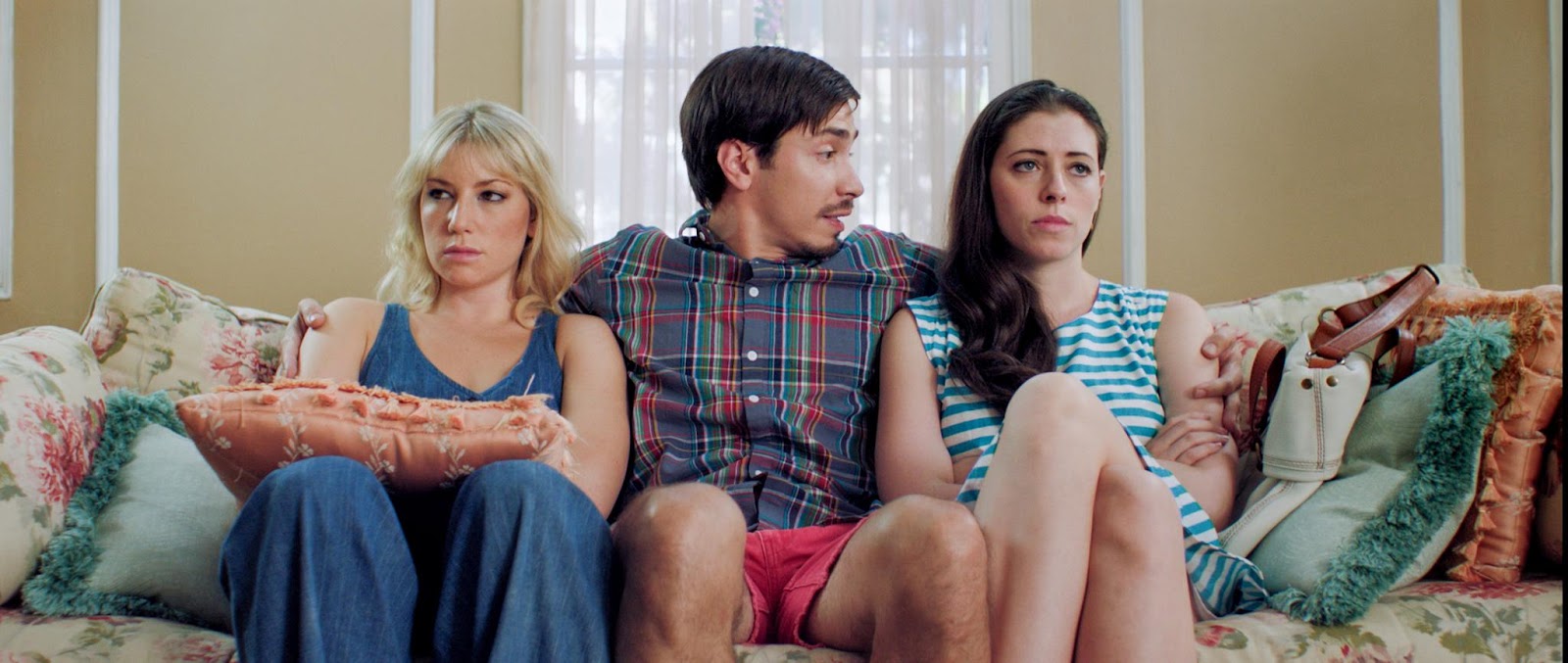
The setup of For a Good Time, Call... is pretty simple.  Lauren Powell (Lauren Miller) is a serious, somewhat boring woman who loses her publishing job at the same time her boyfriend breaks up with her and kicks her out of their apartment.  Katie Steele (Ari Graynor) is a free spirit with multiple jobs whose Manhattan apartment just stopped being rent controlled, so she needs a roommate.  Jesse (Justin Long), their mutual flamboyant gay friend, sees a great solution: have Lauren and Katie move in together!  Unfortunately, the two had a very awkward run-in at college ten years before, so between that and their different temperments life in the apartment is quite tense.

Things change when Lauren thinks she overhears Katie with a boyfriend -- and it turns out to be Katie's work as a phone sex operator.  Lauren is disgusted at first ("I'm better than better than phone sex") but soon sets up Katie to go into business for herself.  And when their first new employee doesn't work out (to put it mildly), Lauren decided to work the phone lines as well.

Sexuality provides plenty of material for comedy; unfortunately, it doesn't here.  For a Good Time, Call... is both predictable and unamusing.  There are the "funny" set pieces, such as Lauren's parents popping in unexpectedly, goofy callers (including several celebrity cameos), a romantic subplot between Katie and a caller, a training montage for Katie, and former enemies turning into best friends.  But there's little humor here -- simply talking dirty and showing sex toys is no substitute for good writing -- and the acting is pretty bad.  (Ari Grayor feels like a budget version of Kate Hudson.)  DVD extras are pretty sparse as well.  For a good time, skip For a Good Time, Call...
Overall grade: F
Reviewed by James Lynch