Showing posts with label Medieval/Renaissance. Show all posts

9.25.2011

Trio Mediæval, Folk Songs (ECM Records, 2007)


Trio Mediæval are a Norwegian/Swedish female vocal trio consisting of Torunn Østrem Ossum, Anna Maria Friman, and Linn Andrea Fuglseth. They have worked together since 1997. While much of their repertoire consists of sacred music and contemporary compositions, they are well versed in the folk music of their homelands. The title of their 2007 CD Folk Songs is as self-explanatory as it gets; accompanied only by Birger Mistereggen on percussion and jew's harp, the trio sing traditional ballads from the old villages in Norway, many of which go back to the Middle Ages.

Like a typical collection of folk songs, the songs range from topics that are universal over time -- a number of the songs are religious, two are children's lullabies, and of course there are some love songs -- to the more exotic and fantastic. "Villemann and Magnhild" is a Medieval ballad in which Villemann, the hero, rescues the maiden Magnhild and drains a troll of his strength simply by stroking his harp. "Rolandskvadet" is a Norse interpretation of the French legend "The Song of Roland." The folk songs of Norway and Sweden, especially when sung by women, have a distinctive lilt to them that's hard to describe if you haven't heard one. They're not alliterative or percussive in the way that Finnish songs tend to be, but there's something about the way the vowels are pronounced that didn't pass down from the Norse end of the Germanic languages into modern English. This makes the voices seem otherworldly, and hard to really capture in words for the uninitiated. But if Nordic singing is an acquired taste, those who've acquired it will find the overall sound of Folk Songs quite lovely. The harmonies are exquisite, and the percussion is sparse but very effective. My one criticism is that the songs all effect the listeners in a similar way, and there isn't enough variety to sustain an album exceeding an hour in length.

Still, Trio Mediæval do a very nice job on the whole, and I'd recommend Folk Songs to anybody who likes Scandinavian singing. I'm never certain what recording will work as a good introduction for somebody not familiar with Nordic music, but people who like vocal music or have a general interest in the music of the Middle Ages will probably find plenty to pique their interest on this album.

Overall grade: B+

reviewed by Scott


"Gjendines Bådnlåt (Gjendine's Lullaby)"

12.14.2010

Faun, Renaissance (Noir, 2005) and Buch der Balladen (Banshee Records, 2009)


Germany has a very active scene for bands performing music from, and inspired by, the Middle Ages and the Renaissance.  I've already reviewed albums by Corvus Corax and Adaro, and the latest of these bands to get my attention is a group called Faun.  Faun are a little bit different from the other German neo-Medieval bands I know in that they're more strongly influenced by contemporary European folk music, particularly from Scandinavia.  Their fourth album Renaissance was released in 2005, while their sixth studio album Buch der Balladen (The Book of Ballads) came out in 2009.

The Faun lineup on Renaissance consisted of original members Oliver "Sa Tyr" Pade (vocals, bouzouki, nyckelharpa, harp, jews harp), Elisabeth Pawelke (vocals and hurdy gurdy), and Fiona Rüggeberg (vocals, whistles and recorders, bagpipes), plus Rüdiger Maul (percussion) and Niel Mitra (electronics).  The wide range of instruments enable Faun to achieve a more diverse sound than you might normally expect from a Medieval album.  Most of the lead vocals are shared by the women, perhaps owing some debt to Scandinavian bands like Hedningarna and Ranarim, and the songs are sung in several different languages.  The song "Da Que Deus" and the instrumental "Rhiannon" are performed in a jig rhythm, giving the album a bit of a Celtic flavor, but the modal melodies evoke a time well before jigs became associated primarily with Ireland.  Faun also venture into Middle Eastern, belly-dance style music on the song "Sirena." While there are some electronic touches in the arrangements, they are generally subtle.  The percussion is likewise mostly subtle, but the exceptions like "Satyros" and "Iyansa" are some of the album's highlights.

For the new CD, Pawelke was replaced by Sandra Elflein. (Elflein was herself replaced earlier this year by a singer named Raida.) Faun set to music segments from legends and epic poems, with particular emphasis on the connection between Norse legends and the folklore of their homeland. Much of Buch der Balladen revolves around the legends surrounding Sigurd and Gudrun and the saga of the Nibelungs.  Although the earliest written versions of these stories come from Iceland, they form a major part of German folklore as well and were of course immortalized in the operas of Richard Wagner. They have been translated into English as well by several authors, including J. R. R. Tolkien. Faun use texts from the Faroe Islands (yes, them again) for their own arrangements, as opposed to the more familiar Icelandic edda. The international flavor to the music on Buch der Balladen continues with "Herr Heinerich," a German translation of a Scottish ballad about a king's encounter with troll, a mythical monster of Scandinavian creation. Faun follow this with the instrumental "Sen Polska," a type of Swedish folk dance. Other ballads on the album include "Der Wilde Wassermann," a German legend about an encounter with a water elemental, and "Belle Dame Sans Merci," a German version of an English poem (by John Keats) with a French title.

Musically, Faun are as much a contemporary folk band as they are Medieval re-creationists. They aren't academically committed, the way Sequentia were on their album Edda, to re-create performances as they would have sounded in the great halls of Medieval Germanic Europe, but they do put care into their arrangements and come up with some really nice music as a result. These arrangements are not as elaborate or as technically difficult as ones you might find on other folk recordings (compare "Sen Polska" with any polska on a Väsen CD, for example), but Faun succeed in turning their relative simplicity into a virtue. As far as early music goes I'm partial to the sound of the hurdy-gurdy, and consequently to songs like "Herr Heinerich" and "Jahrtausendalt."

Faun have been performing together for close to a decade at this point, and have built up a impressive body of music. Fans of the Medieval elements in contemporary folk music will like them a lot.

Overall grades:
Renaissance B+
Buch der Balladen A-


reviewed by Scott

A live performance of "Herr Heinerich"

10.24.2010

Sequentia, Edda: Myths from Medieval Iceland (DHM, 1999)


Sequentia are an early music ensemble, co-founded and led by Benjamin Bagby but employing a rotating cast of performers depending on the needs of a particular project.  Bagby's goal with Sequentia is to recreate pieces of Medieval music in as authentic a manner as possible.  With the project Edda: Myths from Medieval Iceland, released in 1999 but based on several years of preliminary work and performance, Sequentia created musical presentations of Norse myths and sagas preserved in Icelandic texts in an attempt to re-create the kind of storytelling that likely took place in the great Nordic halls of the early Middle Ages.  The album marked the end of an era for Sequentia for unfortunate reasons; Bagby's wife and musical partner Barbara Thornton succumbed to a brain tumor before Edda could be released.

On Edda, Sequentia consisted of Bagby on vocals and lyre, Thornton and Lena Susanne Norin on vocals, and Elizabeth Gaver on fiddle. The source text used in Edda is derived from two 13th century Icelandic manuscripts. The Prose Edda is the work of Snorri Sturluson, an Icelandic scholar and historian who singlehandedly saved much Nordic folklore from being lost to history. The Poetic Edda, from which Sturluson quoted in his own work, had actually been lost for several centuries before re-appearing in 1643. The poems from this text are best known in contemporary terms for their influence on the music of Richard Wagner and the writings of J. R. R. Tolkien.  To create the melodies and backing music, Sequentia needed to go beyond existing sources and take a few leaps of faith.  With next to nothing written down to serve as a guide, the group had to work backward from more recent traditions, trying to identify in existing music the primeval modal structures from which the music evolved, then developing song patterns based on these modes that fit the texts being used.  For the fiddling, Gaver identified the older elements in the musical structures within the Norwegian hardingfele tradition, and then applied the style to more primitive fiddles that existed at the time the stories in Edda would have been musically performed.

From an academic standpoint, Edda is an extremely impressive accomplishment.  Years of research went into making this recording, and it can be fairly said that Sequentia open a door to a place and time in the distant past and breathe new life into it. I felt that much of the music seemed to be missing something, though, that I'm having trouble trying to tangibly define. I've been a fan of contemporary folk music from Scandinavia for most of my adult life, and parts of what attracted me to it is that I feel a certain primal spark in much of it that probably does have Medieval roots. It was only in the last few tracks on Edda that I felt that Sequentia started to find that spark. "Ragnarok," the fiddle interlude between the two portions from "The Prophecy of the Seeress," was Gavner's strongest contribution to the project. It was almost like I could hear her going to a bunch of workshops and instructional sessions on the hardingfele, immersing herself in the tunes and the styles until, just like that, one day it clicks. Likewise, there's a point in the last part of "The Prohecy of the Seeress," where Bagby enters the musical narration with the two women and everything just seems to start working (although I also got the sense that there was room for some percussion in their arrangement).

The music on Edda: Myths from Medieval Iceland may be more fascinating than breathtaking, but it was a worthwhile endeavor, and I can certainly appreciate the amount of work that Sequentia undertook to present the stories in as authentic a manner as possible. People interested in Scandinavian folklore and musical traditions will enjoy giving this a few listens.

Overall grade: B+

reviewed by Scott

1.07.2009

Svanevit, Rikedom och Gåvor (Nordic Traditions, 2008)


Svanevit are a Swedish folk quartet consisting of Anders Larsson (vocals, mandola), Erik Ask-Upmark (harp, bagpipes, whistles, Jew's harp), Anna Rynefors (nyckelharpa, Swedish bagpipe, percussion), and Maria Larsson (fiddle). Their overall sound and arrangement style could be described as being even more traditional than "traditional." That is, their playing is heavily influenced by Renaissance and Baroque styles that pre-date most of the tunes in the Swedish folk canon. For their latest album Rikedom och Gåvor (Wealth and Gifts), Svanevit perform material collected by the fiddler John Enninger, who passed away in 1908.

Going further back in time than most Swedish folk acts do actually makes Svanevit sound like a breath of fresh air. The bagpipes, harp, and Medieval-sounding percussion give the tunes on this album a distinctive flavor that's worth giving a few extra listens. Most of the tunes are waltzes, with a couple of marches and polskas providing some variety. The styles will sound familiar to those who know Swedish folk music, even if people shouldn't expect typical spelmanslag arrangements. Svanevit do a nice job on the song as well as the instrumentals. Larsson's warm, friendly baritone is very effective, especially given that very little Scandinavian folk music features male vocals. The bannd members are likewise solid players of a broad range of instruments, and they make harmonizing between pipes, whistles, fiddles, and harps seem effortless. I do wish that Larsson was a stronger accompanist on the mandola, though. I may be a bit biased as a guitarist and bouzouki player (the mandola and bouzouki are very similar), but I always listen particularly closely to the rhythm instruments in the hopes of hearing something really creative.

Rikedom och Gåvor will definitely appeal to fans of Swedish traditional music, especially if they are in the mood for a somewhat different take on the traditional tunes. Svanevit are solid performers and very creative arrangers, and their approach works well on the whole. The album should also serve as an effective introduction to the musical traditions of Sweden for people who like Medieval or Renaissance instrumental music.

Overall grade: B+

reviewed by Scott


Reprinted with permission from The Green Man Review
Copyright 2009 The Green Man Review

4.04.2008

Karim Baggili Quartet, Cuatro con Cuatro (homerecords.be, 2005)


I first heard Karim Baggili at a multi-artist showcase at Scandinavia House in Manhattan this January. A master of both flamenco guitar and the Medieval oud, Baggili performed for an electric twenty minutes accompanied by only a percussionist and occasionally a singer. The eclectic nature of Baggili's music is reflected in his own upbringing; though born and raised in Belgium, he is half Jordanian and half Yugoslavian. Baggili has performed with a number of different combinations of musicians in his career, most of whom also come from diverse backgrounds but somehow wound up in Brussels. This particular CD, called Cuatro con Cuatro, was recorded in 2005 by the Karim Baggili Quartet, featuring Baggili, Phillipe Laloy on flute and saxophone, Kathy Adam on cello, and Osvaldo Hernandez Napoles on percussion.

Cuatro con Cuatro alternates between livelier, percussive pieces and calmer, jazzier ones. Most of the nine tracks run over five minutes, leaving room for extended solos and improvisations. The music mixes together many styles, from flamenco to jazz to classical to baroque to Arabic. Some of the stylistic pairings are more natural than one might think at first glance, though. All the European plucked stringed instruments, and their corresponding musical traditions, evolved from Arabic predecessors, including and especially the lute and Spanish guitar. The faster pieces like "Septime" and "Mr. Lee" worked better for me than the slower ones, mainly because they better reflect Baggili's considerable instrumental skill. Most of the slower tunes, particularly the lengthier instrumentals, fail to maintain the album's momentum. The exception is the album's one song, a sad Spanish ballad called "La Llorona."

Some of the material on Cuatro con Cuatro is very good, but like a lot of virtuoso performers, Baggili doesn't quite match on record what he is capable of doing in a live concert. You'll have to take my word for it that his mesmerizing set in January drew raves from a lot of people who didn't previously know his work. Cuatro con Cuatro teases the listener with hints of that excitement, but has too many lulls in the action to fully deliver the goods.

Overall grade: B

reviewed by Scott

3.06.2008

Corvus Corax, Venus Vina Musica (Noir Records, 2006)


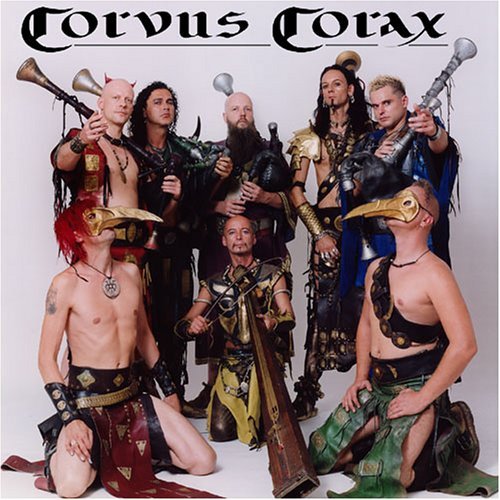
The eccentric German Medieval band Corvus Corax first got my attention a couple of years ago when a compilation of their first decade of music, called Best of Corvus Corax, became their debut American release. The songs the band performs may be meticulously researched from or inspired by ancient (mostly Latin) texts, but their arrangements, mostly featuring an army of bagpipes backed by a barrage of drums, are designed to maximize the energy and mayhem. Their latest album, called Venus Vina Musica, was released in the fall of 2006.

The album begins rather somberly, with a short Latin dirge titled "Anti Dolores Capitis," featuring some deep, infernal chanting at the end. Then the frenzy kicks in with the title track, which I'm guessing is a celebration of wine, women, and song. Most of the songs and instrumentals follow in a similar vein, but the band does break from its basic formula a bit as the album proceeds. The twelve tracks include a rhythmically complex Balkan-flavored instrumental, a French song in a 6/8 rhythm that reminded me a lot of African music, a tune suitable for belly dancing, a dark ominous waltz, and an increasingly frenetic jig. The highlight of the album is the extended jam "Sanyogita," which clocks in at nearly seven minutes. On this track the band demonstrates an ability to gradually build up the tension, instead of simply letting it rip from the start.

Corvus Corax are probably not for everybody -- their presentation is rather bizarre, they don't use the typical assortment of instruments, and subtlety is not one of their strong points -- but I find them to be both interesting and entertaining. When most people think about primal energy or intensity in music, they invariably think about rock and roll, not anything older than that, and certainly not anything a lot older than that. Corvus Corax takes a different approach, and shows that the energy that rock and roll taps into has been a part of music for as long as there's been music.

Overall grade: B

reviewed by Scott

8.24.2007

Various Artists, Stand and Deliver (Noir Records, 2005)

Asleep By Dawn is a magazine devoted to contemporary interpretations of Medieval music. A couple of years ago they made a compilation CD titled Stand and Deliver, from the catalog of performers at Noir Records, for sale and distribution at the Pennsylvania Renaissance Faire. As a subscriber to the folk music magazine Dirty Linen, I had a leftover copy of this disc fall into my hands when I sent in my renewal. The cover art is cheesy to say the least, and you can't help getting the sense that the music on this disc was pulled off of some SCA geek's iPod. But there are actually quite a few good performers out there doing creative things with Medieval music, and several of them are represented here.

The biggest scene for modern Medieval music right now is in Germany, so the ".de" at the end of most of the websites of the bands included in this compilation did not surprise me. Indeed, the CD opens with a fun frenetic song from the most well-known of the German Medieval bands, Corvus Corax, whom I've reviewed here. Germany's folk traditions evidently lean heavily on the bagpipes, as pipes figure prominently on many of the tracks, especially in the first half of the CD. This is not a bad thing necessarily, as a few of the pipe tracks are quite strong, including "A Voi Gente" by Estampie.

Not all the tracks are pipe pieces though. "A Virgen Mui Gloriosa" by Des Teufels Lockvoegel features a really pretty melody sung by a soprano above flute and guitar accompaniment. A couple of heavily percussive songs are well suited for belly dances. The Bulgarian group Irfan performs an ominous interpretation of an ancient chant. I happily get my hurdy-gurdy fix courtesy of Angels of Venice and their song "A Chantar Mar." The German group Filia-Irata performs an old Finnish runo song "Vikon Vaivane." Their dark, sparse arrangement of this song improves on the version of it I'd previously heard, on Värttinä's 1990 CD Oi Dai. Then again, Värttinä has done a better job of tapping into the Medieval elements of Finnish music, particularly the primal elements, on their more recent efforts than they did on their earlier albums. The album closes with a beutifully airy sixteenth-century chant "Polorum Regina," sung by the female vocal group Sarband.

Despite the cheap packaging, Stand and Deliver is a fun listen with many strong songs. It also serves as an excellent introduction to the contemporary performers making music from, or inspired by, the music of the Middle Ages. Granted, this will probably not appeal to anyone who wouldn't be caught dead at a Renaissance Faire. But if you've got your cloak and feathered hat packed, this is the perfect CD to play during the car ride.

Overall Grade: A-

reviewed by Scott

4.05.2007

Le Ménagier de Paris - the same (c. 1393)

Le Ménagier de Paris or The Goodman of Paris as it is often translated, is not going to be for everyone. It's intended for a rather specialized audience, but has a number of features which might of interest to a larger audience than one might initially suspect.

The book is a practical guideline to behavior, household management and cooking written by an old and relatively wealthy bourgousie for his young wife. In the French it would be what is called a primary research source, that is to say an actual medieval document. A 1928 translation by Eileen Power has recently been re-released, and is technically a secondary source since the translator has had to make certain choices in the process of translating. For those of us who do not speak Medieval French well enough to read the original, though, it will have to do as a research source.

It is also a remarkably readable book in it's own right, one that may appeal even to those who are not interested in the minutiae of medieval scholarship. The book is broken down into two sections. The first section, in nine articles, covers proper behaviour of a wife, especially a young one. The second, in five articles, treats of household management and cooking.

The first section is a fascinating window into daily life in a fourteenth century metropolis. The instructions remind the reader of how alien life was in that time, how restricted a woman's place was in middle-class medieval society. They also drive home how religion permeated every facet of life, a thing which is also alien to even the most devout Twentieth Century USAian. It provides a glimpe of a time and culture which is one of the roots of ours today, but which is, for all that, very strange to us.

The second section is a strange mix of the most useful and the most useless informaton, at least to most modern readers. The cooking section is remarkably accessible. A competent modern cook should be able to adapt ("redact," in the jargon) most of the recipes without too much effort, and may find much to spark their own culinary imagination. Mixed in with the recipes, though, are instructions on where to purchase ingredients and how much to pay for them. While this may have been a great boon in 1393 in Paris, it is not so useful these days to know that one should pay 12 pence for ten chickens or that the Porte-de-Paris has nineteen butchers who process 1,900 sheep, 400 oxen, 400 pigs and 200 calves weekly. (Although that may be interesting, it's not usefull in very many situations.)

For those with an interest in medieval daily life, the place of women in medieval Paris, medieval household management or medieval cooking it's a fabulous resource. For everyone else, it's probably not going to be your cup of tea.

Overall Rating: Not Rated

2.03.2007

Adaro, Schlaraffenland (Inside Out, 2004)

In recent years, Germany has developed a scene for modern, progressive interpretations of Medieval music. I have already reviewed The Best of Corvus Corax for this site; that band combines first-millennium texts with a wall of bagpipes and drums and an over-the-top stage presentation. By contrast, Adaro (named after a creature that is half-human, half-fish) is more accessible. Most of their material comes from the fifteenth and sixteenth centuries, but their rocked-out arrangements are clearly aimed to reach a mainstream audience, at least in their homeland. The band is fronted by Christoph Pelgen and Konstanze Kulinsky (whose appearance reminds me very much of Amy Lee of Evanescence). Besides singing, Pelgen plays whistles and bagpipes while Kulinsky plays the hurdy-gurdy. The band's muscle is supplied by guitarist Jürgen Treyz, bassist Henrik Mumm, and drummer Jörg Bielfeldt.

Their most recent album Schlaraffenland came out in 2004. Schlaraffenland, according to the lyrics of the title song that opens the album, is a mythical place where everything goes right. While most bands who specialize in Medieval material prefer the darker, more violent songs, Adaro generally tries to keep things upbeat and positive. The music varies from very hard rock to soft acoustic ballads, with Pelgen and Kulinsky often finding creative ways to make their instruments fit in. The sound of the German language takes some getting used to -- it lacks the inherent alliteration that made Finnish immediately infectious to me, the percussiveness that gives African songs their punch, or the ethereal quality that makes Gaelic so enchanting -- but it does have its own charm, and grows on you if you let it. Highlights include the title song, the pleasantly melodic "Lieg Still," the aggressive "Minne ist ein suser Nam'," and especially the Medieval mayhem of "Komm her zur mir."

On the whole, I found Schlaraffenland to be quite a bit of fun. I have a slight preference for the darker edginess of The Best of Corvus Corax, but in Adaro's defense, that CD is a compilation of a decade's worth of material while Schlaraffenland is one studio album. For all their archaic trappings, they rock hard and have a pop sensibility, and should appeal to a broad audience in spite of the language barrier.

Overall grade: B+

1.26.2007

The Dufay Collective, Music For Alfonso The Wise (harmonia mundi, 2005)

Alfonso X (called "the learned," or "the wise") ruled the kingdoms of Castile and Leon in modern-day Spain from 1252-1284. His wisdom was evidently questionable in some regards, particularly where fiscal responsibility was concerned, but he took much cultural advantage in his proximity to the Arabic Moors. His kingdom's centers of learning helped re-introduce the works of the ancient Greeks and Romans to Europe, and some significant musical developments reached fertile ground on Alfonso's watch as well. The Dufay Collective, a group of scholar/performers of Medieval music, have compiled a collection of songs and tunes from thirteenth-century Spain in the hopes of re-creating the sound of Alfonso's court. Regrettably, the music that accompanied the songs of the troubadours known to have played in Alfonso's court is lost to history, so in a few instances the Collective took existing lyrics from these troubadours and set them to other melodies from that period. Despite focusing on a very specific region of Medieval Europe, the material performed on Music For Alfonso The Wise is a strand of a common thread that interwove the Spanish court with all the regions surrounding the Mediterranean Sea, and whose roots continue to branch out and spread 750 years later.

The instruments used by the Dufay Collective combine European and Arabic traditions. Lead instruments like the psaltery (an early harp) and the vielle (a primitive violin with a characteristically scraping tone) are played over plucked-string rhythm instruments like the oud, rebab, and saz. The first thing that struck me about the disc is how much of the music sounds very similar to modern Balkan music. I'm guessing that as the Muslim influence remained prevalent in the Balkan region for significantly longer than it did in the rest of Europe, current Balkan folk music has kept closer to its form in the Middle Ages. On some tracks, though, the aggressive plucking clearly shows the early evolution of what became flamenco. Of course, the development of flamenco coincides with the Spanish transformation of the Arab stringed instruments into the modern guitar, whose impact on folk music traditions throughout the world in the last few centuries defies any sort of calculation.

The material on Music For Alfonso The Wise comes from two primary sources. The first, Cantigas de Santa Maria, is a collection of odes to the mother of Jesus that was commisioned by Alfonso himself. The second is the earliest known example of a song cycle, Cantigas de amigo by Martin Codax. This album boasts a number of strong and intriguing tracks. "Ontre todalas" begins with minor-key fiddling with a the kind of droning harmony that wouldn't sound out of place in northern European folk tunes, yet when the percussion kicks in is sounds well suited for a belly dance. The combination of "Tant aos peccadores" and "Todo los Santos" would hold its own among modern folk dance recordings. "Quen a Virgen" alternates between the kind of very complex rhythm still prevalent in eastern European folk tunes and the 6/8 rhythm that inspired the modern jig. The plucked strings and percussive handclaps of "Martin jorgar" very obviously bring flamenco to mind. The trembling fiddle on "Non soffre Santa Maria" evokes Hungarian folk music; indeed, this piece would have sounded perfectly in place at Golden Festival.

More than anything else, Music For Alfonso The Wise works for me because I can hear the echoes of so much modern music in the arrangements. Now granted, The Dufay Collective have obviously heard their share of modern music, and its influence may very well have colored their interpretations of the Medieval music they perform here. Yet the melodies are all authentic, and the choice of instrumentation is consistent with the time and place. Music For Alfonso The Wise is an enjoyable and highly fascinating voyage to a part of our distant, but intriguingly not so different, musical past.

Overall grade: A-

Digg This
Del.icio.us

1.04.2007

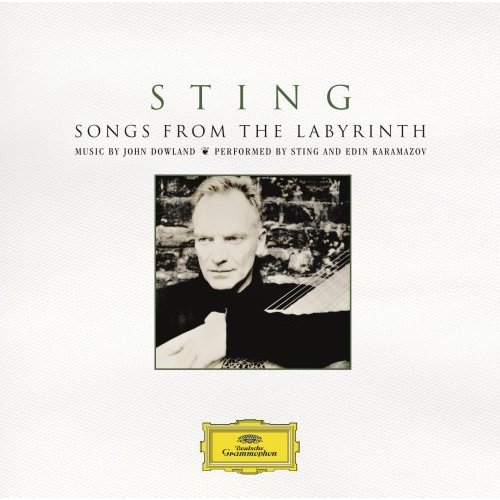
Sting and Edin Karamazov: Songs from the Labyrinth (Deutsche Grammophon, 2006)


Reviewed by Rachel Wifall

“Sting Goes Renaissance”

In Songs From The Labyrinth, Sting and Bosnian lutenist Edin Karamazov pay homage to the English Renaissance musician and composer John Dowland. Upon release in October, the album entered the UK Official Top 75 Albums Chart at number 24 and The Billboard 200 at number 37, rising the following week to number 25. It debuted at #1 on Billboard's Traditional Classical Chart and Classical Overall Chart, where it has remained for thirteen weeks.

Fifteen of the album’s sixteen songs were composed and originally performed on the lute by Dowland, a court musician in the late 16th and early 17th centuries; one (“Have you seen the bright lily grow”) was composed by Dowland’s younger contemporary, Robert Johnson, to lyrics written by playwright and poet Ben Jonson. Interspersed among the songs are readings from a letter which Dowland wrote to Sir Robert Cecil, Secretary of State and spymaster to Queen Elizabeth I, in 1595; in this letter Dowland defends his career choices, which took him to serve foreign patrons, and offers intelligence on possible foes to the queen, including his allegation that “men say that the Kinge of Spain is making gret preparation to com for England this next somer.”

Dowland went to Paris in 1580, where he served the ambassador to the French court. During this time he became a Roman Catholic, which conversion he claimed kept him from a post in Elizabeth I's fiercely Protestant court. In his letter he confides that he “gest that my relygion was my hinderance. Whearupon, my mynde being trobled, I desired to get beyond the seas”; after going abroad, Dowland worked instead for many years at the court of Christian IV of Denmark. After returning to England in 1606 he finally secured a post as one of James I's lutenists, in 1612.

Many of Dowland’s songs display the Renaissance vogue for melancholy; Sting relates to this, claiming that Dowland was “perhaps the first example of an archetype with which we have become familiar, that of the alienated singer-songwriter—something that gives him an acutely modern resonance.” Some of his tunes are upbeat, such as “Fine Knacks for Ladies,” which abounds in alliteration, metaphor and wit as it contrasts shallow materialism with amorous constancy: “Great gifts are guiles and look for gifts again./My trifles come as treasures from my mind./It is a precious jewel to be plain./Sometimes in shell the orient’s pearls we find.” However, even Dowland’s more uplifting love songs have a shadowy side: his famous rollicking “Come again” is an appeal a courtly lover makes to his mistress, full of sexual innuendo (“To see, to hear, to touch, to kiss, to die,/with thee again in sweetest sympathy”—“to die” metaphorical at this time for orgasm). While the original song encompasses six stanzas, Sting chooses to cut it off in the middle of the fourth, ending the number abruptly, yet effectively, on a decidedly lamenting note: “All the night, my sleeps are full of dreams,/My eyes are full of streams, my heart takes no delight.”

Edin Karamazov is one of Europe’s foremost lutenists, whose expertise is evident in his skilled and feeling interpretations of these complex works. Sting, who is studying the lute under Karamazov’s tutelage, plays briefly on track 15, after reading an excerpt of Dowland’s letter “…And from thence I had great desire to see Italy,” and in a duet with Karamazov (“My Lord Willoughby’s Welcome Home”). While on his website Sting claims “I'm not a trained singer for this repertoire,” the 16-time Grammy winner also says, “but I'm hoping that I can bring some freshness to these songs that perhaps a more experienced singer wouldn't give. For me they are pop songs written around 1600 and I relate to them in that way: beautiful melodies, fantastic lyrics, and great accompaniments.” While Sting has never displayed a great vocal range, his distinctive raspy and plaintive voice and his straightforward renditions are appropriate to this genre, rendering fresh and heartfelt Elizabethan and Jacobean popular music.

The name of the album comes from Sting’s fascination with labyrinths, a pattern of which is carved into the center of the soundboard of a lute which was given to him as a gift; in his informative and reflective introduction to the album, Sting also writes of his garden labyrinth, in which he and Karamazov became acquainted. He further relates the image of the labyrinth to his fascination with Dowland’s music:
Related to the Arabic ‘ud, the lute is close enough to the guitar for a modern guitarist to feel relatively familiar with it, but different enough in tuning and fingering to force a brain-teasing restructuring of synapses. Slowly and surely, I began to be drawn into the labyrinthine complexities of this ancient instrument and its beguiling music.

Sting and Karamazov have recorded a program entitled Sting: Songs From the Labyrinth, which was filmed at Sting's 16th-century manor house in Wiltshire, in the ancient gardens of Il Palagio (his home in Italy), and before a live audience at St. Luke's Church in London. It will air on Monday, February 26 at 10 p.m. (ET) on PBS Channel Thirteen/WNET. This Great Performances program will also be released as part of a special DVD/CD package entitled The Journey & the Labyrinth: The Music of John Dowland. Sting and Karamazov have also announced a European tour, which will begin in February. Tour dates are available at www.sting.com/news/index.php.

Digg This
Del.icio.us

9.28.2006

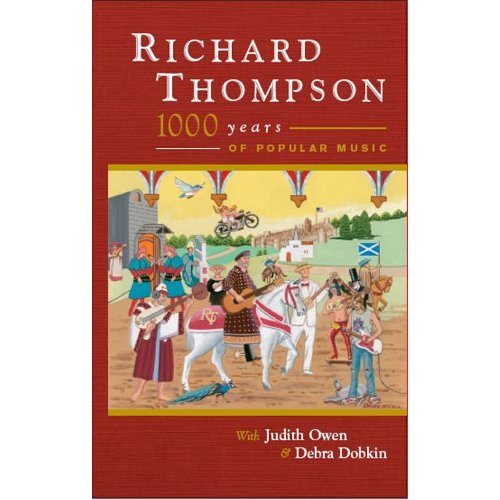
Richard Thompson, 1000 Years Of Popular Music (Cooking Vinyl, 2006)


In 1999, Playboy decided to ask a number of prominent musicians to list their choices for the best songs of the millennium. Richard Thompson decided to have a little fun with the request and took it quite literally, citing pieces from the Middle Ages through the Renaissance and up to the present. Playboy never published his list, but the process of compiling the list inspired Thompson to create a live show in which he'd perform music spanning a thousand years. The show has taken on a few different guises over the past couple of years, and an unofficial version of 1000 Years Of Popular Music has been available at Thompson's website and at his shows for a while, but an official release didn't take place until this summer. This version of 1000 Years Of Popular Music, consisting of two audio CD's and one DVD, was recorded at Bimbo's 365 Club in San Francisco in February 2005. Thompson is joined for this performance by Judith Owen on vocals and keyboards and Deborah Dobkin on percussion and vocals. The show was a deceptively difficult undertaking; the performers had to play songs in a great variety of styles, at least some of which could not have been familiar to them, and often had to modify the original arrangements so that the pieces could be performed by just three people. Still, there are good reasons why Richard Thompson is widely revered in some circles, and he more than adequately pulls this off.

The material from the first half of the concert ranges from the thirteenth century to the early part of the twentieth. "Sumer Is Icumen In," the opening song, is a sprightly early jig sung in the round in Middle English. Its text comes from a manuscript at Reading Abbey. "King Henry" recounts the events leading up to the 1415 Battle of Agincourt, tennis balls and all. Thompson then tries his hand at Italian with the Renaissance song "So Ben Mi Ca Bon Tempo." Coming from the seventeenth century, the folk ballad "Bonnie St. Johnstone" reflects the transition to a style still common in Celtic ballads today. Thompson then backs up a bit, bringing out Owen and Dobkin to sing a capella the Elizabethan madrigal "O Sleep Fond Fancy." The three-part harmonies continue with an excellent rendition of the dark religious ballad "Remember O Thou Man," the highlight of the first disc. After this, the show jumps to the nineteenth century with a version of the American folk ballad "Shenandoah." While Thompson does a nice version of it, I have to say that the version on Merrie Amsterburg's new album Clementine And Other Stories is superior. "Black Leg Miner" is an energetic English folk standard from the same period, reflecting the plight of striking miners -- and the worse plight of those who tried to work through the strike. Thompson then continues with two humorous songs from the turn of the last century. "I Live In Trafalgar Square" is a rousing Music Hall song sung from the perspective of a homeless man who's found the ideal resting spot. "There Is Beauty In The Bellow Of The Blast," from Gilbert and Sullivan's The Mikado, features a perfect vocal delivery from Owen while Thompson serves as the male foil and ably mimics the scored orchestral arrangement on his acoustic guitar. Disc one closes with "Java Jive," the first in a sequence of American popular standards from the period between the Depression and the aftermath of the Second World War.

The second disc begins with an excellent lead vocal from Owen on Cole Porter's "Night and Day." Thompson then follows with a rousing version of "Orange Coloured Sky," originally popularized by Nat 'King' Cole. After this, he chooses the relatively obscure "Drinking Wine Spo-Dee-O-Dee" and "A-11" to represent blues and country, respectively. At this point, Thompson brings the show into the rock era. The Kinks' dreamlike "See My Friends" represents the British Invasion, and likely exerted a huge influence on Thompson as a teenager. Next comes the evening's best performance, a stirring rendition of the Australian classic "Friday On My Mind" by The Easybeats. The backing vocals could be a little tighter, but they provide the right amount of manic intensity to back Thompson's rapid-fire singing and picking. The Squeeze song "Tempted" follows in the set. This song has near universal popularity among rock fans old enough to know it, but as Thompson points out in the liner notes, it was a very minor hit when it came out. The concert reaches the year 2000 with what is obviously the wild card of the set, "Oops!... I Did It Again." I'm not sure if Thompson was going for irony with this choice, or commenting on the current state of popular music compared to what's been done in the past. At any rate, it loses its humor value after the first listen, and what's left is a song that, despite Thompson's best efforts to make it presentable (including plucking the melody as a Medieval jig at an interlude near the end), just doesn't belong.

The three encores jump around a bit chronologically, starting with Owen singing the 1950's jazz standard "Cry Me A River." The trio then brings the set all the way up to 2004 with the song "1985" by Bowling For Soup. This song holds its own surprisingly well, although if anybody performs this song a thousand years from now during a tribute to the current millennium, I doubt the audience will get all the references. Thompson closes out the show with an amusing a capella, call-and-response song from the early days of British Music Hall called "Sam Hall."

The DVD contains the same songs as the CD's do, along with a couple of interview snippets and Thompson's introductions to each song. The dialogue brings out Thompson's thought process as he developed the show and also shows his humorous side to a degree that only occasionally gets seen in his own music. The performance was as much fun to watch as it was to listen to, although as a guitar player I wouldn't have minded a few looks at Thompson's technique up close. Judith Owen also uses a whole litany of odd hand gestures while singing, which was amusing at times but could also be a bit of a distraction.

1000 Years of Popular Music
contains many good songs, performed solidly by one of music's venerable elder statesman and an able supporting cast. Fans of Richard Thompson will certainly like this, and anybody curious for a musical history lesson will find much to like about it as well.

Overall Grade: A-



Digg This
Del.icio.us

5.02.2006

Corvus Corax, Best of Corvus Corax (Noir Records, 2005)


Corvus Corax have been playing their unique brand of agressive Medieval music throughout their native Germany and the rest of Europe for over a decade. Now they have issued their first ever American release, a compilation of their best material to date. While they use a great variety of homemade instruments, all of which were originally developed in the Middle Ages, the standard Corvus Corax sound consists of five pipes and three drums in a full-tilt, spectacularly unsubtle bombardment of the eardrums. This will definitely not appeal to everybody, but the more I listened to it, the more I dug it. Most of the music on this CD is instrumental, with melodies that evoke a distant past but arrangements that put the group squarely on the cutting edge. The percussion, in particular, injects Corvus Corvax with an energy that would make a lot of arena rock bands envious. The handful of songs work well too, especially "Cheiron," with powerful deep harmonies and lyrics dating back to 100 A. D. Their sound and appearance might take some getting used to, but the music on Best of Corvus Corvax is too energetic and too much fun to be denied. And something tells me their concerts are an experience not to be missed; hopefully they'll make an effort to get over here often from this point.

Overall grade: B+