Showing posts with label Comic books. Show all posts

10.15.2017

PROFESSOR MARSTON AND THE WONDER WOMEN

Wonder Woman creator William Moulton Marston led an interesting life, many elements from which can be found in his famous female superhero creation.  Professor Marston and the Wonder Women is a biopic that explores Marston's relation ship with two important women -- and how it all led to Wonder Woman.

The movie opens in the 1940s, with William Mounton Marston (Luke Evans) being grilled on the salacious elements of his Wonder Woman comic book by Josette Frank (Connie Britton), a member of the morality police.  This is intercut with flashbacks to Marston's life.
In the 1920s, Marston was a professor at Harvard, teaching the then-new science of psychology and working on inventing the lie detector; he also teaches his students DISC theory, which includes dominance and submission elements and the idea that women would do better running the world than men.  He worked with his wife Elizabeth (Rebecca Hall), a blunt-spoken psychologist who's unhappy she's not being given the same degree as her male counterparts.

Olive Byrne (Bella Heathcote) is a student of Marston's who also becomes his research assistant.  She also inspires a tangle of emotions and desires between the three people, leading to the two main sections of the movie.  Early on, there's a question of what will happen, as everyone seems attracted to each other (though Olive has a fiancee).  Later in the movie, they adopt their "unconventional lifestyle" and deal with the consequences, both good and bad.
Professor Marston and the Wonder Women is an enjoyable look at some unusual people.  The movie is very pro-kink, as the intricate connection between the trio is more than just a man wanting to be with two women, but all of them having relationships with each other.  While not heavy-handed, the movie shows how experiences in Marston's life became part of Wonder Woman's world, from the lie detector becoming the lasso of truth to a BDSM demonstration (and prototype for Wonder Woman's costume).  The actors are all good, though Rebecca Hall has the most fun as the woman always ready with a quip or sarcasm.  Given the popularity of the recent Wonder Woman movie, this is an informative (and adults-only) look at how she came to be.

Overall grade: B+
Reviewed by James Lynch


9.03.2017

KNIGHTS OF THE DINNER TABLE: MEN THAT HACK

 While the characters in the comic Knights of the Dinner Table usually role play in the sword and sorcery world (HackMaster), they sometimes branch out into new genres.  Knights of the Dinner Table: Men That Hack has the characters branching out into the James Bond-esque world of espionage, with two full-length, disaster-filled adventures.

The first story begins with Pete persuading the burned-out B.A. to pick up Hacknoia: The Role-Playing Game of Conspiracy, the Unknown, and Espionage.  B.A. is convinced his adventure will be "the best adventure I've ever run."  He has Bob, Dave, Sara, and Brian playing NSB agents sent, unarmed, to investigate mysterious crop circles in Canada (which Dave never stops believing is a Communist country).

Unfortunately, Bob and Dave trying to find out what's in the secret envelopes they pass to B.A. leads to to a "it never happened" reset.  Then the players arm themselves at Ahkmed's Guns, Booze, Chew, and Ammo (plus Bob stealing a stapler from R&D), get in a massive gun battle at customs, run into the descendant of an enemy from HackMaster, and turn on each other.

The next story happens two years later, as B.A. returns to Hacknoia.  ("But you hate that game!"  "I never said that."  "Dude, you drop kicked your books off the Jackson Blvd. bridge.")  This time around the players are trying to find a nuclear bomb being delivered to Canada.  This time the players are bristling about the fact that there are two NPCs with them -- and one is assigned the lead in the mission.  Chaos (and another trip to Ahkmed's) ensues.

I've had the first story in Men That Hack as part of my KODT live readings for years, and the additional material by Jolly Blackburn suits the strips quite well.  The second story, put together from webstrips and new material, is also quite funny, from Bob and Dave paying to roll up decent characters (and suffering from the dreaded Appendix Q table) to the overarmed and under-intelligent players messing everything up.  There are plenty of laugh-out-loud moments through both stories, and Men That Hack shows that the Knights can be as amusingly incompetent in the spy world as in the medieval fantasy world.

Overall grade: A
Reviewed by James Lynch

6.24.2017

I HATE FAIRYLAND

After reading I Hate Fairyland, you'll never hear the word "fluff" the same way again.  This is a comedy from Image Comics filled with massive violence inside a brightly colored fantasy world -- and it's funny as hell.

A little girl named Gertrude wished she could be on a grand adventure in a magical land.  She gets her wish, being transported (face first) to Fairyland, a magical place full of magical creatures, vibrant colors, and all sorts of animated life.  Queen Cloudia gives her a simple quest: Find a magic key, use it to unlock the door, and return home.  She's given a companion -- the talking fly Larrigon Wentsworth III -- a map of all the known lands, and a small bag that can hold very large things.

Twenty-seven years later, Gert is still wandering around Fairyland.  She hasn't grown physically, she's no closer to finding the key, and she takes her frustrations out on the denizens of Fairyland, usually slaughtering them (even the narrator at the star of the issues) with a battleaxe or cannon.  Larry is sick of Gert but is stuck with her, while Queen Cloudia can't directly harm Gert, as she's still a guest of Fairyland.  The Queen can, however, encourage others to take out Gert -- and she has a plan to make Gert a permanent part of the fantasy workd.
I Hate Fairyland is a demented and delightful reversal of the saccharine-sweet world of some fantasy.  Gert is a true anti-hero, perfectly willing to use or kill anyone in order to get back home.  It's hard not to feel sorry for her, but harder still to really support, well, just about anything she does.  (This is reflected by Larry, who clearly wants to be rid of Gert but can't; he also sometimes pulls out a pistol to help her.)  The first collection, Madly Ever After, sets up this twisted fantasy world quite well; the second collection, Fluff My Life, has the consequences of the cliffhanger at the end of the first collection, plus a little kid in a dragon costume and post-apocalyptic Gert.  If you have a sick sense of humor, I Hate Fairyland is for you.
Overall grade: A-
Reviewed by James Lynch

1.29.2017

KNIGHTS OF THE DINNER TABLE: THE CATTLEPUNK CHRONICLES -- THE FOUR HERDSMEN OF THE APOCALYPSE

In the comic book world of the Knights of the Dinner Table, the "evil" (definitely hostile) version of the Knights are the Black Hands: Weird Pete, Nitro, Newt, Stevil, and (the inexplicably nice) Gordo.  While the Black Hands usually play the sword-and-sorcery Hackmaster, they have delved into other gaming genres as well.  After seeing the Knights take on the Western genre in The Cattlepunk Chronicles -- Outlaw Trail, the Black Hands' KODT Cattlepunk strips are collected (with over 60 pages of new paterial) in The Cattlepunk Chronicles -- The Four Herdsmen of the Apocalypse.

This collection is divided into two parts.  In the first part ("The Early Years"), Nitro is burned out as the GM, so Pete takes over as the GM, running Cattlepunk and "borrowing" several ideas from B.A.'s old campaign.  It turns out that the other players had forgotten what a hard-ass Pete was, and when Nitro takes over as GM the other players spend the whole time at each other's throats.

The second part ("The Herd of Doom") has Nitro picking up the reins of Cattlepunk again, as a favor to a friend.  After several false starts (when the Black Hands kill each other off before getting through the flavor text), Nitro gives his players the task of delivering a massive herd of cattle.  This leads to more in-fighting, a humiliating encounter with a Western legend, and the discovery of what could be the most devastating weapon in the Old West.

The Four Hersdmen of the Apocalypse is delightfully dysfunctional.  Much as I love seeing the Knights in action, the Black Hands are pretty fun when they're sniping at and plotting against one another.  There's lots of fun as the players struggle in the world of the Old West, and the self-contained issue has plenty of laugh-out-loud moments from this world of role playing. ("On the upside -- we got to use the brain spatter tables.")  The Four Hersdmen of the Apocalypse is another funny and worthy KODT collection.

Overall grade: A-
Reviewed by James Lynch

11.29.2016

TABLE TITANS BOOK ONE: FIRST ENCOUNTERS

One challenge of portraying people playing tabletop games in comic books is that it can be boring to see people sitting at a table rolling dice.  Scott Kurtz frequently delves into assorted sides of gaming with his online comic PvP, and he spun off into a Dungeons and Dragons comedy with Table Titans.  This group of D&D players begin on their own with Table Titans Book One: First Encounters.

The story begins with the Table Titans -- snarky dude Alan, rules-obsessed Andrew, and real-life warring mythical dwarf Val -- getting ready for a D&D competition.  Their goal: claim the Winotaur, a trophy of great renown, currently owned by rival gaming group the Dungeon Dogs.  Adam isn't happy Brendan is their Dungeon Master, but Brendan is the only person willing to DM for them.  And their fourth player is Darby, a cheerful and slightly dopey guy who's never played D&D before.

Then the D&D adventure begins, with the players getting (sometimes getting stuck with) their pre-generated characters.  Everyone's quite happy, except for the would-be fighter Val:


They then embark on the D&D adventure, involving a town under siege my a mysterious monster, a former adventurer, a conspiracy, and a cute blink dog as their new helper and mascot.  Will the Table Titans solve the mystery?  Can Val deal with playing a bard?  Will Brendan remain as their DM?  And who will wind up with the Winotaur?

I enjoyed Table Titans but -- and as a gamer I never thought I'd say this -- the comics are almost too focused on the gaming.  We know virtually nothing about the players outside of the gaming table (except for Val): There's no backstory for the characters or how they met, or why the Table Titans can't get another DM).  On the plus side, the comics do capture the often-unintentional humor that happens at the game table, and Kurtz keeps things interesting by showing the in-strip D&D game as a full-fledged adventure.

Table Titans lacks the over-the-top bad behavior and worse playing that is a staple of Knights of the Dinner Table, but it's still an enjoyable trip into the world of some D&D players.  The first volume also has a few extras: the PvP comics that introduced the Table Titans, the pre-Brendan Table Titans playing the Mines of Madness, character sketches, and tales from the table from real-life roleplayers.  Table Titans Book One: First Encounters is a nice, enjoyable look on some D&D players.

Overall grade: B
Reviewed by James Lynch

10.03.2016

KNIGHTS OF THE DINNER TABLE: THE CATTLEPUNK CHRONICLES -- OUTLAW TRAIL

Saddle up, pardners!  While the characters in Knights of the Dinner Table usually play in the sword & sorcery world of Hackmaster, they've occasionally delved into the Wild West.  The Cattlepunk Chronicles -- Outlaw Trail collects many of those adventures, along with dozens of pages of new material.

The Cattlepunk Chronicles starts with B.A. being talked into buying the new Hard Eight game Cattlepunk by Weird Pete.  B.A. sees it as a chance for the players to be less reliant on magic and more creative.  But for players Bob, Dave, Johnny Kizinski and Brian, it turns into massive numbers of characters being rolled up, in-game player kills and grudges, and an almost instinctive impulsive to rob any bank the characters see.  B.A. abandons the game after the players' antics; but when his cousin Sara later joins the group (replacing Johnny), she talks B.A. into returning to Cattlepunk.  But Sara and B.A.'s desire to play lawful characters is continually overrun by the other players' outlaw characters...

The Cattlepunk Chronicles is a nice collection showing what happens when horrible fantasy players become, well, horrible Western players.  We have not only the Knights engaging in some of their worst behavior, but also B.A. being talked into buying more and more product and Sara trying and failing to get the Knights to role-play.  There are players slaughtering each other (and rolling up new characters whose sole purpose is revenge), the introduction of recurring "villain" Red Gurdy Pickens, and campaigns and towns getting destroyed.
Fortunately, all of this bad behavior and trainwrecks of campaigns is pretty damn funny.  The Knights' antics are just as funny with six-shooters as with magic swords, and having these strips together instead of scattered through the KODT run gives a better sense of unity.  There are plenty of laugh-out-loud moments, from the characters loading up on quirks and flaws to get building points ("Inappropriate sense of humor, male pattern baldness, speech impediment, lemur-phobia") to the continual grudges and betrayals.  And even when B.A. gets what he thought he wanted, it still blows up in his face.  The Cattlepunk Chronicles -- Outlaw Trail is terrific fun for fans of KODT, bad gaming, or Westerns gone wrong.

Overall grade: A-
Reviewed by James Lynch

9.22.2016

THE ELTINGVILLE CLUB by Evan Dorkin

Years before The Big Bang Theory brought us four lovable geeks, comic book writer and artist Evan Dorkin lampooned the worst of geek culture with his quartet of pathetic and antisocial geeks.  The Eltingville Club collects Dorkin's comics and strips of this club, plus a new strip wrapping things up and essays.

The Eltingville Club (full name: the Eltingville Comic Book, Science-Fiction, Fantasy, Horror, and Role-Playing Club) is made up of four high school guys.  Bill Dickey is most interested in comic books and science fiction; he's also the most likely to lash out -- verbally and physically -- at anything he dislikes or anyone who disagrees with him.  Josh Levy is focused on science fiction and television shows; as the overweight member of the group, he suffers through constant fat jokes.  Pete DiNunzio is most interested in horror and is a bit pretentious in his views.  And Jerry Stokes is the group's gamer; he's the quietest and nicest member of the group, and also annoys the others with his frequent impersonation of Twiki from Buck Rogers.
The four guys meet in one of their parents' basement, where they rant and curse about everything they don't like about fandom, make trades, and often wind up with their hands on each others' throats.  They have no social life (in the middle of one meeting someone yells "Hey!  Holy shit!  Guys!  Do you realize our prom was tonight?!")   They have no jobs (and no skills or interests beyond the groups') and get money for their hobbies by yelling at their mothers.  When they go out, it's usually to shoplift whatever they want, or to stuff rare toys out of sight at Toys "R" Us so no one else can get them.  Their "adventures" include engaging in an hour-long trivia contest for a rare action figure, trying to stay awake for a 36-hour Twilight Zone marathon, making costumes for Wizard magazine's contest, going on a zombie walk, enduring an intervention, or getting their ideal job at a comic book store.  Their escapades usually turn into disasters, often ending with riots, trampling, fires, or arrests. And their final meeting happens at Comic Con, of course.

The Eltingville Club illustrates the worst of fandom -- and pretty bad humanity in general.  The memers of the club are misanthropic, selfish, sexist (the only women in their world are in porn or x-rated comic books), angry, and overall pathetic.  They're as likely to turn on each other as the things they hate; near the end someone meeting the group for the first time asks, "So, like, were you guys ever actually friends?" -- and the answer seems to be "no."  But it's amazingly funny to watch this group of horrible geeks self-destructing, whether tossing around constant geek references, battling with comic book replicas, or continually getting busted and yelled at by their parents.  There are some digs at geek culture in general -- the owner of Joe's Fantasy World comic book store makes The Simpsons' Comic Book Guy look handsome, polite, and professional --  but Dorkin's sights are mostly focused on the four Club members.  And after the strips about the Eltingville Club, Dorkin discusses the comic's origin, making the one-episode animated series, and provides another comic -- this time about pretentious geeks.

The Eltingville Club is full of cursing, grossness, and horrible behavior.  It's also laugh-out-loud funny; and, in the world of the Internet, disturbingly accurate.  It's savagely funny.

Overall grade: A
Reviewed by James Lynch

7.31.2016

KNIGHTS OF THE DINNER TABLE: 20 YEARS OF COVERS

It's said that the cover of a comic book is very important, as it catches a potential reader's eye and may entice them into buying the book.  Knights of the Dinner Table celebrated its first two decades of publication with Knights of the Dinner Table: 20 Years of Covers, a coffee table book that features all the covers of the comic -- plus additional material.

Knights of the Dinner Table follows the misadventures of the Knights of the Dinner Table -- B.A., Bob, Dave, Sarah, and Brian -- a role-playing group in Muncie, Indiana who mainly play Hackmaster, a thinly-veiled version of Dungeons & Dragons.  Over the years the comic has expanded its scope, introducing other gaming groups (most often the Black Hands), the employees of Hard Eight Enterprises (who produce Hackmaster), the annual GaryCon conventions, and more.  Throughout the years and changes, the focus of the comic has always been gaming -- and that focus is reflected in the book's covers.

The early covers focused mainly on the Knights, either showing all of them together or the four players with gamemaster B.A. appearing in the background somehow.  Over time the other characters and groups made their way to the covers: the Black Hands would be tormenting the Knights, individual characters would get the focus, the annual GaryCon shows would pop up, there was a tribute to Gary Gygax, etc.  Knowing that many of the readers were gamers and/or geeks, the characters would appear in parodies of movies, TV series, other comic books, and even original D&D sourcebooks.  And there were many guest artists, providing different (and, frankly, sometimes better) artwork than inside the comic book.

In addition to the covers, KODT: 20 Years of Covers also has an introduction by the series' creator Jolly Bkackburn.  There are also summaries of all the stories in every issue, plus the occasional panel or artwork from the issues, which elevates this collection from just artwork to a pretty good guide to the stories appearing in every single issue featured in this collection.

Unfortunately, the production of KODT: 20 Years of Covers was part of the disastrous KODT Live Action Series Kickstarter campaign.  The online store Noble Knight Games generously provided copies of the book to those Kickstarter backers who never got their book; unfortunately, they sent out all the copies they had (and I got the last one!).  Fortunately, Kenzer & Company has made KODT: 20 Years of Covers available as a downloadable PDF ; and the hope remains that more physical copies of the book will eventually be produced.

I've been a fan of Knights of the Dinner Table since 1998, and Knights of the Dinner Table: 20 Years of Covers is a terrific collection of the series' amusing and pretty original covers (which almost never have anything to do with the issue's stories).  This book may not be for everyone, but it's terrific for fans of the series, gamers, and geeks in general.

Overall grade: A-
Reviewed by James Lynch


7.03.2016

WHY DOES BATMAN CARRY SHARK REPELLENT? by Brian Cronin

Every week, Brian Cronin explores the veracity of comic book legends on his website Comic Book Legends Revealed, so it makes sense that he known a substantial amount about comic book history.  It's no surprise that his 2012 book Why Does Batman Carry Shark Repellent? And Other Amazing Comic Book Trivia! is a collection of interesting, unusual, and often obscure tidbits from the world of comic books.

Why Does Batman Carry Shark Repellent? is divided into six sections about comic books -- characters, writers and artists, storylines, beyond the panels, comics and culture, and movies and television -- and each section has numerous multiple-item areas.  Readers will learn about Nine Great Superhero Pets, Four Artists with Bizarrely Unique Styles, Five "WTF?" Moments in Comic Book History, Six Notably Recalled Comic Books, Seven Bands that Got Their Names from Comic Books, and Five Most Awkward Sex Scenes in Comic Book Movies.  Most of the entries have descriptions (though some are just lists, especially the surveys), many have artwork accompanying them, and some are guest-written by artists, writers, and other comic book professionals.  (My favorite: Peter David's "Top Six Characters Known for Sitting Around.")

Why Does Batman Carry Shark Repellent? is ultimately a collection of trivia -- heck, the word "trivia" is in the subtitle -- but it's a well done collection of trivia.  While the simple lists (usually from surveys) are very basic, Cronin usually provides some explanation and/or context for the entries, giving the reader the reasons why something is included instead of sending them out to look up why something is so unusual.  This book is a pretty good visit to the world of comic book trivia.

Overall grade: B
Reviewed by James Lynch


5.02.2015

FREE COMIC BOOK DAY

Today was Free Comic Book Day, a day when comic book stores and publishers give out free comics to those who love both superheroes and comic books in general.  This unofficial geek holuday -- the first Saturday in May -- was an opportunity for comic book stores to draw the interest of both potential new readers and those who have collected comics for years or decades.  And several stores had additional ways to celebrate -- as did the fans!

I was able to get to two local comic book stores (Apocalypse Comics and Players Choice; both in South Carolina) before work.  Alas, getting to Apocalypse Comics 10 minutes after the store opened meant, today, a long wait on line.  Fortunately, it was worth the wait: The store had large stacks of different titles, and while I'm sure they didn't last the day, I was able to get one of every one I wanted -- or that looked interesting.
As with most years, there are a wide variety of genres and publishers.  Marvel Comics had a preview for its upcoming Secret Wars special, while lots of independent publishers used the day to roll out their titles.   There are also lots of books based on television shows (The Simpsons, Bob's Burgers), video games (Street Fighter), and even movies (Fight Club).   And in addition to new characters, old favorites like the Tick, Judge Dredd, and others appear in comics released during the day.

 Both stores and customers got into the spirit of the holiday.  Stores had different events and incentives to draw customers of all ages and get them to spend as well as load up on freebies.  Apocalypse Comics had lots of discounts on various books, games, and figures; they also had lots of other events through the day, from bouncy castles (below) to radio folks doing a live show to "pro" wrestling events.
 As for customers, there was lots of cosplay (glad to see Squirrel Girl [below] is growing in popularity) and discussions about everything from the comics there to the current and upcoming superhero movies.  The little kid behind me had a toy Wolverine claw, while folks dressed as various heroes, villains, and groups.

Free Comic Book Day was, as always, a lot of fun and left me with lots and lots of comic books to read over the next few days.  Now I just have to wait for the first Saturday in May, 2016...

Written by James Lynch

6.17.2014

Tim Hanley, WONDER WOMAN UNBOUND

Wonder Woman occupies a unique place in the comic book universe.  She is one of D.C. Comics' "Big Three" characters (along with Batman and Superman), instantly recognizable, and a unique character (as opposed to a female version of a male character).  At the same time, her comic and character have struggled in a male-dominated genre, there is a definite kinky aspect to her character, and she's undergone numerous changes through the years.  Tim Hanley examines Wonder Woman, the world's influence on her, and her influence on the world in his book Wonder Woman Unbound: The Curious History of the World's Most Famous Heroine.

Hanley examines Wonder Woman through the Golden, Silver, and Modern Ages of comic books.  For the Golden Age, he focuses on William Moulton Marston, a psychologist who envisioned Wonder Woman as inspiring young girls, as well as a way of "preparing" the world for a matriarchy based on female superiority; he also worked some of his bondage fantasies into the character as well.  The Silver Age saw Marston's successor Robert Kanigher taking the character in a more sexist direction,  Wonder Woman lose her powers to become a "mod" woman of the 1960s, and then regain her abilities in no small part to Gloria Steinem.  And the modern era was largely a muddled mess of different tries at increasing her popularity and sales.

Wonder Woman Unbound is an excellent history of Wonder Woman because it goes beyond the character to look at the world around the character -- from other comic books to World War II to the rise of feminism -- and how those affected the character.  Hanley provides a combination of facts (often supplemented by bar graphs showing various percentages that illustrate his point), opinion (his section on the recent Wonder Woman is called "the Mundane Modern Age"), small but effective humor, and a very good ability to relate the times and the character together.  There were a few times I disagreed with his downplaying evidence that went against his conclusions, but Wonder Woman Unbound is a fascinating and intelligent examination of Wonder Woman -- how she affected the world that affected her.

Overall grade: A+
Reviewed by James Lynch

6.05.2014

SEX CRIMINALS vol.1 ONE WEIRD TRICK

It's a real thrill to find a comic book that's funny, dramatic, real, fantasy-filled, and thoroughly original.  It's also about sex.  Sex Criminals vol. 1: One Weird Trick collects the first five issues of this terrific series.  And like Y: The Last Man, it's a premise that sounds like a porno but is actually very adult -- er, mature -- er, well done.

Written by Matt Fraction and illustrated by Chip Zdarsky, Sex Criminals opens in the middle of Suzie and Jon in trouble in a bank.  Suzie then narrates their story in a series of flashbacks.  Suzie had a rough childhood: Her father was killed at a bank, her mother was distant from her, and she was ostracized at school.  When she has her first sexual experience (alone, in a bathtub), time seems to stop and the world seems to be full of psychedelic lights.  And in her case it's literally true: For a while after she climaxes, time freezes for everyone around her, everything goes quiet, and she can interact with the frozen people and things around her.

Suzie tries to learn about this, but she hits a virtual brick wall of lack of information.  The "bad" girls at school tell her a variety of bizarre and humorous sexual positions, her doctor is no help, and her mother calls her a whore.  She winds up at a library, which inspires her to become a librarian.  Unfortonately, her library is about to be foreclosed on by the bank.


 At a library fundraiser, Suzie meets Jon.  He's funny, intelligent (quoting Lolita when they meet), handsome, and he wants to be an actor but is a secretary.  And when they wind up in bed, afterwards they're both amazed that the other isn't frozen in time:
 It turns out that Jon has the same power as Suzie.  His backstory is similar to Suzie's, but with several differences that highlight the differences between men and women.  While Suzie tried to figure out what was going on, Jon used his ability to pillage his local porn store.  ("I literally must have stolen hundreds of thousands of dollars of porn from this place over the years."  "Boy.  That's gotta be like... seventeen pornos at these prices.")  While Suzie calls the frozen-time experience "the Quiet," he calls it "Cumworld," after the name of the aforementioned porn store.  But despite their differences, Suzie and Jon are thrilled with each other and to have found someone like themselves.
 Jon also has a plan to save the library: They use their power to enter the Quiet/Cumworld, rob some banks, and donate the money anonymously to the library.  Suzie isn't sure about this, while Jon seems a little too eager: "It's less than one thousandth of a percent of their annual budget on fucking lobby pens, Suze."  This leads to helping the library, but also to Suzie learning some unpleasant things about Jon as well.

Oh, there's also a trio of people in white who call themselves the Sex Police who seen determined to stop Suzie and Jon.


There is so very much I like about Sex Criminals.  While the idea of an orgasm-fueled superpower may seem crazy (even for comic books), it's treated initially as a typical adolescent discovery and exploration of sexuality, whether not finding information or overindulging in the discovery.  There's plenty of humor here, from the numerous details of Jon's porno store ("OBAMACORE: Medical/socialist themed," "MEN FUCKING LESBIANS: Everyone's Having a Horrible Time!") to a musical number where the comic book folks couldn't get the rights to print the song lyrics.  The relationship between Suzie and Jon also rings very true, from the initial infatuation and euphoria to the concerns when learning more about each other may be worrisome and troubling.  And the big bank robbery leads to more action and complications -- plus a cliffhanger that has me eagerly waiting for the second volume.  Sex Criminals is certainly for adults only, and it shows just how much comic books can offer adults. (The trade paperback has quite a few extras: a photoshopped ad, the alternate covers, and their full list of "ultimate sex moves" that did and didn't make it into the comic.)
Overall grade: A+
Reviewed by James Lynch

5.18.2014

XCon World VII

This May brought two things to Myrtle Beach, South Carolina: lots of motorcycle riders for Biker Week, and lots of fans of comics, sci-fi, fantasy, zombies, and more for XCon World VII.  Since I'm a huge geek (who's also terrified of riding a motorcycle), I spent the past three days immersed in the area's annual slice of fandom delights.
XCon World VII was set up largely as the past few conventions were.  Almost everything happened in the central area, with an screening room off the main room for movies and a tent outside for panels.  There were lots of booths for comic books, statues, stores (like Medieval Times, MagiQuest, and the Hard Rock Cafe), artists, costumers, and more.  A semi-local gaming group had a table and ran demos through the convention.  There were celebrities, such as: Richard Hatch, from Battlestar Galactica; Ming Chen, Michael Zapcic and Bryan Johnson, from Comic Book Men; Sam J. Jones, star of 1980's Flash Gordon; Olivia Olson and Jessica DiCicco, who do voices on Adventure Time; and Soni Aralynn, a costumer and cosplayer who posed with me:
There were other attractions as well.  Little kids could play in a Bouncy Castle, while bigger kids could thrill at seeing full-size versions of the Ecto-1 from Ghostbusters, the Mystery Machine from Scooby Doo, a Dalek rolling around the convention, and the Batmobile from the 1960s tv show Batman.


There were lots of panels and interactive events happening through the convention.  Panels included a Zombie Apocalypse Prep Class, getting an independent comic book made through Kickstarter, a Wrestling Q&A, and even some Nerd Church on Sunday morning.  People could also participate in the Geek Dating Game, the Nerd Trivia Game (I won against my two opponents!), or battling with foam weapons or medieval weaponry.


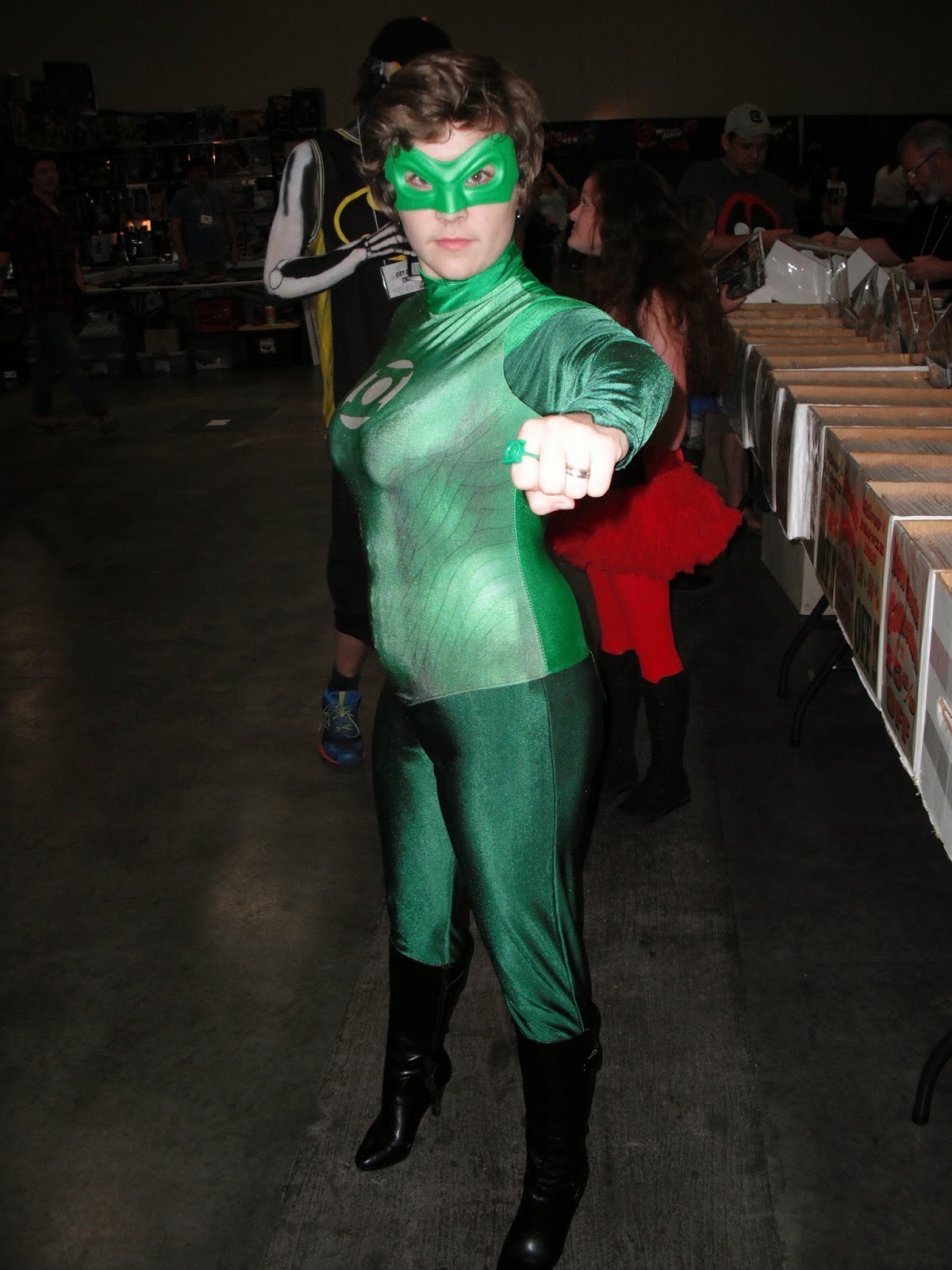
Geeks have been dominating movies and television, and it's no surprise that pop culture affected a lot of fan costuming.  There were numerous characters based on Captain America: The Winter Soldier, Frozen, and The Amazing Spider-Man 2.  Classic characters like Wonder Woman, Catwoman, and different versions of the Doctor mingled with folks from Teen Titans Go!, Game of Thrones and The Walking Dead.  And since Deathstroke has been the main villain on Arrow, it's no surprise that multiple versions of him were at XCon World VII.


Change is inevitable from year to year at the convention -- this year there were a lot fewer t-shirt sellers and a lot more vendors with bootleg dvds -- but, alas, some of the problems with XCon World remained.  There were no classrooms or sealed areas for panels, resulting in a lot of noise pollution either from being surrounded up on the main stage, or from passing traffic in the outside tent.  With only two areas for panels, there wasn't that much offered, resulting in a lot less time picking where to go and a lot more time circling the convention floor.  Instead of spending the whole day there, you could pick one or two panels of interest, go around the convention area once or twice, and be done for the day in just a few hours.

But even with those flaws, XCon World VII was still pretty fun.  I talked to a lot of interesting people, I loved the costumes (not to mention that this was the first time I saw people dressed as Jesus and a piece of watermelon), and I look forward to going there next year.  Probably not on a motorcycle, though...


Written by James Lynch