Showing posts with label Väsen. Show all posts

11.24.2009

Väsen, Väsen Street (NorthSide, 2009)


Over the past fifteen years, no band has epitomized new Swedish folk music more than Väsen. A superior live act with an unsurpassed sense of instrumental interplay, Olav Johansson (nyckelharpa), Mikael Marin (viola), and Roger Tallroth (guitar) have built up enough of a following internationally that the organizers of the Lotus World Music & Arts Festival have started lobbying the town of Bloomington, Indiana to name a street after them. Whether their efforts come to fruition or not, Väsen Street can be enjoyed by anybody for the price of a typical CD.

On the new album, Väsen provide the usual assortment of self-composed and traditional polskas, schottishes, and waltzes. The schottishes (bouncy tunes in 2:4) get a bit more emphasis than usual, and "Garageschottis" is my favorite track on the CD. There are a couple of twists on Väsen Street as well. "Absolute Swedish" veers off in a bluegrass direction about halfway through, with the assistance of American musicians Mike Marshall (mandolin) and Darol Anger (fiddle). "Hagsatra Brudmarsch" was originally composed for Mikael Marin's wedding and played by a wedding orchestra; for the recording, Väsen are joined by Marin's wife Mia (from the band [ni:d]) and Emma Reid on fiddle, along with frequently recurring fourth member Andre Ferrari on percussion.

Otherwise, anybody familiar with Väsen will know exactly what to expect. This is something of a mixed blessing, as dependability often goes hand in hand with predictability. And their recorded output, good though it is, still doesn't match their phenomenal live shows. Having said that, on Väsen Street the band continues to meet the high standard of musicianship they've set for themselves, and if you like the sound of Swedish fiddle music at all, then it's impossible not to love Väsen.

Overall grade: B+

reviewed by Scott

Hey, I was there! Väsen performing what would become the title tune of their new album at the 2008 Nordic Roots Festival in Minneapolis.

10.11.2008

Nordic Roots Festival 2008, Cedar Cultural Center, Minneapolis MN, Sept. 26-28 2008


The last weekend in September marked a milestone in the appreciation of world music in the United States. The Nordic Roots Festival convened for the tenth consecutive year at the Cedar Cultural Center in Minneapolis, and once again fans of New Nordic Folk music traveled from across the country to attend. Most of the people attending the Festival were already aware that the 2008 edition would be significant for another reason -- this year would be the last with an all-Nordic format. I can't really object to the decision, honestly. The genre of New Nordic Folk has a handful of guaranteed draws, namely the Finnish band Värttinä and the Swedish groups Väsen, Hoven Droven, Hedningarna, and Garmarna. Last year, the Festival couldn't get any of the obvious headliners. Given all the expenses and difficulties that go into putting the Festival on, there were a distressing number of empty seats even for the night shows. So I don't really think preserving the status quo was sustainable over the long haul. This year, though, the Festival succeeded in getting Väsen, Hedningarna, and Hoven Droven to headline the night shows. That combination, plus the knowledge that the Festival would change after this year, resulted in a record number of festival passes being sold in advance.

Annbjørg Lien with her quartet

Friday night's show commenced with Norwegian fiddler Annbjørg Lien leading a performance of her most recent project, titled Waltz with Me. I've already discussed the CD here, so I'll refer you to that if you want to know details about the music. Lien's quartet for the evening included two Americans, Bruce Molsky (fiddles, banjo, guitar, vocals) and Tristan Clarridge (cello), along with veteran Swedish fiddler Mats Edén (fiddles). The performance was solid, if somewhat predictable given my familiarity with the CD. While Lien has performed at the Festival several times, this was the first time she actually sang, doing the parts that a guest vocalist did on the album. You could tell that she doesn't have as much confidence in her voice as she does in her hardanger fiddle playing, but she handled herself well enough.

Väsen

Always a sublimely good live act, Väsen took the stage shortly afterwards and didn't disappoint. Olav Johannson (nyckelharpa), Mikael Marin (viola), and Roger Tallroth (12-string guitar) are superior musicians who just have this special chemistry together. They made a point of acknowledging not only Rob Simonds, the founder of NorthSide Records and driving force behind the Festival, but also the Festival audience for their unyielding loyalty and affectionate support. "We all talk about you back home," they said. Several other performers would make similar statements over the course of the weekend.

Saturday began with a pair of workshops, the first of which was held by members of the band Frigg. The tune they taught was "Vankarin Polska," which I had already learned when I was in Maine in August. I could still use the practice, though, and then they invited everybody at the workshop to come onstage and play the tune with them during their Sunday afternoon set. Well now, this weekend just got more interesting. I also sat in on Annbjørg Lien's hardanger fiddle workshop; I don't play the instrument myself but I know several people who do, and I had my digital recorder with me.

Triakel


The Saturday afternoon show featured Triakel, a Swedish trio featuring Garmarna's Emma Härdelin (vocals), Hoven Droven's Kjell-Erik Eriksson (fiddle), and Janne Strömstedt (harmonium). Hardelin and Eriksson may take some rather big liberties with the tradition in their more famous other bands, but Triakel is about as traditional as New Nordic Folk gets. This is common with Scandinavian folk musicians, especially the younger ones; they tend to have multiple projects going on, some of which are firmly rooted in the tradition, and some leave plenty of room for experimentation. Triakel's set consisted of traditional songs from their home region of Jämtland, with subject matter ranging from the humorous to the quite dark. They might not be as exciting as some of the other groups, but their combination of professionalism and charm was pleasing nonetheless.

Detectivbyrån

The lone newcomer in this year's Festival was a Swedish trio called Detectivbyrån. My friends Mai and Pam bumped into them on the way from the airport to the hotel on Thursday, and assured me they were really nice guys. Indeed, one of them came over to us as they were setting up their gear before the Saturday night show, and asked if we could take pictures for them on his brand new camera. I got several shots for them over the course of their show, and I also filmed their opening tune. I'm kind of hoping it shows up on YouTube at some point. With a glockenspiel, accordion, drums, and some synthesizers, they weren't folky in the same way that the rest of the bands were. Then again, their sound is so impossible to categorize that they fit in just as well at the Festival as they would any place else. Plus, the Festival has as open-minded an audience as you're ever going to find, and we've always appreciated music that's a little bit different. Detectivbyrån rattled off one goofy, off-kilter waltz after another, and won over the audience pretty easily.

Hedningarna

The mighty Hedningarna headlined the Saturday night show. Hedningarna were one of the essential bands of the 90's from any genre, whether performing as a mostly instrumental group or with the help of two Finnish women singers. (Their 1994 CD Trä and their 1996 CD Hippjokk would get A+ ratings from me.) They've been mostly silent this decade, but they still embody Scandinavian folk music at its most viscerally primal. The instrumental core quartet, led by founding members Anders Norudde (fiddles, winds, pipes) and Hallbus Totte Mattson (lute and hurdy-gurdy), got to pretty much all the good stuff in their repertoire. Their combination of Medieval instuments (including Norudde's vast assortment of homemade keyed fiddles) with heavy metal distortion and the atmosphere of a rave will startle the uninitiated, but the Festival crowd got exactly what they paid to hear.

Frigg, by themselves


The workshop students take the stage (photo by Mai Kiigemagi)

And that's me in the back (photo by Mai Kiigemagi)

I'd been fantasizing about taking the stage at Nordic Roots for quite some time, and on Sunday afternoon I got the chance. Now, I should acknowledge that Frigg performed by themselves for most of the show and did just fine. They had a very good new CD (already reviewed here) to plug, but got to plenty of their older "hits" as well. And then the stage got awfully crowded. There were at least twenty-five of us up there, including the band. I stood next to Frigg's cittern player, Petri Prauda, mainly so I could see what chords and stuff he was playing. (I was playing my bouzouki, which is very similar to a cittern.). Given the number of amateur players and the speed of the tune, I thought we sounded pretty tight. Mai said she could hear me, and that apparently wasn't a bad thing.

Hurdy-Gurdy

And finally, Hoven Droven

Sunday night brought the last show in the last Festival in an all-Nordic format. The opening act was Hurdy-Gurdy, a duo consisting of Hedningarna's Totte Mattson and Garmarna's Stefan Brisland-Ferner. As odd and archaic as the hurdy-gurdy looks, it's a remarkably flexible instrument. And when put in the hands of two creative musicians with and endless supply of amplifier pedals and other assorted electronic gadgets, the effect is pretty mind-blowing. Between sets, the chairs were pushed off too the side. Everybody who'd seen Hoven Droven at the Festival knew that they dislike playing in front of a seated audience, and that the chairs were going to get moved sooner or later anyway, so the Festival decided to simply take care of it beforehand in as orderly a fashion as possible. As things were being set up onstage, a couple of members of Hoven Droven teamed up with Annbjørg Lien and Mats Edén to form the Cedar Spelmanslag, who played some traditional dance tunes out on the open floor. Hoven Droven were their usual hard-rocking selves, running through the most familiar tunes in their repertoire. The highlight for me came when they got everybody to jump up and down during their march "Skuffen," just like we had done during their extremely memorable 2005 performance that became the live album Jumping at the Cedar.

But alas, all good things must come to an end. The Global Roots Festival, as it will be called next year, will feature bands from around the world. I'm curious to see who they get to come and play. It could easily wind up being better than the Nordic Roots Festival, but one way or another it won't be the same. As it stands, I got to eight of the ten Nordic Roots Festivals, and the fact that I kept going back should say more than enough about what kind of time I've had there over the years. It was a great run.

reviewed by Scott

1.04.2008

Top 10 CD's of 2007

Another year, another mountain of CD's reviewed here. As I've finally got all the reviews up, I'll spare long discussions and just link to the original posts.

10. The Born Again Floozies, 7 Deadly Sinners: I had a whole bunch of B+ albums, and room for only one of them in the top 10. (I think I need to make some of my B+ grades into B's, while we're on the subject. Some of the B+ albums were clearly better than others.) Perhaps being freshest in my memory gave this particular CD the needed boost, but chalk one up for novelty.

9. Vieux Farka Touré: The younger Farka Touré picks up his father's mantle with nicely with a lot of groove-oriented guitar playing on his debut.


8. Alamaailman Vasarat, Maahan: Totally frenetic, but also totally original and fun.


7. John Fogerty, Revival: A venerable legend gets mad, gets even, and keeps rocking.


6. Roachford, Word of Mouth: It will take more than my word of mouth to get Roachford albums released in the U. S. again. Our loss.


5. Kíla, Gambler's Ballet: Another album not yet released here, but at least I have hopes for this one.


4. Gomez, How We Operate: I know, this came out in 2006, but it would have cracked last year's list had I known about it. So it's on this year's list instead.


3. Väsen, Linnaeus Väsen: A great live act in either format, but their albums as a quartet have always worked a little better for me than their albums as a trio.


2. Ranarim, Morning Star: Two Swedish albums in the top three. Deal with it.


1. Black Rebel Motorcycle Club, Baby 81: Essential hard rock from a band that keeps getting better.


reviewed by Scott

9.20.2007

Väsen, Linnaeus Väsen (NorthSide, 2007)


The Swedish folk group Väsen began their career in the early nineties as a trio, with Olav Johansson playing most of the melodies on a Medieval keyed fiddle called a nyckelharpa, Mikael Marin providing counterpoint on the viola, and Roger Tallroth supplying rhythm on the twelve-string guitar. They quickly developed a very dedicated following among fans of the traditional fiddle music of Sweden, due largely to the tremendous on-stage musical chemistry between the three members. Väsen soon found themselves in the vanguard of the new Nordic folk movement, which brought contemporary interpreters of Scandinavian music around the world to audiences for whom the styles of music had, up to that point, been largely unfamiliar. Near the end of the decade Väsen decided to expand their sound by adding percussion, and André Ferrari was brought into the fold. Purists might not have known what to make of Ferrari, but Väsen's 1997 CD Whirled remains one of the definitive albums of the new Nordic folk genre, and their live shows were nothing short of superb. Ferrari balked at extensive traveling in the aftermath of 9/11, though, and Väsen have spent most of this decade recording and performing as the original trio. But for the first time in eight years, Ferrari went into the recording studio with the rest of Väsen, and the new CD Linnaeus Väsen is the result.

The concept for the new CD, curiously, revolves around the renowned eighteenth century Swedish botanist Carl Linnaeus, the founder of the system of scientific nomenclature used in modern biology. Described by biographers as having "no ear for music," Linnaeus nevertheless came from a family of musicians and was an avid dancer of polskas. Most of the tunes performed on this CD have some connection to Linnaeus, and would have likely been recognized by him. In fact, the opening tune "Carl Linnaeus Polonaise" was composed for him by his brother-in-law, Gabriel Höök.

The music on Linnaeus Väsen maintains the same high standard that the band have always set for themselves, whether as a trio or a quartet. As before, Ferrari makes his presence most strongly felt on the more energetic pieces. The highlight for me is "Grevilius' Polonaise," a polska taken from the notebook of a prominent fiddler from Linnaeus' home village of Växjö during the time Linnaeus would have been attending secondary school. This particular piece has a strong melody that lends itself well to the kind of dynamic shifts at which the band has always excelled. Ferrari's ominous pounding propels a breathtaking set of marches from the playing of Linnaeus' great uncle, Sven Tiliander. The brilliant interplay of the viola and percussion underneath the melody on "Söderblom's Polska" showcases the band's willingness and ability to innovate with traditional music.

Some people might be partial to the trio version of Väsen over the quartet, but while they've always been fantastic in concert regardless of which line-up I've seen, I always felt that the quartet did a better job of matching their live energy on disc. In that regard, Linnaeus Väsen picks up right where Whirled and 1999's Gront left off. Long-time fans of the band shouldn't need my recommendation to go out and get this, but anybody unfamiliar with the folk music of Sweden will find this an enjoyable introduction.

Overall grade: A-

reviewed by Scott

10.12.2006

Nordic Roots Festival 2006


Since it's inception in 1999, the Nordic Roots Festival has lured fans of Scandinavian folk music from all across the country to spend a weekend each year watching world class musicians perform at the Cedar Cultural Center in Minneapolis. This was the sixth of the eight Festivals that I've had the pleasure of attending. A big part of the Festival's enduring appeal is that it has the air of a family gathering; at this point I look forward to seeing a lot of familiar faces, both on the stage and in the audience. The performers also come very eagerly, as they have a hard time finding audiences this receptive to their music even at home. And of course, there is the music. The genre of new Nordic folk music has a lot of original and creative performers putting their own distinctive stamps on a tradition rich in quality music, and all of the best acts have shown up at the Festival at least once over the years.
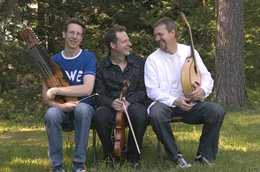
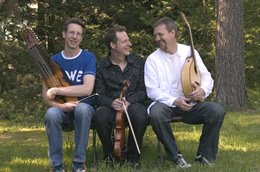
For the first time since 2001, the Festival began on a Thursday night instead of Friday. Performing on Thursday night were frequent Festival headliners Väsen. Simply put, Väsen are one of the planet's great live bands, due to the unmatchable onstage interplay between nyckelharpist Olav Johansson, violist Mikael Marin, and guitarist Roger Tallroth. For this show the trio added a bit of a twist to their usual set by inviting up American fiddler Darol Anger, with whom they've recently been collaborating. Anger brought a quirky, jazzy sound to Väsen's arrangements, adding a few solos above the band's backing. I welcomed the change of pace as a fresh look at a lot of material that is very familiar to me at this point.
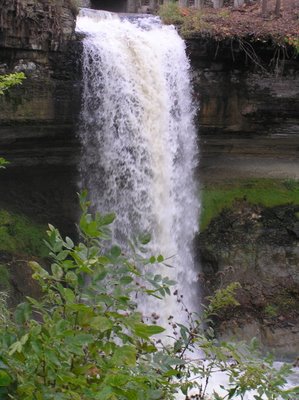
Given that there were no shows on Friday afternoon and I had a rental car, Friday was an ideal time to go exploring unfamiliar parts of Minneapolis. My friend Mai and I settled on scenic Minnehaha Park in the southeastern corner of Minneapolis. The beautiful falls inspired Longfellow's "The Song Of Hiawatha," and continue to leave lasting impressions more than a century later.
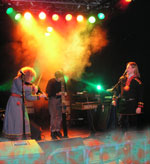
Friday night's concert began with the Festival only first-time performers, Vajas. Vajas are three Sámi from the extreme north of Norway. Like the Finnish Sámi performer Wimme, Vajas combines modern electronics with joiking, a traditional Sámi style of wordless singing. Joiking reminds many people of Native American singing, a connection that does not appear to be lost on Vajas singer Ánde Somby; he composed much of their debut album Sacred Stone in the heat of the Pima Desert in Arizona.
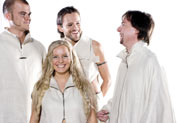
Vajas were followed by Gjallarhorn, from the Swedish-speaking region of Finland. Gjallarhorn's 2000 CD Sjofn is one of the essential albums of the new Nordic folk genre, and one of the best albums of any genre in the present decade. Only singer Jenny Wilhems remains from the Sjofn line-up, but Gjallarhorn still sets Medieval ballads to modern arrangements heavy on percussion and bass droning. The biggest change in their sound comes from the replacement of the Australian digeridoo with a more tonally flexible baroque instrument called the sub-contrabass recorder. It's weird and wonderful both in its look and its sound. Its player, Göran Månsson, jokingly informed the audience that it was available at Ikea in both white and black. Gjallarhorn's set focused on material from their new album Rimfaxe, which focuses on the role of the horse in Nordic mythology. (A legendary horse whose name ends in "faxe"? That sounds awfully familiar, wait don't tell me...) The new material sounded excellent in concert, and Wilhelms is a powerful singer in spite of her diminutive size.
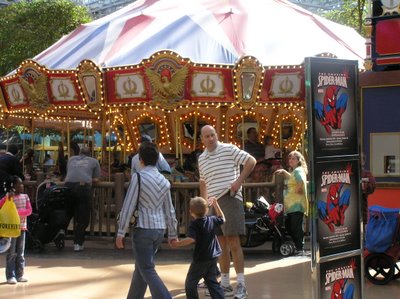
With no guitar workshops to attend this year ( there were a pair each of voice and fiddle workshops, though), I had more time to explore Minneapolis on Saturday afternoon. My girlfriend Donna arrived on Friday night, and she was eager to see the Mall of America. The mall is, well, big. It has an aquarium, a dinosaur exhibit, and at least one indoor amusement park, but we didn't notice anything special or noteworthy from a shopping perspective. Then again, we covered about 5% of the mall in two hours.
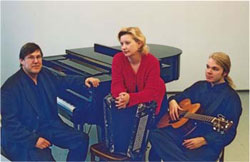
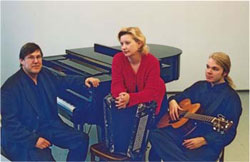
Saturday belonged to the Finnish performers, particularly the outstanding accordionist Maria Kalaniemi. The afternoon set featured Kalaniemi, guitarist Olli Varis, and pianist Timo Alakotila paying tribute to the Finnish tango. Originally from Argentina, the tango was embraced in Finland decades ago, and remains a staple there among both folk and popular musicians. The middle of the floor was left open for dancers, who had a crash course for about half an hour before the show. Kalaniemi's effortless playing makes the accordion sound as graceful as a swan, and her tangos would go over well in any context. She came back in to open the evening concert as a solo artist, occasionally accompanied by Varis, playing pensive, meditative music from her new CD Bellow Poetry. The most striking feature of Kalaniemi's evening set was her newly found willingness to sing. She actually has quite a good voice, but this was the first time I'd heard it. Still, you pay to see Maria Kalaniemi play the accordion, just like you'd pay to see Eric Clapton play the guitar. Anybody who bought the Festival Pass got their money's worth from her twice on Saturday.
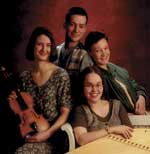
The Saturday evening show was headlined by the Finnish kantele quartet Loituma. Loituma haven't recorded for six years, and haven't really done anything together since 2003. Indeed it seemed doubtful that the band had any future, until something really strange happened. An anonymous blogger posted a little cartoon of an anime character twirling a leek, for no apparent reason, in a repetitive loop. The leek was being twirled to the recording of Loituma's goofy a capella number "Levan Polkka." Somehow, Loituma and the twirling leek made their way across cyberspace, and soon many short films set to "Levan Polkka" could be found online. Interest in Loituma's music soared, and just like that they're playing together again. As they didn't have any new material, their set mirrored what they played when I saw them at the Festival in 2000. This wasn't a bad thing, as I'd forgotten how much I liked them. In addition to being good singers and musicians, they have a good sense of humor and an endearing Finnish charm. Predictably, they closed the main part of their set with their "hit."
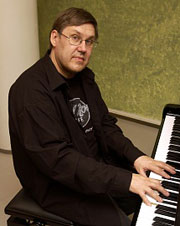
On Sunday morning we visited the Global Market, a quirky mini-mall featuring food and clothing from all sorts of different cultures. It had much more personality in much less space than the Mall of America, if you ask me. And naturally, the lady selling Swedish pastry was going to the Sunday night closing show. In the meantime, Sunday afternoon featured Timo Alakotila performing an off-the-cuff set with a lot of different performers coming up to make guest appearances. Most of the guests were not surprising, given that they were already performing at the Festival. For example, Maria Kalaniemi played some tunes with Alakotila on accordion, as did Swåp's Karen Tweed, who had previously recorded an album with him called May Monday. A few unexpected twists did happen, though, including young fiddle students from the Suzuki program at nearby Augsburg College coming on stage to play a couple of tunes from the repertoire of Alakotila's primary band, JPP.
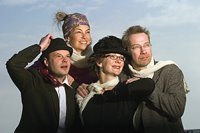
The final show of the Festival featured two bands who've been part of many of the previous Festivals, and are always received very warmly. Swåp consists of guitarist Ian Carr and accordionist Karen Tweed from England, along with Swedish fiddlers Ola Bäckström and Carina Normansson. They always put on entertaining and energetic shows, and this was no exception. The quartet play off each other terrifically, and like many of the Festival acts, they make the crowd laugh between tunes. Unfortunately, Swåp faces a murky future; Tweed had announced on her website that she'd be leaving Swåp at the end of October to focus on other projects. While she was apparently reconsidering her decision at the time of the Festival, there's no guarantee at present that Swåp will perform at the Festival again in this configuration. This would be a shame, but if true, I can take plenty of solace in the memory of many fine shows over the years.
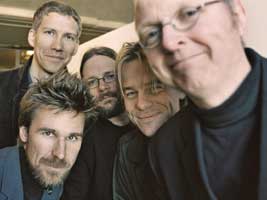
At the 2005 Festival, the Swedish folk/metal party band Hoven Droven put on the kind of show whose legend grows with each retelling, at least among the Festival attendees. The band and the audience fed off each other in a way that I don't think I could do justice describing to anybody that wasn't there. The performance was recorded for posterity, and Hoven Droven's headlining set at this year's Festival coincided with the CD release of that performance, titled Jumping At The Cedar. The band made a brilliantly warped entrance, coming out with banjos and mandolins and singing some country song in English that had really silly lyrics. Then they promptly left the stage, coming back a few minutes later with their usual heavy artillery. The set went over the top at a few points -- perhaps the band tried a little too hard to outdo the previous year's show -- but was wildly entertaining nonetheless. In Hoven Droven's world, traditional polskas can morph into "Manic Depression" by Jimi Hendrix, and nobody thinks twice about it. Given that the Festival was otherwise mellower than normal, the crowd by this point was eager to release some energy, and the band had little difficulty working them into a frenzy. The seats were put away halfway through the set, and the party just picked up steam from there. I guess I'd have to put their 2005 show ahead of this one, as what happened that night was something almost impossible to duplicate, but Hoven Droven certainly left the crowd satisfied again.
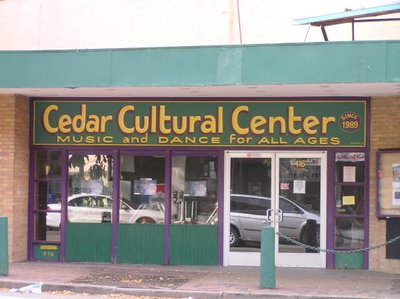
As usual, I didn't really want to go home the following morning. But next year's Festival is well into the planning stage, and I'm already counting the days.

Digg This
Del.icio.us