Showing posts with label WEB Griffin. Show all posts

4.04.2008

Men At War, Book III, The Soldier Spies

We turn our attention, once again, to to the Men At War series by author WEB Griffin. Our regular readership will recall that I've recently reviewed book one of the series, The Last Heroes, and its followup novel, The Secret Warriors. This Men At War series focuses on the role of the Office of Strategic Services (OSS) during World War II.

It's pretty obvious by this third novel, that this series is done before the more masterful works by this author. Like listening to a debut album of your favorite musician, or watching a high school game from a professional athlete, clearly the writer was still learning his chops. Much of the later formula is followed, but it is still getting developed here, and doesn't quite have the same smoothness found in The Corps or The Brotherhood series.

In The Soldier Spies, we have two basic plots intertwining. The first is the plan to nab a German scientist and his daughter that is involved in their jet engine production. They reasonably figure that if they grab their metallurgist, they can back work what they're using, and bomb the heck out of the factories and mines that produce it. This story is told from both the Allies and Axis side. At times it's a bit much as griffin insists on using the German ranks, ad nauseum, and I'm still not exactly sure what an Obersturmfuhrer is, for example (and I shouldn't need the Wikipedia to understand a novel). In later works, he uses footnotes liberally to explain this minutiae, and more than a few of them are an interesting read on their own. However, this time around, we're on our own.

The other basic plot involves the effort to destroy the German submarine pens. With concrete reinforced roofs, Allied bombs bounced off with little damage, and suffered heavy losses from Nazis fighters and antiaircraft fire. There was also the matter of "pilotless bombers," better known as missiles that were in their infancy. The Allies countered with a plan to develop remote controlled bombers that could deliver a larger payload of explosive to the target. Of note, Joseph Kennedy, Jr makes a cameo as being involved in this project.

Any Griffin novel always has a few side trips. In The Soldier Spies there are two that stand out. The first is when a senior naval officer goes along on a B-17 for a bombing run into Germany. While he is an observer, he has to step up to the plate and attempt to pilot this large bird home even when he has no multiengine flying time. The other is the talk about "General" Fertig. I put his title in quote because this guy was a Lt. Colonel in the Army Engineering Corps who after the Fall of Bataan in the Philippines didn't surrender, promoted himself to Brigadier General, and led a resistance against the occupying Japanese that not only proved General MacArthur wrong, but did influence the course of the war as the Japanese had to devote resources to dealing with this resistance. Fertig is a fascinating character, and he also comes up in another Griffin work, Behind the Lines.

Despite many parts of The Soldier Spies being good, too much of it isn't. The sum of the parts isn't any greater, unlike much of this author's works. I'd recommend that readers start with Griffin's other works first.

Grade: B-

Reviewed by Jonas

You can read the beginning of the novel here.

2.25.2008

Men At War, Book II, The Secret Warriors

After starting off the Men At War series with The Last Heroes, it was time to turn my attention to the second book in the series, The Secret Warriors. This chapter in the role that the OSS played during WW II pushed the plot along with most of the major characters returning for another tour of duty.

The book starts and ends quite strongly, with the level of action and intensity that this author is known for. Much of the plot focuses on obtaining the uranium needed for the first atomic bombs. I never really thought about it, but the ore needed for the uranium, at least suggested in this book, came from a mine in Africa. More specifically, it was from the Belgian Congo, and was swiped from under the nose of the Germans, and smuggled out on a cargo plane. It's quite an interesting tale to hear how this was accomplished, at considerable peril. There are also some interesting cameos along the way including Charles Lindbergh (an aviation consultant during WW II), and Joseph Kennedy, Jr.

The downside of The Secret Warriors is that it sags for much of the middle, with a confusing cast of characters that make you wonder who the main players even are at times. In addition, Griffin's writing style, a terse, newspaper one, doesn't necessarily add to the excitement at times. To the best of my knowledge, the first four books of the Men At War series were originally published under a pseudonym, and while it is recognizable as Griffin, it's hardly the author's strongest work.

Grade: B-

Reviewed by Jonas

1.25.2008

Men At War, Book I, The Last Heroes

Lest you were worried that I ran out of WEB Griffin books to read, have no fear! I've started 2008 off right with the Men At War series, and took a look at the first book, The Last Heroes. Let's see, Griffin has focused on Army life in The Brotherhood series, on Marine life in The Corps, so we're due for the Navy, and that is what The Last Heroes focuses on. However, before we start humming "Anchors Aweigh," it's more focused on the OSS (Office of Strategic Services, the precursor to the current CIA), and naval aviation, with sprinklings of lots of tales that we've touched on before.

The novel starts in the early summer of 1941. It appears that America's involvement in the war seems inevitable, and preparations are being made. These include President Franklin Roosevelt putting Wild Bill Donovan in charge of setting up the OSS (interestingly a lifelong friend, law school classmate, and diehard Republican). While each of the branches of the service would collect intelligence relevant to them, for example the US Navy's intelligence branch keeping up on the strengths and weaknesses of foreign navies, no one really had the entire picture of what was going on with enemy countries. Hence the need for the OSS.

Against this backdrop, Griffin writes a tale of the chosen service members that get involved with the newly forming OSS. In The Last Heroes, we get taken from Washington DC, to an American private air wing fighting the Japanese over China, to Morocco, and even a stop in the Philippines. Griffin manges to work in some info about General MacArthur that didn't make it into The Corps series. Another theme is collecting uranium for a nuclear bomb.

My criticism of this novel is that for the small size of the book, there's too much going on with too many characters. I can see plenty of groundwork being laid for future plots and relationships, but it ends up being a little confusing at times. Still, at this writing, there's 6 novels in the series, and with Griffin's son cowriting the last two, I'd expect this series to outlast the author.

Overall Grade: B

Reviewed by Jonas

Also reviewed:

The Secret Warriors, Men At War, Book II

12.07.2007

The Hostage (2005)

Once again, I turn my attention to author WEB Griffin, the "poet laureate of the military." Having finished The Corps series, The Brotherhood of War series, and most recently, the Honor Bound series, it was time to turn my attention back to his most recent series, the Presidential Agent one. My entry into this one was less than spectacular, with By Order of the President, but after an extended hiatus of a year, I was determined to press on, and I'm glad I did.

The Hostage is a much stronger novel than its predecessor. With the background information out of the way, full force can go into the storytelling, with a few occasional side trips, such as why an American WW I General's statue is outside of a European embassy. The protagonist is again Major Charley Castillo, a first rate hero. While his role was less defined previously, he now is attached to the Department of Homeland Security under some cover division. He really is at the order of the President to get the job done, and cut through the bureaucracy. Increasingly, Castillo reminds me of Scott Harvath from the Brad Thor novels.

That said, this time out, he has his work cut out for him. A US diplomat has been murdered, and his wife taken hostage in Argentina, and the clock is ticking to find her with not . At points, there are plenty of references to places in Argentina that get referred to in other Griffin novels, so this kind of felt like going back to the old neighborhood (there's also a curious reference to an old, twin engine plane that fits the description of Lowell's from The Brotherhood of War series, but not specific enough to know if it's of any significance).

As the story unfolds, we get a glimpse into the corruption that went on during Iraq's "Oil for Food" program. In the end, while some poor Iraqis got some meager food, the administrators took more than their reasonable cut of the profits.

What we end up with is an international thriller, centered around Argentina, with multiple stops in Europe and in the United States. The prose is sharp, and this is quintessential Griffin. It still is not my favorite novel by him, but it's a big step up from the series. I'm looking forward to The Hunters, which is currently his latest book.

Overall Grade: B+

Reviewed by Jonas

11.09.2007

Secret Honor (1999)

After reading, Honor Bound, and Blood and Honor, it was time to read Secret Honor which concludes the series, well kind of, but we'll get to that in a minute.

You may recall that the Honor Bound series, as the author refers to it, focuses around Clete Frede, and his efforts in the OSS in Argentina during WW II. Those looking for that aspect of the story do get it. We follow Frede, who has gotten Dorotea "in the family way" and needs a shotgun, no make that sooner rather than later, wedding ceremony to make things right. Money talks to the Church, and the usual year of mourning after the death of his father is waived as his family provides significant funds to the local Church. All in all, there was much description of the events leading to the wedding, so I was a surprised, and even disappointed that the ceremony itself was only briefly described.

In fact, only about half of Secret Honor takes place in Argentina. In typical WEB Griffin fashion, after getting us interested in one main character, he then focuses on another one. This time it's Peter, a decorated German officer in Argentina. After he comes under suspect after a German resupply mission goes bad, and he gets ordered back to Germany for an investigation. Interestingly, he really is an Argentinian sympathizer, and he shares his father's goal to assassinate Hitler. Apparently, at least a few German officers felt that the war was not just, saw the concentration camps for the atrocity that they were, and realized that the Axis was going to lose the war when it was all said and done. The two things they did about it were to stash money overseas (which came up in the previous novel), and to plot against their leader.

While Peter is in Germany, we do get some fascinating side trips. One is a trip to Hitler's secret bunker complex, where the decorating was all done with bomb proof cement. I've seen a History Channel segment on this, but it was great to read the author's descriptions as well. The other is a trip to the development facility of the Messerschmitt Me 262, the first jet fighter aircraft. The history of this plane is fascinating, as well as how its potential was not realized early enough during the war. Still, while this airfield makes for an intriguing pit stop, it really doesn't integrate well into the rest of the overall novel, or the series.

At the end of the novel, we kind of just stop. After several years, and no follow up, I think that we should consider the series complete. However, it just doesn't feel like it is. Perhaps the book sales were not as robust as planned, so Griffin turned his attention to more profitable projects. That said, compared to The Corps, or The Brotherhood series, the Honor Bound novels simply do not come together nearly as well as they did. While these novels are interesting, they really don't represent the author's best work. Keeping that in mind, Secret Honor is the weakest novel of the series as well.

Overall Grade: B-

Reviewed by Jonas

9.25.2007

Blood and Honor (1996)

After enjoying WEB Griffin's Honor Bound, I moved on to the second novel in this series of three, Blood and Honor. This novel continues the plotline in a highly parallel fashion. Once again, it is set in 1943, in Argentina at the height of WW II. The Germans are coming to the realization that they probably are not going to win the war, and are preparing for the worst- that there will be serious reparations like at the end of the first World War. The plan is to secretly smuggle out some serious cash, and hide it for later use.

The main protagonist is Clete Frede, the almost retired Marine who has a fortune in both the US as the heir apparent to an oil fortune, and in Argentina as the heir apparent to his father's fortune which includes sizable land holdings. Once again, the Germans are sending in a supply ship to aid their Southern Atlantic submarine fleet that has menaced British and American shipping (apparently both Axis & Allies were trading with the Argentinians for wool, beef, and other staple products during the war).

While much of the storyline sounds very similar, this is a completely different novel. In a major (WARNING: Plot Spoiler!) twist, Clete's father gets assassinated very early on, giving Clete a huge inheritance, and a struggle as he delves into his father's life and gets the know the man he barely knew. Also, his girlfriend, Dorotea, announces she is pregnant. Much of the middle of the novel focuses on the pomp, circumstance, and ritual surrounding the funeral, and the planning of the wedding (an interesting point/counterpoint of life and death). It turns out that the father was also involved in planning a coup d'etat, and this comes to fruition in Blood and Honor as well (it would appear that Argentina has more regime changes than most other countries...).

Don't think that this book doesn't have any military content. Clete still works for the OSS, and is involved with planning and executing the mission of finding the disguised sub tender. To that end, he needs a plane. In typical military fashion, the hardware he wants (this) isn't available, but he gets something "just as good," (this, which you can see is a lot bigger) which ends up presenting its own set of challenges as he has no experience in the larger plane, and it's too big for the improvised dirt runway. Finally, at the end, just when I expected the sinking of the ship, this novel goes off in a Godfather direction, and goes for revenge in a matter of fact way.

This longish novel did take me a while to get through. It's also a little confusing as there are several lengthy formal names both of Spanish and German derivation that did slow me down at times (especially the German ones). It is an enjoyable break from the traditional war novel genre, yet it incorporates some of the essential elements and quite simply defies a neat category.
The prose is especially strong, with crisp details that paint a descriptive picture in a concise fashion which is one of Griffin's signature items. This author also incorporates, in italics, the individual characters thoughts that combine in both the third person, and first person point of view simultaneously, which few other authors even attempt, and even fewer successfully pull off. At times I feel like this Honor Bound Series is like reading a script for a television mini series, and I can't wait to read the conclusion, Secret Honor.

Overall Grade: B+

Reviewed by Jonas

9.04.2007

Honor Bound (1994)

Following a brief hiatus from WEB Griffin, it was time to delve into another of his series. After all, I had finished The Corps, and The Brotherhood of War, but still didn't want to get back into the Presidential Agent series. After finishing his longest series, it was time to look at his shortest series, Honor Bound.

Honor Bound starts with a brief look at the Marines on Gaudalcanal, and even uses a character from The Corps series, Colonel Dawkins, in a cameo appearance. The connection with The Corps quickly ends, and a Marine aviator ace, Captain Clete Frede, who should be on a war bond tour gets pressed into service. The plot focuses around this Frede character, and how he ends up in the OSS, the forerunner of the CIA that is a common thread that permeates many of the Griffin novels (and also the film, The Good Shepherd).

Interestingly, this OSS had jurisdiction throughout the Western hemisphere, including Latin America. Now, while my knowledge of WW II is pretty good, I can't say I'm well versed in what went on in South America during that war. Seriously, the last time I studied Argentina and Brazil, it was high school global studies class! The author, Griffin, winters in Argentina, so he's picked up some first hand knowledge, and it clearly shines through here. Even though Argentina was officially neutral, there was a significant Nazis involvement down way south. For the plot of Honor Bound, the Germans are running submarine supply out of Argentinian waters, all on the QT- except the OSS knows.

The decision is made to send a small group of Americans to disrupt things for the Germans, without bringing the war down to Argentina. This Clete Frede is an interesting character as he is half American, and half Argentinian by descent. This reminds me of the protagonist of the Presidential agent series who also has mixed blood, and therefore uncertain allegiance.

Honor Bound successfully transports us to a far corner of the world, during a tumultuous time in world history. It is a novel less about war in the end, and more about what it takes to mount a clandestine operation in a foreign country, without getting caught. It is definitely not the standard WW II novel with the marines charging up the hill. There is a lot of culture, and place setting. This novel builds in the first 100 pages at a slow pace. Once the freight train gets moving, it is quite intriguing. I'm already working on tracking down the next novel in this series, Blood and Honor.

Overall Grade: B+

--Jonas

7.06.2007

Retreat, Hell! (2003)

I’m happy to report, that after under a year of reading (with a few interruptions…), I’ve been able to finish the ten part series of The Corps. The final part is entitled Retreat, Hell! and I enjoyed both the novel, as well as the entire series quite well.

The title of Retreat, Hell! is based on the famous quote during the Korean War when the Americans were pulling back from North to South Korea: “Retreat, hell, we’re just advancing in a different direction!” The final part of the saga focuses around the Korean conflict, and how the Americans advanced north of the 38th parallel in pursuit of the North Korean Army in the Fall of 1950. We have much of the usual cast of Marines including McCoy, Zimmerman, both Pickerings, and even Banning. We get an inside look at the politics around General “El Supremo” MacArthur, who President Truman realizes is a double edged sword, but keeps over there to prevent him for running for the Presidency. We also get to learn about CIA operations behind enemy lines that generate information about the Chinese presence in North Korea that was hidden from other military intelligence and reconnaissance. This part of Retreat, Hell! was pretty much what I expected without any great surprises.

However, much of this novel concerns itself with military healthcare. Griffin has touched on some of these issues before, but never at such length. We get an inside glimpse into the healthcare for our nation’s wounded, both physically and emotionally. I can also say that the author did a great job of integrating this into the narrative, and I can take no issue with any of the medical facts of the story so he must have done his homework.

Retreat, Hell! is a wonderful read. While it doesn’t stand on its own, it brings together a lot of the other novels, synthesizes, and finishes well. While it ends with some future directions for the characters, my only criticism is that the story doesn’t really feel complete. It’s been four years, and no other novels seem to be planned for the series, but I could definitely enjoy these characters for at least another novel or two. I’d love to read about MacArthur’s relief of command which occurred a few months after the novel ends. Does General Pickering stay with the CIA after the war? Does McCoy ever rise in rank above Major? What happens to the CIA after the Korean War? How about when one of those Marine Corsairs encounters a Russian MIG jet? If the mark of a good author is that they leave you wanting more, than Griffin has done a splendid job.

W.E.B. Griffin, in the afterword of the novel, shares with us that he had two excellent sources for these novels. The first is that he was a combat correspondent during the Korean War which gave him access to plenty of source material. The other is that he was personal friends with Lieutenant General Ned Almond, one of MacArthur’s inner circle, better known as “The Bataan Gang.” With this level of access to first hand and not generally known information, I can comprehend why this series is so rich in inside information that’s not found in the history books or on Wikipedia.

Preliminary Grade: A+


Final Comments on “The Corps” Series

Now that I’ve finished both The Brotherhood of War, and The Corps series, I can draw some conclusions. I think they both are excellent, but overall The Corps is the stronger series. This is because it is better organized, and it moves forward in a more linear fashion with really no backtracking that characterizes Brotherhood. The Corps is less ambitious in the years of the story taking us from the Shanghai Marines from 1938 on up to the Korean War in 1950. Brotherhood on the other hand starts in the middle of World War II, but takes us up through the middle of the Vietnam Conflict which spans a longer period. One other slight disappointment is that nowhere do any of the characters from the two series meet. I really was hoping that Killer McCoy was going to bump into Craig Lowell somewhere in Korea! Seriously though, anyone with an interest in the military will enjoy The Corps immensely. The only real downside is that they are addictive, so don’t plan on reading just one. Once started, you can’t be satisfied until all ten books have been read. The author does have some other, shorter series and we’ll be looking at some of those as well in the months ahead.

Overall Grade: A+

6.08.2007

Under Fire (2002)

After enjoying In Danger's Path, and things coming together nicely, I wasn't sure what else to expect out of this series. After all, Under Fire was moving on to the Korean Conflict from WW II, and the series had not previously taken such a big jump in time as it has taken eight books to cover WW II to only 1943.

Under Fire starts with a healthy dose of reminiscing by the Marines of their glory days of the Second World War. In fact, some of them had life after the war in civilian roles, and this book goes through some of that. When a certain Captain (McCoy) warns of an impending North Korean invasion, he is quickly swept under the rug. When in fact it turns out to be very true, the Marines are once again called upon to serve their country. General Pickering is pulled out of retirement to run the newly formed CIA that grew out of the OSS of WW II (this is reportedly the plotline in the film The Good Shepherd that I have and still need to watch). Part of the book concerns itself with the military infighting among the upped echelons in the Pacific theater. I truly would think that General MacArthur, a five star no less, really wouldn't have to put up with much at this point in his career. Griffin however paints a much different picture in Under Fire.

True to many of the other novels in The Corps series, we have some more fascinating, and obscure history. This time it's the preinvasion of the Flying Fish islands with their lighthouse, in preparation for MacArthur's amphibious invasion of Inchon. If the islands were not captured in advance, and covertly, the North Koreans would have had advance notice of the invasion. General Pickering rounds up the usual cast of characters to operate behind enemy lines and quietly take these islands in advance without the North Koreans even realizing it. While this has only come to the forefront recently, it is a quite engaging and intriguing part of the Korean Conflict.

Under Fire is a great read, and I enjoyed it thoroughly. It showcases what WEB Griffin is best at, and despite its hefty size, is hard to put down once started. My only disappointment is that there is only one novel more in the series to go.

Grade: A+

4.20.2007

In Danger's Path

In Danger’s Path is the eighth novel in WEB Griffin’s series of The Corps. While it weighs in at a lengthy 550 pages in hardcover, it is well worth the effort.

The main plot focuses on, true to Griffin’s other novels, a little more obscure history. The US Navy needs better weather information about the Northern Pacific. The Army and their Air Corps also need this same info as they plan ahead for an invasion of the Japanese islands. It is decided that weather data from Mongolia would be helpful to both services. The issue becomes as to which service will mount the mission, and how to setup a weather station in Japan’s backyard, and keep it supplied without the enemy bombing it. While this doesn’t get highlighted in history books, this mission and the weather station is historically true.

Griffin uses this as his starting point for this apocryphal story of some of our favorite US Marines to setup the weather station in the Gobi Desert (imaginatively called Operation Gobi- seriously they should have had a better code name than that!). The storyline divides between General Pickering, now a bigwig at the OSS (Office of Strategic Services, the forerunner of the CIA) in charge of Pacific Operations. We follow the planning stages, and the interservice politics involved in a complicated mission on the other side of the world. There is also a sideline about a potential break in security that results in a shake up among the brass.

The other major plot line focuses on some issues that hadn’t seriously come up from the first novel in this series, Semper Fi. In typical Griffin fashion, he diabolically shelves these storylines on the back burner just until you start to give up hope (or at least forget…), and then he thrusts them into the forefront. More specifically, we hear more about the foreign wives left behind in China from the Marines that were withdrawn before World War II. He also interweaves some chronologically older events into this novel that brings things together. Seriously, anyone that can mesh eight books together into a cohesive plot line must be a master of their trade!

By the end of In Danger’s Path, it is 1943, all of the major characters in the series are featured, and a lot of loose ends get tied together. After eight novels, some of which are not exactly short, we have been taken on quite a tour of the Marines in World War Two. In my view, Griffin probably could have ended the series here. In fact it appears that this is the last of The Corps novels that deal with WW II. However, there are two more novels that head on over to the Korean War, and who knows if there are more coming.

Grade: A-


For reviews of the first six novels of the series, click here. For the seventh novel, Behind the Lines, see here.

2.23.2007

Behind the Lines

In this seventh part of the series, Griffin manages to turn some obscure history into a full blown plot. More specifically, Behind the Lines deals with the guerilla resistance in the Philippines after MacArthur withdrew, and the Japanese occupied the island nation.

With Douglas "El Supremo" MacArthur withdrawn from the Philippines to Australia, most of the remaining US forces surrendered when Corregidor, their island fortress fell. However, there were some that didn't go along with this plan. Wendell Fertig was a lieutenant colonel in the Army reserve, in the engineering corps; on paper an unlikely person to organize and lead a resistance movement. However, he ends up doing just that.

In order to increase his stature among the Filipinos, Fertig self promotes himself to General. Various troops come to join his rag tag group which attack Japanese convoys to procure supplies. With a radio, they attempt to establish contact with their military forces across the ocean.

With Fertig's group back in touch, it becomes a political football as to if and how the US military should assist him. Apparently MacArthur had felt previously that guerilla operations could not be mounted, and didn't want to be proven wrong by an engineering corps light colonel, from the reserves no less.

They decide that with the Army turning a cold shoulder that the Marines can take on the challenge. Also, the newly formed OSS (which eventually evolved into our CIA), also is trying to get involved like "a camel sticking its nose into a tent." In other words, they're not welcome, and even worse, their point man is Macklin, the lying, conniving and cowardly officer that everyone loves to hate from earlier novels in the series. Leading the Marines is Ken "Killer" McCoy, who was introduced in the first novel, but we haven't seen nearly enough of lately. Just to keep things interesting, Macklin outranks McCoy, but will be shot if he impedes the mission!

Also contributing to the depth of the novel, is the way that that Griffin handles the radio codes. By taking us through the various substitution ciphers, we gain a much better appreciation of creating and breaking a code. I’ve often wondered how they work, and now I have an appreciation of the intricacies of creating and breaking such transmissions.

I enjoyed Behind the Line very much. As is typical of Griffin, this work is historically accurate, and overflows with realism. I recommend Behind the Lines to any World War II buff.

Overall Grade: A


For our review of the eighth novel, In Danger's Path, see here.

1.12.2007

The Corps

After enjoying the nine part Brotherhood of War by W.E.B. Griffin, I'm now going to review the ten part series on The Corps. I'm planning on reviewing each novel, but keeping it together in one post, by adding them in. This series of novels follows the story of the Marine Corps through the Pacific theater of World War II.

Semper Fi
This is the first novel of the series. We start in Shanghai, China where the Marines are deployed, and engage in reconnaissance of the Japanese in the nearby area. The principal character is James McCoy, an enlisted man. We learn of his spying activities, and how he reluctantly ends up going through Officer Candidate School, to become a 2nd Lieutenant. He then gets assigned to the Intelligence division Semper Fi finishes with the attack on Pearl Harbor. Griffin cleverly puts McCoy in the aftermath of Pearl, and then in the Phillipines.

This is a very well done novel. The history is all spot on. The writing is succint, and flows. The only criticism I can give Semper Fi is that once it is started, it's addictive, and impossible to put down.

Grade: A+

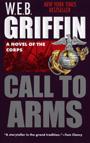
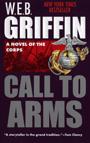
Call To Arms

This second installment develops the series further along the theme of the Marine Raiders. Not to be confused with the football team, these Raiders were an almost forgotten attempt at a Special Forces unit during World War II. If you've never heard of them, you're hardly alone as the author goes through some of the actual history in the preface.

As the Marines are already thought of as an elite unit, the idea of an elite within an elite was quite controversial back in the day. Call To Arms explores some of this controversy. This is done by having now Second Lieutenant Ken McCoy getting assigned to the intelligence division, and then reassigned to the forming Raider division. The novel concludes with a Raider attack on Makin Island which displayed a lot of the weaknesses of the new division and tactics. It was done more for psychological value than true strategic importance against the Japanese.

In the meantime, McCoy's wealthy best buddy, Pick Pickering, ends up in Naval Aviator school in Pensacola, Florida. He also starts to get involved with a widowed Admiral's daughter.

Along the journey, Griffin manages to interweave in some details about the history of the M1 carbine, also known as the Garand.

I was a little disappointed that the story of Wake Island, "The Alamo of the Pacific," got rather glossed over. That said, the rest of the novel is well done, and the interweaving of the characters among the history is masterfully done.

Grade: A

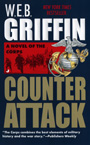
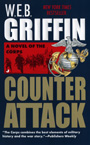
Counterattack

This third part of the saga continues a number of the plot lines from the previous two novels, with its formidable cast of over a dozen main characters. There is one notable exception though- the main character from the last two books, "Killer" McCoy only gets a passing mention or two. Also notable is that we move back in time to Pearl Harbor and Wake Island, now seen through different perspectives.

There is A LOT going on throughout this work. In my opinion, there are two main plot lines in Counterattack.

The first involves Fleming Pickering. He is the father of Pick Pickering that was a room mate, and good buddy of McCoy. He is a fascinating character that was a Marine Corporal during WW I. Also notably, he is a master ship captain, and owns a shipping fleet. While he would certainly contribute to the war effort with his ships, he decides to support the war by reenlisting. What follows is an almost comical look at military politics as he tries to get into another service than where he would be obviously most qualified- the Navy. He ends up, with his considerable political and financial influence becoming a special aid to the Secretary of the Navy. Through a series of letters, we are given insight into General MacArthur, and the military interservice squabbling in the Pacific during WW II.

As if the preceding wasn't enough for one novel, there is a second major plotline that intertwines eventually. This focuses on what were called Coastwatchers. These were civilians on nearby islands that were monitoring the Japanese buildup for a possible invasion of the Japanese into Australia. This is better known in the history books as the Solomon Islands. WW II buffs will know that this culminates in the poorly planned US Marine assault on Gaudalcanal, and Griffin takes us there too.

Counterattack is another well planned and written novel in the series. Lest you think this is all about war, there's a lot of Americana and rich nostalgic touches that interweave to form a unique tapestry. Griffin succeeds at bringing us history in a personal and involving way.

Grade: A-

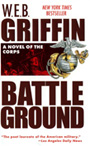
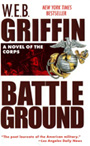
Battleground

Here's two World War II facts:

#1- The Americans had broken the Japanese radio transmission codes.

#2- The Japanese southern expansion was stopped at the Solomon Islands, thereby preventing them from taking over Australia and New Zealand.

While many of us will remember these facts from our history lessons, WEB Griffin is able to weave them into his tale of historic proportions in Battleground, the fourth part of The Corps. It is this weaving of facts among the fictitious characters that make Battleground a real page turner. Also, in typical Griffin fashion, this novel chronologically starts somewhere in the middle of part three. With a new character that eventually gets integrated in, we see the events around Guadalcanal from a different perspective.

About two-third's of Battleground follows Sergeant Moore's path from his initial entry into the Corps, to Guadalcanal. Along the way we learn the value of Japanese language translators, and the importance of intercepting and decoding Japanese radio messages.

The remainder, aside from the Battle of Midway, concerns itself with General MacArthur and his so called court. The author, by cleverly embedding Captain Flem Pickering with them reveals to us an apocryphal look at the inner circle. We also see how there was downright friction between MacArthur, and Admiral Nimitz, the two logistical leaders of the war in the Pacific as the old Army-Navy rivalry plays out.

Overall, Battleground is one of the stronger novels in The Corps series. My only real criticism is that by focusing on newer characters, some of the older crew, like McCoy make only a cameo appearance. No matter though, as we've got several more novels to go in The Corps to get everyone back involved.

Grade: A


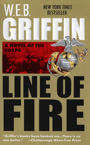
Line of Fire

Line of Fire is the fifth part of the epic Corps series. Our storyline can be divided into three segments.

The first is the introduction of Private Hart (as if we needed another character in this...). He in intriguing because we learn he is a police detective that enlists for the "Marine police" to avoid being drafted into the Army infantry. The only hitch in his plan is that there are no "Marine police" and he ends up having major problems in boot camp. Before too long though, he gets integrated into the rest of the storyline.

The second part involves the senior Pickering. Not content being a reserve Navy Captain, he gets recommissioned as a Marine General. While this is somewhat incredulous, I suspect that it is important to keep him in the developing plot. It also is entertaining as he heads his own "royal court" and the rest now have to cater to his every whim and need.

This leaves us with the third and most significant part of the storyline. The two Marines that got abandoned on Buka, a Japanese held part of the Solomon Islands to operate a radio outpost attempt to be rescued. True to their motto, "no man left behind" a high risk operation, using unconventional tactics gets planned and executed. It is exceedingly well plotted, and I only wonder how much of it is true, because it is an exceptional tale.

What's also nice about The Line of Fire is that all the major charcters get involved. My criticism of the last novel, or two, is no longer valid. This novel is a well integrated and executed advancement of the story of The Corp. Wow, at least we're halfway done with the series!

Grade: A

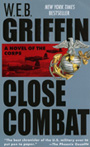
Close Combat

In Close Combat, the sixth installment of The Corps series, Griffin advances the plot, ties up some loose ends, promotes more than a few Marines, and sets the stage for the later books.

Much of the story follows the path of Corporal "Easterbunny" Easterbrook. Apparently, he left his Coppertone on Paris Island to earn his nickname. He gets interweaved among the Guadalcanal story as a combat correspondent. As he only had the bare minimum of prewar reporter experience, he gets a lot of on the job training, and grows up fast. He ends up getting assigned to Major Jake Dillon's team that provides footage for newsreels.

The other main storyline of Close Combat is a War Bond tour. This featured military heros touring the US in an attempt to raise money for the war effort. Apparently, it also boosted the recruiting and enlisting effort as well. While a bond tour may sound a little out of place given the book's title, it works well to juxtapose a group of characters. It also allows Griffin to write about the US during the height of the war with more than a little hint of nostalgia.

Close Combat works very well as a middle novel of this series.

Grade: A

Behind the Lines

See our review here.

In Danger's Path

See our review here.

Under Fire

See our review here.

Retreat, Hell!

See our review here.


Overall Grade: A+


Digg This
Del.icio.us

6.23.2006

The Brotherhood of War: Special Ops

Special Ops is the ninth novel in W.E.B. Griffin's epic Brotherhood of War series. At the very least, not too many series of anything go to this many parts. Of further interest, part eight was published in 1988 (The Aviators), and Special Ops wasn't released until 2001. The belated timing makes this feel more like an epilogue than a finalization or conclusion.

Special Ops is considerably longer than the novels that comprise the first eight parts of the series. The first third of Special Ops cleverly interweaves among some of the earlier novels providing additional detail and enriching the previous plots and characters. The latter two thirds takes off where The New Breed left off. Once again we're in the Congo. This time Griffin chooses to use a somewhat obscure Cuban revolutionary that planned to export Communism to Africa. Several of our favorite special forces characters are there to thwart the spread of the Communists.

On the one hand, it was fun to see how many of the concepts, like Special Forces, Army Aviation, and secret CIA air cargo company get synthesized into a single complicated operation. There were also some characters in previous novels that never quite got their chance in the spotlight that Special Ops provides. On the other hand, unless you have read the previous novels recently, be prepared for some confusion at times, and some significant memory jogging. Also, some of the previous favorite characters play only a minor role in this book.

To conclude, fans of this series will need to read Special Ops. However, it doesn't quite stand alone, and be prepared for a long read to take in this complicated tale.

Overall Grade: B


Also reviewed by W.E.B. Griffin:
By Order of the President

3.21.2006

The Brotherhood of War: The Aviators


The Aviators is the 8th novel in the "Brotherhood of War" series by W.E.B. Griffin. In order the books in the series are:
-The Lieutenants
-The Captains
-The Majors
-The Colonels
-The Berets
-The Generals
-The New Breed
-The Aviators
-Special Ops

The Brotherhood of War series was written throughout the 1980's (although the last book came out years later as a tag on). The novels are closely knit, and don't stand alone, and should be read in order.

The novels follow the careers of a handful of US Army officers through roughly two decades. It starts in the closing days of World War II, and progresses to the middle of the Vietnam Conflict. I got a real sense of day to day army living, as well as the importance of politics in advancing a military career. It is masterfully plotted as the characters paths cross multiple times. There is also plenty of nostalgia and "Americana" thrown in to keep the whole enterprise interesting from the cars, the old airlines, and the product references sprinkled throughout. It is also well done as the characters, as more senior officers, recall their more youthful endeavors, which we, the audience, know from the earlier novels. By the end of the whole thing, many of the characters have the feeling of an old friend of the family.

What is even more fascinating, is that the novels also impart a fair amount of military history. The novels show us the closing days of the European theater of WW II, the Korean War, the Vietnam Conflict, and the lesser known Congo Rebellion. Even more intriguing, the novels chronicle the transformation of the US Army into a much more mobile fighting force able to respond and adapt more quickly. The two intertwined, and sometimes competing themes behind the transformation are Special Forces (focused on in The Berets and The New Breed), and the rise of Army Aviation (focused on in The Aviators).

The Aviators focuses on a Captain John Oliver who becomes General Bellmon's assistant. We know the General, and his entire family well from previous novels. While Captain Oliver is officially the "aide-de-camp," they more affectionately refer to the position as the "dog robber." The Aviators gives us an account of the Captain's role in greasing the gears for the General as they attempt to create an Army air mobile division, against the Air Force's opposition.

Like a retired uncle of senior military rank, Griffin masterfully spins a tale of these officer's lives against the backdrop of the army's evolution. What results is a classic American tale with enough historical accuracy that leaves me wondering if perhaps most of it really is true. Short of signing up for a tour of duty, this may be the most inside of the Army that most of us will get. This is the grittiest inside story of the army that I have read to date. Clear your bookshelf and enjoy!

Overall Grade: A

1.17.2006

By Order Of The President

W.E.B. Griffin has long been revered for his gritty military novels full of insider tales and technical detail of World War II, the Korean Conflict, and the Vietnam War. He paints his characters in fine strokes, and has more believable characters than most Hollywood movies. I have enjoyed his novels previously, including the “Brotherhood Of War” series.

In By Order of the President, Griffin takes his somewhat formulaic approach to military history fiction into the modern age of post 9/11 America. Whereas in his previous works there is no central protagonist, in this novel, there is. Major Charley Castillo is one complicated hero. He is the son of a Vietnam Medal of Honor recipient on his father’s side, with Tex-Mex roots that go back to the Alamo. On his mother’s side, his roots are strongly German. Is it any wonder the kid speaks five languages? Also, Major Castillo is a gentleman soldier, one who does it for patriotism, as he is independently wealthy. Just to make the Major one more step complex, he’s working for Army Intelligence the Department of Homeland Security, and has Secret Service credentials. This larger than life hero can also pilot both helicopters, and airplanes. This is one talented hero we want on our side!

In this first novel of his latest series, the plot focuses on a missing 727 aircraft in Africa. What follows is a harrowing “goose chase” by the US with efforts by various departments coming up short of finding the airplane. The President summons Castillo to cut through the red tape, unite the agencies, and most importantly, find the plane. In short, Castillo’s mission is to prevent “9/11 Part II.” The plot takes us across four continents in search of the 727, and we meet plenty of forgettable characters along the way.

Overall, I wanted to enjoy this novel, but it comes up short. The over 500 page tome, has enough plot only for about 300 pages. A fair chunk of the background gets revealed through long, and expansive flashbacks that sometimes get confusing. The characters are a little less real and believable than in his previous efforts. The novel starts and finishes well, but there is a long, and rather significant lull in the action, where nothing really gets developed. I honestly felt like the book needed some further work to bring it up to Griffin’s previous standards.

All right, enough procrastination for now, what’s the bottom line? If you’re a Griffin fan, and you want something more modern, give it a try, but be prepared to skim along for some of the slower chapters. If you haven’t read this author before, try some of his earlier works first, they are significantly better in this reviewers opinion.

Overall Grade: B-


Also reviewed by W.E.B. Griffin.