
8.30.2007

Kate Havnevik, Malankton (Universal Republic Records, 2007)

Kate Havnevik hails from Oslo, the capital of Norway. She had been working on several different recording projects simultaneously, of which Melankton was the first to get released and therefore qualifies as her debut CD. Havnevik's style is an intriguing blend of pop and electronica with lush orchestral arrangements. In general, Melankton works best when the orchestration gets precedence over the electronics.

The techno/electronica genre boasts a number of noteworthy female singers who have clearly inspired Havnevik and influenced her approach. Havnevik chose a number of prominent producers in the genre to collaborate on the album with her. The most noteworthy of these is Guy Sigsworth, best known for working with Imogen Heap both as a producer on her solo records and as a collaborator in the band Frou Frou. The problem with this is that Havnevik wears her influences very clearly on her sleeve, and some of the songs wind up sounding too familiar. Songs like "Travel In Time" and "It's Not Fair" would have been more impressive singles at the beginning of the decade than they are now.

Havnevik shows a bit more ambition, though, by going to Slovakia and having the Bratislavia Symphony Orchestra record tracks which Havnevik largely arranged herself. The orchestral elements in the songs really stand out, and play to the strength's in Havnevik's voice. In particular, "Nowhere Warm" and "Timeless" are terrific ballads that by themselves more than justify the purchase of the CD. The latter song, which makes very effective use of a repeating four-chord progression, was added to the album after its initial release, to take advantage of its inclusion in an episode of Grey's Anatomy.

Kate Havnevik is a talented vocalist with some promise as a songwriter and arranger as well. Melankton only occasionally succeeds in distinguishing Havnevik from performers with a similar style, though. I'd definitely recommend a couple of the songs, but if you're not a fan of the style of acts like Frou Frou or Portishead or Massive Attack, you'd probably be content to download those songs instead of purchasing the whole CD.

Overall Grade: B-

reviewed by Scott

The Comedians - Graham Greene (1966)

There are some books that make you despair for humanity while at the same time giving you a spark of hope. The Comedians is one such book. Set in the hideous darkness of Haiti under Papa Doc Duvalier, the action of the book concerns the fate of three men - Smith, Jones and the narrator, Brown. Brown is adrift and rootless, an observer rather than an actor; Smith is a vegetarian and a believer in the essential goodness of humanity, who is defeated by Haiti and moves on to the neighboring Dominican Republic; Jones is a con-man who tries to wrestle Haiti on its own terms and ultimately becomes more absorbed by Haiti in his short time there than Brown who has lived there for years.

By having Smith and Jones arrive from, respectively, North America and Europe, Greene is able to have Brown and other characters provide explanations for them of the situation in Haiti and to meditate on the state of politics in small counties - especially poor ones who are at the mercy of big ones, where they are treated as pawns in political machinations. Several pointed references are made to US political policy with regard to Haiti and the corruption attendant on it.

Smith, who had come to found a vegetarian center and help the people, is confronted with corruption, murder by the Tontons Macoute and such appalling chaos that even his optimism cracks and he and his wife depart.

Jones, a rogue, who always seems to land on his feet, is arrested soon after his arrival, then becomes and honoured guest as he tries to run a big con, then becomes a refugee in an embassy after his game is discovered, and finally joins a pathetic insurgency in the hills.

Brown watches it all, and becomes involved only when he must.

The black horror is offset by the shining hope represented by Jones' attempt at redemption and Smith's continual striving for betterment of the human state. Even as the terrible events unfold around the characters, there is a dim flame lighting the darkness. This is a good book, a moving book, by an author of proven talent and power.

Overall Grade: A-

8.24.2007

Various Artists, Stand and Deliver (Noir Records, 2005)

Asleep By Dawn is a magazine devoted to contemporary interpretations of Medieval music. A couple of years ago they made a compilation CD titled Stand and Deliver, from the catalog of performers at Noir Records, for sale and distribution at the Pennsylvania Renaissance Faire. As a subscriber to the folk music magazine Dirty Linen, I had a leftover copy of this disc fall into my hands when I sent in my renewal. The cover art is cheesy to say the least, and you can't help getting the sense that the music on this disc was pulled off of some SCA geek's iPod. But there are actually quite a few good performers out there doing creative things with Medieval music, and several of them are represented here.

The biggest scene for modern Medieval music right now is in Germany, so the ".de" at the end of most of the websites of the bands included in this compilation did not surprise me. Indeed, the CD opens with a fun frenetic song from the most well-known of the German Medieval bands, Corvus Corax, whom I've reviewed here. Germany's folk traditions evidently lean heavily on the bagpipes, as pipes figure prominently on many of the tracks, especially in the first half of the CD. This is not a bad thing necessarily, as a few of the pipe tracks are quite strong, including "A Voi Gente" by Estampie.

Not all the tracks are pipe pieces though. "A Virgen Mui Gloriosa" by Des Teufels Lockvoegel features a really pretty melody sung by a soprano above flute and guitar accompaniment. A couple of heavily percussive songs are well suited for belly dances. The Bulgarian group Irfan performs an ominous interpretation of an ancient chant. I happily get my hurdy-gurdy fix courtesy of Angels of Venice and their song "A Chantar Mar." The German group Filia-Irata performs an old Finnish runo song "Vikon Vaivane." Their dark, sparse arrangement of this song improves on the version of it I'd previously heard, on Värttinä's 1990 CD Oi Dai. Then again, Värttinä has done a better job of tapping into the Medieval elements of Finnish music, particularly the primal elements, on their more recent efforts than they did on their earlier albums. The album closes with a beutifully airy sixteenth-century chant "Polorum Regina," sung by the female vocal group Sarband.

Despite the cheap packaging, Stand and Deliver is a fun listen with many strong songs. It also serves as an excellent introduction to the contemporary performers making music from, or inspired by, the music of the Middle Ages. Granted, this will probably not appeal to anyone who wouldn't be caught dead at a Renaissance Faire. But if you've got your cloak and feathered hat packed, this is the perfect CD to play during the car ride.

Overall Grade: A-

reviewed by Scott

Another Armchair?

I'm guessing that imitation is the highest form of flattery, but you'd think that in this day and age, someone would check if their name is unique (as I did) before setting up their blog...

See here.

For the record, we've been around eons longer than her! Remember, we are THE Armchair Critic, before others wanted to copy us.

--Jonas

Kid Nation (CBS)

Kid Nation is the latest attempt at reality programming. The premise is that we throw a bunch of kids into a Western town, and we let them setup their own society. All right, so far so good, but I had a few questions when I heard about this related to the children's welfare, and the more I hear, the less I like it.

My first thought was when were they doing this, and were the kids missing school. Apparently, rather than waiting for the summer, these children missed 6 weeks of school in the spring! What about their right to an education? Also, these children worked 14 hour days to be able to provide for themselves. The parents all signed a waiver, but some got upset when their kids arrived home with burns from the cooking they were doing under difficult circumstances. And the reward for all of this? A lousy five grand!

This reminds me of the exploitation of children around the turn of the century in the factories. Hours were long, working conditions poor, and significant injuries were far too frequent. If we all thought that this type of exploitation of younger folks was over, and only in our nation's past, guess again. Interestingly, if they had filmed this in Hollywood the laws are stricter, and they would have needed tutors, and limited the hours of work. Unfortunately for these children, they ended up in New Mexico, strategically chosen as known for having lax child protection laws.

It's, once again, a sad day here in the U.S. when a big business, like CBS, can get away with taking advantage of our nation's youngsters, all for some silly show. Needless to say, I won't be watching this in the new Fall lineup. Meanwhile, CBS is getting ready for season two of this atrocity.

--Jonas

More info.

The Chocolate War (1988)

When I think about films and chocolate, the ones that immediately come to mind are “Like Water For Chocolate,” and “Willy Wonka and the Chocolate Factory.” I had not previously heard of The Chocolate War, but when I read the back of the DVD box, it definitely gelled with me: Catholic boy’s school, overbearing Brothers, nonconformist student swimming upstream. Hmmm. Well, it came out in 1988, a momentous time in my high school career, so I simply had to see this film.

The premise is that Brother Leon needs to raise some extra dough for the school that year. In a traditional Catholic capitalistic manner, he buys twice as many boxes of chocolate to sell compared to last year (leftover from last Mother’s Day, no less), and doubles the price per box. He then gives each student a quota of fifty boxes to sell, and uses more than gentle persuasion (he fails one student pending his improvement of sagging sales) to keep the lackluster sales going. He even turns to a secret society of the Vigils, some underground fraternity, to exert pressure on the other students to move the Godiva goods. The only thing is that one student takes a stand, and refuses to sell the boxes of confection- no matter how hard everyone pushes him.

Well, at my Catholic high school we didn’t sell chocolate, but we definitely sold yearbook ads, and collected canned goods. While we didn’t have an exact quota, I recall a poster up in the homeroom with all of our names on it, and they were clearly counting up the tally, so I can definitely relate to this. Thankfully, we didn’t have such a secret society as the Vigils. However, in one scene of the film, every time a Brother says a certain word, the class jumps up and makes noise. While we never did that in high school, there was one occasion where the class decided that every time the Brother turned around we would move our desks up by an inch. Slowly, but surely, like in a game of Space Invaders, by the end of the period the guys in the front row could touch the blackboard. Thankfully, the Brother thought this junior English prank had some merit, and got a laugh out of it too. It was kind of funny as it developed to see the Brother realize that something was going on, but not able to put his finger on it. Nowadays, this would probably end up on YouTube, but back then it was just a story to tell in the lunchroom.

Anyway, back to the film. The Chocolate Wars is an interesting look back at Catholic high school, and the peer pressure that can be exerted both by fellow students, as well as the teachers. The characters although stereotypical at times, do have enough development to feel like real folks. Supporting the drama is a now vintage 80’s soundtrack that brought back plenty of memories as well. If you wax nostalgically for the days of Pac Man, then The Chocolate Wars is for you.

Overall Grade: B+

--Jonas

Bright Star (1990)

Harold Coyle takes a look at some alternate history in Bright Star, the third book by this author. For the record, the library was out of the first two, so I decided to plunge right in at this point of the continuing series.

This book takes us through a fictitious chain of plausible events that pits Egypt in a war against Libya. Complicating matters is that the US and Russians are both involved in war games in the area when the hostilities break out. Next thing we know, we are on the verge of WW III as both sides amass forces. Particularly disturbing is a nerve gas attack that threatens to escalate things through the point of no return. The scary thing is that even seventeen years later, I could see much of this "what if" geopolitics happening.

Bright Star starts and finishes strongly, with a big saggy middle. The protagonist, Scott Dixon, a newly minted Lieutenant Colonel is seriously internally conflicted, and wonders if he even has a continuing place in the Army. I think the novel should have focused more on him. Instead, we have way too many side characters which are not of any consequence. We really don't need so much development on every Libyan sergeant that just dies a few pages later, for example. Complicating this is the author, obviously well versed on current military tactics and hardware, uses all the technical terms for it. To assist us civilians, he puts a glossary in the back of the book, but it doesn't list all the terms in the book. While I learned what a tank heavy battalion is, I'm still trying to figure out what a T-72 is. To clarify, he puts in diagrams of troop locations on maps, but uses the shorthand of the military, so again, I was feeling left out despite the partial explanation in the book.

It really takes no skill to obscure the obvious. A truly great scholar can take a complicated subject matter and make it approachable, easy and fun. Coyle would be wise to remember that. Plenty of other authors have been able to take on military subject matters without making them feel so confusing to those of us that don’t drive a tank for a living.

Before we write off Bright Star, it does have some redeeming characteristics. First, it covers tanks and tactics better than anything I've read before. Also, the last few pages talk about the difficulties of a long term occupation and trying to change an entire country. While this book was written in 1990, and the comments were about Libya, this is a message that has quite a bit of relevance today with our current situation in Iraq.

Overall Grade: B-

--Jonas


The Mapmaker (2001)

I've always been fascinated by the practical art of cartography, but after trying to watch the film The Mapmaker, my interest waned in the subject. The plot is about as exciting as watching paint dry. Some guy ends up in some little Irish town with a 3 month assignment of mapping out the area to expand tourism. You see, not every sheep path was on the previous maps, and the town can’t live without this knowledge. What qualifies him, I still don't know as his previous assignment was to document the water sewers of some Dublin water district. Anyway, I think they've never heard of Google Maps, or even satellite imagery, as this dude walks around the area with some GPS gear and a video camera that somehow coordinates the video to the location. While going about, he stumbles on some town secret.

I truthfully couldn't even watch the entire film. My efforts to understand what was going on were hampered by some serious Gaelic accent (the most I've heard since hangin' around the "Tree House" way back), and an "el cheapo" DVD that didn't have any subtitles to clue me in. While maps are made to guide travelers, the The Mapmaker simply lost me halfway through. If you're dying to see views of green grass and the Irish countryside, there are plenty of better ways then this film.

--Jonas

Grade: Incomplete

8.23.2007

Letters From Iwo Jima (2006)

When I heard that Letters From Iwo Jima was the companion film to "Flags of Our Fathers," which I extremely disliked, I put off seeing it. Still though, I was at least a little bit curious about this film that deals with such an important WW II battle, that I finally decided to check it out. It is directed by Clint Eastwood.

The film begins, in a manner reminiscent of "Saving Private Ryan" with a look at modern day Iwo Jima, and the relatively small monument that stands at the peak of Mount Suribachi. We quickly cut to 1944, and show the Japanese soldiers digging in their fortifications for the impending American invasion. You see, the unique aspect of this film is that it shows the battle not from the American side, but from the Japanese side (which likely explains why it was such a hit in Japan). While this is an intriguing concept that the entire film is in Japanese takes this concept more than a little too far. Seriously folks, after about an hour of reading subtitles, I wished that there was an English subtitle track at least for the DVD, instead of another disc of useless bonus features.


As Letters From Iwo Jima develops, we meet Japanese soldiers of several different ranks. Then, like in a season of TV's "Lost," we develop these characters further by showing scenes of their life before war, and showing that they are just ordinary folks thrown into extraordinary circumstances. Then with the American invasion in full swing, we see how the outnumbered Japanese fight while low on food, water and ammunition. Clearly, this was a dark time for them, but their humanity does poke through the blood and guts on a few occasions, like when they have a touching conversation with a captured American Marine, and they all realize that they’re not that different.

I know that this film was the lower budget of the two, but I was still appalled that they recycled several of the battle scenes straight out of "Flags of Our Fathers." At least they should have cut it a little differently, or had a different angle on the same machine gun nest. My near photographic memory simply identified too many scenes that should have been mixed up a little more to keep it visually more interesting.

Still, in the end, despite the lengthy 2:20 running time, I did find Letters from Iwo Jima a stronger effort than "Flags of Our Fathers." It shows that "war is hell," no matter which side of the battle that you're on.

Overall Grade: B


--Jonas

The iPhone


Two months ago, Apple launched its new product the iPhone with much fanfare. Combining a camera phone with an iPod and easy Web access, the iPhone is Apple's attempt to extend its policy of combining utility with user-friendliness to the world of hand-held mobile phones. I got one as a wedding present, and while I have a couple of reservations about it, I cannot deny that it is a very cool toy.

The phone itself:


As easy as it is to forget sometimes, the iPhone is first and foremost a mobile telephone. It does perfectly well in this regard. I found the contact list much easier to set up and access on the iPhone than it was on my previous cell. You can also sync the iPhone with an online address and phone directory, if you have one. The headphones have a tiny microphone that's very easy to talk into, and certainly not awkward to handle.

The keyboard:


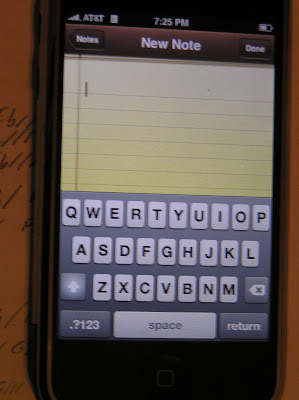
Many of the iPhone's different functions require the use of a keyboard. The keyboard appears when needed, and responds when you touch the surface. It takes time not only for you to adjust to the keyboard, but for the keyboard to adjust to you. This will probably wind up being the most controversial aspect of the iPhone, as it will frustrate almost everybody initially. Making typos will be very common, but the iPhone has two mechanisms to address errors and facilitate typing. First, the built-in dictionary enables the iPhone to anticipate words as you type them, even if some of the letters are off by one space on the keyboard. It can then recommend a word for you, which you can accept simply by typing the spacebar or adding punctuation. Second, the keyboard adjusts the sensitivity range of particular letters depending on the frequency with which you use them. I still consider my ability to type with this keyboard as a work in progress, but I'm getting better at it, and I used it to write most of this review on a moving train and managed pretty well.

The iPod:

Yes, it's a fully functional iPod too. You sync it to iTunes just like you would any other iPod, and getting it to play is smple. So I can type up an album review for The Armchair Critic while playing the album, without needing any other device. And I'll even know if my wife is trying to call me while I've got the music cranked. (Well, I didn't say the device was perfect.) The iPhone will interrupt the music if a call comes in, and give you the option of answering. As mentioned before, the tiny mic in the headset (which otherwise works just like regular iPod earphones) makes shifting from the phone back to the music very simple.

Photos:

The iPhone is not the first mobile phone to also double as a digital camera. It takes some decent pictures, but it's so lightweight that you do need to be careful about holding it steady. Like other camera phones, I wouldn't use it in place of a quality camera if you're planning on taking a bunch of pictures, but it does give you the option to take those quick, spur-of-the-moment shots that you'd generally miss if you left your camera at home. I'm much more impressed by the iPhone's ability to store photos, however. I have over a thousand pictures from my wedding and honeymoon on it, using only a small amount of the device's memory. That's much easier than carting around a couple of massive scrapbooks to show people, that's for sure.

Going online:

Now here's the fun part. The iPhone will access the Web with Wi-fi if possible, and with dial-up if necessary. Its browser is Safari, which Mac users will already be familiar with. Even though connecting via the phone link is slow, it's still adequate for most purposes. So you can go online from pretty much anywhere. You can sync your bookmarks from your PC, so you can get to all your favorite sites pretty quickly. Tapping twice on the surface enables you to zoom in, so it's not hard to set the page to a readable size or to move around on the page. I would prefer, though, that it would maintain the size of the old page when I switch to a new one. Still, navigating the Web with the iPhone becomes very easy after a few tries. I don't recommend spending long stretches of time navigating with it though, as it's a bit of a strain on the eyes.
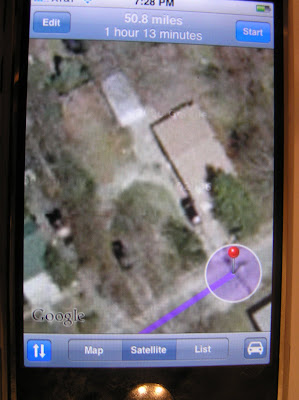

A lot of functions in the iPhone's main menu are tied to the Web access. The weather button, for example, will immediately bring up the forecast for the city (or several cities) of your choosing. You can get stocks as well, along with YouTube (this goes slowly if you're on dial-up). My favorite function is the map button -- not because I've used it for anything specific yet, but because I can get a satellite photo of the spot on the map I'm looking at with the touch of a button. (My sister-in-law was over the day they snapped my house.)

The Cost:

At $500 for 6GB of storage for music and photos, or $600 for 8GB, the iPhone ain't cheap. And that's before the monthly phone bill from AT&T. The latter issue may keep sales down for a while, because people using cell phones other than AT&T or Cingular might not want to sever their existing contract before it expires. Even if you do have an existing AT&T contract, you'll still wind up spending an additional $20 a month for data storage. Plus, if you already have a camera phone, an iPod, and a laptop you're happy carting around for typing and basic net-surfing on the go, the iPhone might not survive a cost-benefit analysis. I'm not surprised, therefore, that initial sales of the iPhone did not match Apple's expectations. I probably wouldn't have been too quick to buy one for myself if I didn't get one as a gift. Still, the iPhone is a device that's both very useful and a lot of fun, and I'm still figuring out all the things I can do with it. I think word of mouth on it will be mostly favorable over the long haul.

reviewed by Scott

8.22.2007

Superbad (2007)

There are plenty of teen comiedies about trying to get laid and trying to party hard. The bad ones are juvenile and exploitative, the good ones make us laugh, and the great ones seem to speak for their generation. Superbad, co-written by Seth Rogen (who wrote The 40-Year-Old Virgin and Knocked Up), is the latter type of movie: a sensitive, crude, hysterical, and honest portrayal of teens.

It's two years before high school graduation, and teenage buddies Evan (Michael Sera) and Seth (Jonah Hill) are ready to party and get laid. Evan is polite, nervous, always apologizing, and infatuated with Becca (Martha MacIsaac), whose flirtations he is oblivious to. Seth, an overweight kid who curses and talks more trash about women than any movie character since Jay in Clerks, has the hots for Jules (Emma Stone). Unfortunately, Evan and Seth have very few friends apart from each other, spending most nights in Evan's basement drinking beers and watching online porn. And with them going to different colleges in the fall, they feel the stress of their upcoming separation.


Evan and Seth see a big chance for sex and partying when Jules invites them to her party. The two friends start planning, helped by their annoying friend Fogell (Christopher Mintz-Plasse) whose fake license leads Seth to promise Jules that he'll bring the booze for the party.


But the course of teenagers never does run smooth. Fogell's fake I.D. only says "McLovin" and when Fogell is buying the booze he winds up in the middle of a robbery and the new best friend of two party-animal cops (played by Bill Hader and Seth Rogen) who take him all over town. Meanwhile Evan and Seth wind up at an adult party surrounded by strangers, as they try to procure the promised alcohol for the party.


Superbad is a wonderful movie. The characters are all very believable, dealing with the stresses and promises of being a teenager. (The two cops are very over the top, but they still supply lots of laughs.) The movie is both funny and honest, as Evan and Seth try to live up to all their big talk while dealing with who they really are. And the laughs come from beginning to end. Superbad will be a classic about what it is to be a teenager -- and what a great comedy is.


Overall Grade: A

Reviewed by James Lynch

8.21.2007

Inside the Postal Bus - Michael Barry (2005)

This is a book for bike racing fans, or at the very least for fans of the Tour de France. It is memoir of cyclist Michael Barry's year, 2004, with what was at the time quite possibly the best team in professional cycling - US Postal, led by Lance Armstrong. If none of those names - Tour de France, Barry, US Postal or Armstrong - mean anything to you, this is probably not your book.

I am not a big cycling fan, my interest pretty much starts and stops at the Tour de France, but I am interested enough in some of the nuts and bolts to find this book an engaging look at the business, with enough detail to fill in holes in my knowledge of the culture and sport. Having watched the Tour for a few years, a lot of the names of the riders were familiar, and the insights into the aspects that don't make it on to TV were occasionally fascinating.

Armstrong is almost completely absent from the book, which is kind of a relief actually; especially in the US coverage of Armstrong has been so thorough and all encompassing that it's nice to read about other riders for a change.

Barry is not a great writer, although to give him credit the book is not ghost written and the writing isn't bad. He does manage to convey quite a bit of his own character and love of cycling through the book. Barry emerges as quite a likable fellow, clearly one of the best riders in the world - you don't get onto a professional team or compete in the Olympics without that - but not one of the best riders in the world of professional cycling. Looking over his professional record, I see a few wins here and there, but quite a few decent placings. More telling, though, is how many superstars he has ridden in support of. Professional cycling is a team sport, and like most team sports, the superstars get the press but without the team they wouldn't get very far.

As a slice of life look into the world of professional cycling, the book is well worth checking out; it is however not likely to appeal to the general or casual reader.

Overall Grade: C+

8.20.2007

Scotland Under Mary Stuart - Madeleine Bingham (1971)

This book, subtitled, "An Account of Everyday Life", attempts to be a survey of life in 16th Century Scotland. I am a fan of "Daily Life" types of history books (see for instance Frances and Joseph Gies' excellent books Life in a Medieval Castle, ... a Medieval Village, and ... in a Medieval City) which is why this book was such a disappointment.

The structure of the book is not at fault, it is broken into chapters which make a reasonable amount of sense. Perhaps the problem lies in a scarcity of information, although it seems unlikely given the bibliography (partial no less) at the end. Perhaps it is merely that I am not the target audience, but if I am not, who is?

The writing itelf is not terribly smooth or engaging, and relies heavily, perhaps too heavily on anecdotes.

Ultimately, though, I think the failing of the book is that it tries to be too simple while at the same time failing to provide enough basic information. That is to say, it assumes knowledge on the part of the reader that he or she may not possess, and then fails to provide illuminating details. For example, historical figures are often referred to by various different names at various points without ever explicitly clarifying who is who. This is complicated by the fact that the book is arranged topically rather than chronologically. Referring simply to "the Queen" could mean several things, depending on the year, and who is the "Queen Regent?" Here is a sentence from the first chapter, "Nor did these raids cease with the flight of the Queen, and in October 1567, when Scotland was ruled by the Regent Moray..." Who is Moray? Why is he Regent? The Queen (Mary Stuart, we find on a previous page) was around in 1565, so when did she fly? Where? Why?

Upon reflection, it may be that this chapter bears the burden of the book's failure. Without a more solid grounding in the history, the reader (or at least this reader) felt a bit at sea in later chapters, resulting in a somewhat frustrating experience.

The other problem with the book is the scope. "Daily Life" requires a certain simplification and homogeneity in the subject. (As in "Life in a Medieval Village.") Scotland was too hetrogenous at the time to be easily reduced to a "typical" situation, so every topic was touched on so lightly as to leave the reader (or again, this reader) unsatisfied.

If one is already a Mary-Queen-of-Scots-ophile the book may be more useful, but otherwise, I can not recommend it.

Overall Grade: D+

In the House of Secret Enemies - George C. Chesbro (1990)

In the House of Secret Enemies is a collection of short stories featuring "Mongo the Magnificent", the hero of a fairly extensive series of mystery books (including The Fear in Yesterday's Rings previously reviewed here.) Several of the stories were later expanded or incorporated into Mongo novels. The result is that this is probably not a good introduction to Mongo or the books. Which is not to say that they aren't good stories, because they are, rather Mongo lends himself better to novel length works, and the stories give away plot bits that Chesbro recycles. If, however, you've already read the novels (or at least An Affair of Sorcerors which is where most of the stories end up), the book is a fascinating insight into one man's artistic process. You can read and see how the ideas are born, mature and change, and eventually grow into a novel.

As with most Chesbro, the writing is good and the characters interesting. The plotting here is not his strongest, though, another reason why it is more for the Mongo completist than the newcomer.

Overall Grade: C

8.17.2007

Crowded House, Time on Earth (ATO Records, 2007)

Neil Finn initially founded Crowded House after his previous band Split Enz, still the most famous group to originate in New Zealand, split up in the early eighties. Drummer Paul Hester was recruited from the final Split Enz lineup, and bassist Nick Seymour completed the original trio. The band eventually became a quartet during a career that spanned ten years and four albums, with Mark Hart adding keyboards and guitar on the last album Together Alone. The members of Crowded House fought with their share of inner demons, though, especially Hester. Despite his outward happy-go-lucky demeanor and the light-hearted songs he contributed to the band, Hester suffered from bipolar disorder to a crippling degree. In 2005, ten years after Crowded House split up, Hester hung himself.

Finn had spent the years after Crowded House alternating between performing as a solo artist and as half of a duo with his brother Tim, who was part of Split Enz and also a member of Crowded House for one album and tour. The songs Neil wrote in the wake of Hester's suicide were clearly affected by that event, so much so that it only makes sense that Finn decided to record these songs together with Seymour and Hart as a re-united Crowded House. Ethan Johns and Matt Sherrod split the drumming responsibilities during the recording sessions, and Sherrod has officially joined the band as the fourth member.

The new CD is called Time on Earth, and it can be argued that Hester is as present on this album as he was on the four Crowded House albums he drummed on. The opening song "Nobody Wants To" talks about the fear and reluctance people have to address the subject of death or their own mortality. On "People Are Like Suns," the closing song, Finn sings about the limited time we have. Several of the songs in between follow similar lines as well. The material gets heavy at times, but the sincerity of Finn's feelings comes through, especially on the sonically agressive "Silent House," the album's most emotionally potent track.

Given the subject matter, much of the music on Time on Earth is predictably on the darker side. Finn has made a very long and productive career largely out of making melodic and accessible songs that hold up even when they veer towards melancholy, though. There might not be a "Don't Dream It's Over" on Time On Earth, but songs like the anti-war ballad "Pour le Monde" make the album a worthy addition to the Crowded House catalog. The CD has a couple of good upbeat tracks too, including the power-pop song "Even A Child" which Finn
co-wrote with Johnny Marr (from The Smiths, obviously, but also more recently with Modest Mouse).

Time on Earth is not always an easy listen or a feel-good record, but there is plenty of quality on it, and it serves as a fitting tribute from Crowded House to a fallen bandmate and friend.

Overall grade: B+

reviewed by Scott