8.27.2010

SEX AT DAWN

What if the world of sexual relations and practices, if the interaction between men and women, was not what it is now? What if the practices of the past, ignored or denied, influence us today? These are some of the areas covered in Sex at Dawn: The Prehistoric Origin of Modern Sexuality by Christopher Ryan and Cacilda Jetha.

The main area challenged in Sex at Dawn is the "standard narrative" that throughout history males and females meet, assess each other's mate value, become monogamous, and then each look for signs of infidelity in the other while seeking opportunities for infidelity for themselves. Much of this is what the authors describe as "Flintstonization:" projecting current beliefs, trends, and practices onto the past.

What evidence is there against ancient monogamy? Ryan and Jetha provide an abundance of sources, but their two main ones are bonobos (polygamous apes that are very close genetically to humans) and foraging societies (the standard before the advent of agriculture) where "sharing is not just encouraged; it's mandatory." Sex at Dawn goes through: the assumptions of and problems with the standard narrative, the development and effects of love, lust, and sex in prehistory; a part dealing not with sex but false assumptions (led by Malthus) about the horrific life of ancient humans; fairly recent sexual sex and society; and how this affects humans today.

Sex at Dawn is a very impressive trip through both history and the distortions and assumptions of history. The authors provide extensive branches of research -- historical, social, psychological, anthropological -- to create a full picture of the full view of human (and pre-human) sexuality. Far from being dry and boring, Sex at Dawn is colloquial and engaging. Quotes are here from Darwin to the Kama Sutra to Stephen Colbert; there's also a lot of humor here, as one can gather from chapters like "On Gettin' Funky and Rockin' Round the Clock" and "The Pervert's Lament." The authors are convincing, taking on some very widely-held social and scientific assumptions about sex, gender and racial traits, and evolution. And they don't romanticize their findings, even while promoting.

My only quibble is that at the opening of Sex at Dawn the authors assert that this work isn't an assault on the status quo, but by the end they have quite a few suggestions that do just that. With that in mind, Sex at Dawn is a fascinating and intelligent look (or new look) at human sexuality -- and how its past impacts our present.

Overall grade: A
Reviewed by James Lynch

8.26.2010

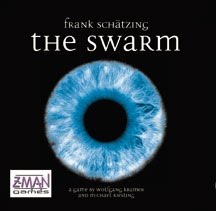
THE SWARM

There's something in the ocean, and it's up to you to find it with ships and researchers. But there are also dangers in the sea. This is the premise of The Swarm, a decent but flawed combination of strategy and puzzle game for two to four players.

The board of The Swarm has swarm tiles, face down, on the ocean spaces and land tiles along the four sides of the board. Each player stars with a research station and one researcher. A research point track runs along the sides of the board, a turn order area shows the order of play, and action cards are placed along the side.

First, players use research points (which ultimately determine the winner) to buy action cards. The card at the left costs zero, the next one costs one research point, the next costs two, and so on. At the right of these cards are two special cards, a Research Station, and finally turn order cards (that determine the turn order for the next turn; they also let the player choose one of four special cards). Cards are purchased one at a time, and as they are bought the remaining cards are pushed left, so ultimately remaining cards cost nothing. And each player has a Wild Card that can be used once per turn

After all the cards have been bought, players play their action cards. The Research Station card lets a player place a Research Station, with a researcher, on a land space on the board. The Ship card lets a player place a ship next to a Research Station, then move their ship(s) a total of three spaces; as a ship moves over a face-down swarm tile the player takes that tile and places it in front of them. Danger cards let players place or move a Whale, Tsunami, or Crab to damage players through their Ships or Research Stations. Most important is the Researcher card, who lets a player add a researcher to a research station -- or place swarm tiles.

Players put swarm tiles on the board so their links (each has two to four links) connect with either a research station or a ship. A player can only place a number of swarm tiles equal to the number of researchers they have in play. Players earn research points for two- and three- link tiles, and at the end of the round players score research points based on their longest connected system. A player also puts their colored tokens ("buoys") on a placed tile, and other players can only join a placed tile by adding a tile with more links, or using the special "Golden Tile" card; these let players share the space. At the end of the game (after four turns for two players, three turns for three or four players), players also get points for connecting two, three, or four sides of the board by connected systems.

There is a good deal of strategy in The Swarm. Using the points that give victory to buy cards needed to achieve victory is an interesting mechanic. Tile placement is challenging, as creating long connected systems can be tricky; it's also impossible to truly block someone off. The Ship-Research dynamic is also challenging: You need to move lots of Ships to get the tiles for your connected systems, but you need lots of researchers to place them.

The Swarm also has its problems. The menaces aren't that menacing. If an opponent hits you with a Whale, Tsunami, or Crab, you lose research points (based on how high your score is) and the attacker gains the same number of victory points. However, since the score doesn't get very high until the end, the effect of this is minimal. There's also very little background to the game: Is the swarm alien or natural? Is it harmful, beneficial, or sentient? (The center tile is called the swarm queen.) Why is the Crab giant but the Whale and Tsunami don't destroy ships or research stations? (The novel by Frank Schatzing, on which this game is based, provides more information.)

The Swarm is more interesting than exciting, more planning than thrilling. This is one game I'll enjoy playing occasionally.

Overall grade: C+
Reviewed by James Lynch

8.23.2010

Tom Petty and the Heartbreakers, Mojo (Reprise Records, 2010)


Thirty-four years after the release of their first album, Tom Petty and the Heartbreakers show no signs of slowing down. Mojo is the outfit's twelfth studio album, not counting Petty's three solo albums or the recent album Mudcrutch on which Petty and two other Heartbreakers figure prominently. Petty's long time fans have a good idea what to expect, and while they might not be overwhelmed by Mojo, they won't be disappointed by it either.

Mojo can roughly be broken into two halves. The first half finds Petty and his bandmates -- lead guitarist Mike Campbell, keyboardist Benmont Tench, bassist Ron Blair, drummer Steve Ferrone, and third guitarist/harmonica player Scott Thurston -- heading in something of jam-band direction, similar to what Petty did on the Mudcrutch album. Two of the album's strongest tracks, "First Flash of Freedom" and "Running Man's Bible," run in excess of six minutes. Eventually the album takes a bluesier turn, though; presumably this is what inspired the album's title. "U. S. 41" is some fine swampy acoustic blues, and the single "I Should Have Known It" and closing song "Good Enough" features some blistering guitar work from Campbell. As always, the musicianship is rock solid. Mojo may lack the kind of standout song that would force its way onto a Petty Best Of, but that's partly because of the depth of Petty's back catalog.

Tom Petty and the Heartbreakers' stick-to-basics approach to making music is certainly familiar, and if there's a fault in it it's that the familiarity sometimes leads to predictability. Having said that, Petty's formula has worked for him for a very long time, and you can always count on enough quality songs to make the album worth your while. Mojo is not an exception.

Overall grade: B+

reviewed by Scott

The opening song "Jefferson Jericho Blues"

8.22.2010

MALL OF HORROR

Zombies attack! Survivors hole up in a mall! People are as dangerous as the undead! These are fairly common themes in zombie movies and stories -- and they're the basis for Mall of Horror. This board game pits three to six players against each other as the zombies amass.

Each player gets three characters: a Pin-Up cheerleader, a Tough Guy, and a Gunman; in a four-player game, each player also gets a Kid. Players also have a voting wheel, used to choose buildings and cast votes.

The board is composed of six buildings. Each building can hold a certain number of people. The Parking Lot can get players action cards (but leave the characters very vulnerable), the Security H.Q. gives advance warning of where zombies are headed, and the Supermarket is more easily invaded by zombies.

Each turn players vote to see who searches the truck (more on voting below), elect a Chief of Security, roll four dice to see where the zombies attack, move characters, and withstand the zombie attack. The game ends when there are only four characters left alive (or six characters in a six-player game) or all remaining characters are in a location other than the Parking Lot. Each player adds up the values of their remaining characters (Pin-up: 7; Tough Guy: 5; Gunman: 3; Kid: 1) and whoever has the most points wins.

The key to Mall of Horror is voting. When a vote is called for, each character at the location gets a vote --except the Gunman,who gets two votes -- and players secretly vote with their voting wheel. If there's a tie everyone votes. The winner gets to: search the truck in the Parking Lot vote (getting three action cards, then choosing one to keep, one to give away, and one to discard); elect a Chief of Security (who gets to see the die roll indicating where the zombies are heading); or choose which player has to lose characters to the zombies.

Ah, those pesky zombies. After the dice are rolled but before they're revealed, each player uses their voting wheel to select a building to send a character. Then the dice are revealed, and a zombie goes to each building; the building with the most Pin-Ups gets an extra zombie due to the screaming. Next players choose one character to send to their chosen location; if they're sent to a building that's full, the character goes to the parking lot. Then the attack begins!

If there are more characters than zombies (and the Tough Guy counts as two), the attack is repelled -- but the zombies stay at the building. If the number of zombies is equal to or greater than the number of characters there, the players vote on who has to sacrifice a character; then the character is discarded, as are all the zombies at the location. Every zombie at the Parking Lot gets to kill a character, determined by voting. Only four zombies are needed to succeed at the Supermarket, no matter how many players are there. Zombies at an empty building stay there -- and if eight zombies accumulate at an empty building, that building is condemned and no one can go there.

Mall of Horror is a game of mixed quality. This does capture the feel of a zombie uprising, as the zombies are initially fairly easy to repel but, as their numbers increase and the characters start dying, a sense of desperation is felt. Strategy is key, as players have to decide what to go for (control of the Security Office, risk the Parking Lot for cars, or even who to send to a building about to be overrun by zombies.) And the art is appropriately creepy.

The rules are fairly straightforward -- and that can be a problem. With the only real variety being in the action cards, the voting and moving can be repetitive. All the characters have the same art, and each type of character functions the same for all players. There are also a few small translation problems, from awkward wording in the rules ("A mysterious scientific experiment allowed dead to raise to devour the living ones") to the building labeled "Cachou." And while a few action cards will kill zombies (or slow them down), the only true way to win is by sacrificing the others -- which could lead to some hurt feelings among players.

Mall of Horror reminds me of the old joke about two friends who see a tiger charging at them. The first friend starts putting on his running sneakers, the second tells him that he can't outrun the tiger, and the first answers, "I don't have to outrun the tiger. I just have to outrun you." If you and the other players want a horror game about sacrificing opponents instead of directly defeating evil, then Mall of Horror is for you.

Overall game: B-
Reviewed by James Lynch

8.16.2010

The New Pornographers, Together (Matador Records, 2010)


With their quirky power-pop style, The New Pornographers were one of the most intriguing bands of the last decade. Comprised of an all-star selection from the Vancouver indie scene of the late 90's, the octet feature a top-notch singer/songwriter in A. C. Newman, and as good a backup/change-of-pace vocalist as you're ever going to find in Neko Case. They brought their music into the new decade this past May with the release of their fifth album Together.

Together follows a similar format to the previous New Pornographers albums. Newman writes the bulk of the songs, singing lead a bit more than half the time and giving several songs to Case. Dan Bejar writes and sings two or three songs on each album as well. Other than the addition of keyboardist/vocalist Kathryn Calder during the tour for their 2005 album Twin Cinema, the supporting cast of Blaine Thurier (keyboards), John Collins (bass), Todd Fancey (guitar), and Kurt Dahle (drums) has remained constant since the beginning. The band's sound hasn't changed much over the years, featuring catchy guitar rock with cerebral lyrics. I think the predictability has hurt the band somewhat on their recent albums, but there are some good songs on Together regardless. My favorite song on the new album is a particularly energetic rocker called "Your Hands (Together)." "Up in the Dark" and "We End Up Together" are strong upbeat tracks as well, and the curiously title "Valkyrie in the Roller Disco" is a good ballad as well.

While I wouldn't recommend Together as highly as I would Twin Cinema, there is enough quality on the new record to justify the purchase. The New Pornographers have built up an impressive catalog of songs over the past ten years, and they do not appear to be done just yet.

Overall grade: B+

reviewed by Scott

"Your Hands (Together)"

8.15.2010

Ruthie Dornfeld, Duets Abroad (Ruthie Dornfeld, 2010)


Seattle-based fiddler Ruthie Dornfeld does plenty of playing at home in bands like Rouge and Cinnamon Bird, but she has also spent much of her musical career collaborating with some of the finest folk musicians in Scandinavia and the Balkans. On her new CD Duets Abroad, she pairs up with a number of her favorite performers. Most of the guests musicians hail from Finland, with one performer each from Denmark, France, and Hungary.

Duets Abroad is not a typical folk duets album. Yes, there are a couple of nice, pleasant-sounding tunes with a relatively standard guitar and fiddle arrangement, but the rest of the album hits you in many different ways. In particular, the collaborations with Hungarian multi-instrumentalist Balázs Dongó Szokolay are quite unusual. Szokolay's frenzied, dissonant approach to his pipes and whistles will challenge any preconceived notion of folk music as something meant to be soothing or relaxing. (To put it another way, Dornfeld's duets with Szokolay really kick ass and you should check them out.) To be fair, the rest of the album works nicely as well. There are plenty of good examples of both the Finnish and American fiddling traditions, along with some original compositions. The alternation of accompanying instruments between guitar (France's Patrick Desauny and Denmark's Morten Høirup), mandolins (Petri Hakala), jaw harp and singing bowls (Tapani Varis), harmonica (Jouko Kyhälaä), and accordion (Pekka Pentikäinen) makes for nice variety. Instruments like the harmonica and the jaw harp may not strike you as suitable instruments for accompanying a fiddle before you hear them, but the tracks these instruments are used on sound really good. That these instruments function well in this context is ample testament to the skills of the musicians Dornfeld has chosen to work with.

Duets Abroad is not only a fine collection of folk fiddle tunes, but it is also a textbook demonstration of the sonic diversity of contemporary folk music and the creativity of the people who play it. Ruthie Dornfeld has a great assortment of friends and plenty of talent in her own right, and she knows how to make good use of both.

Overall grade: A-


reviewed by Scott

The Chieftains featuring Ry Cooder, San Patricio (Hear Music 2010)


Over a career spanning nearly half a century, The Chieftains have established themselves as Ireland's most internationally revered folk music group. They have used their status to sort of appoint themselves cultural ambassadors, collaborating with musicians from around the world and across many genres on their recordings. In some ways, guitarist/producer Ry Cooder's career has followed a similar pattern. Best known as the producer and co-ordinator behind Buena Vista Social Club, a celebration of the folk music of Cuba, Cooder likewise enjoys sharing the spotlight with different musicians from different cultures. Cooder's previous album Chavez Ravine touted the music of the Mexican community in Los Angeles, and his interest in Mexican music led to his current collaboration with The Chieftains, called San Patricio. The album was inspired by the story of Irish immigrant soldiers in the Mexican-American War who came to sympathize with the plight of the Mexicans struggling against the American invaders. They changed sides, for both religious and moral reasons, but were defeated along with their Mexican allies; those who survived the battles were captured and hanged as deserters.

The music on San Patricio focuses on the kind of traditional pieces that would have been familiar to the San Patricios as mid 19th century Irish immigrants, and to the Mexicans whom they aided in vain. People familiar with Chieftains albums will recognize the pattern, as Paddy Maloney (whistles and pipes), Sean Keane (fiddle), Kevin Conneff (bodhrán), Matt Molloy (flute), and Tríona Marshall (harp) accompany a small army of guest performers. Most of these guests are Mexican, although Linda Rondstat sings a song in Spanish, Ry Cooder performs an original composition, and Moya Brennan sings a song from the Irish perspective. Galician piper Carlos Núñez, a frequently recurring guest on Chieftains recordings (Galicia is a Celtic region in Spain), also makes a few appearances as well. The best cameo, though, comes from actor Liam Neeson, who recites Brendan Graham's poem "March to Battle (Across the Rio Grande)" about the ill-fated San Patricios.

It takes a rare courage to choose to be on the losing side of history, but that's essentially what the San Patricios did. Yet their cause still resonates today. Neither The Chieftains, nor Ry Cooder, nor anybody else who worked on San Patricio needs to be reminded of the conflicts which Mexicans and people of Mexican descent face in America right now, especially in the territories that were taken from Mexico without any sort of justification. So the political statement here is obvious, and greatly appreciated at least by me. As far as the music goes, it's a lot like many other Chieftains recordings -- perhaps too much so to really distinguish itself. Fans of The Chieftains will know exactly what to expect, and while this guarantees a certain level of quality, there's a lot of predictability here as well.

Overall grade: B


reviewed by Scott


Behind the scenes of the making of San Patricio.

8.14.2010

SCOTT PILGRIM VS THE WORLD

The course of true love never did run smooth -- but it rarely involves nearly as much martial arts as in Scott Pilgrim vs. The World. This movie, adapted from the manga comic of the same name, combines wandering young adult romance with hyperactive, unrealistic, funny combat.

Scott Pilgrim (Michael Cera) is a 22 year old Canadian semi-slacker. He lives in an apartment with gay roommate Wallace Wells (Kieran Culkin), he's unemployed and plays bass in a band, and he's still fairly hung on his last girlfriend. The latter may be why he's dating Knives Chau (Ellen Wong), a 17-year-old Asian high school student.

Things change for Scott when he meets the girl of his dreams (literally), Ramona Flowers (Mary Elizabeth Winstead). Ramona is cool, aloof, and has some unique baggage: Scott must defeat her seven evil exes before they can truly be together. This lot ranges from twin musicians to a psychically-powered Vegan. Oh, and Scott is still dating Knives Chau.

Director Edgar Wright (who did the wonderful Shaun of the Dead) knows that Scott Pilgrim vs. the World is about style not substance, and he directs accordingly. All the characters are cool and aloof, usually saying clever things with a deadpan demeanor. Even the numerous elaborate battles seem routine to everyone. The cast delivers, but there's little depth to any character.

Scott Pilgrim vs. the World has a pretty unique visual style. The absolutely ridiculous battles here owe more to video games (multiple hits, defeated enemies turning into coins, etc.) than any other combat scenes in movies -- even the ones based on video games. Words drift across the screen for sounds, characters notice curses bleeped out, and intense emotions are accompanies by visual cues. This is key to the humor in the movie.

For all the fighting and young adult romance, Scott Pilgrim vs. the World is, first to last, a comedy. And it's a terrifically entertaining one. This movie makes it very easy to let the brain relax and laugh along with this zany, fast paced, consistently over-the-top manga world brought to life. I could say this movie is about learning to deal with the romantic baggage from out past, but it's more about how discovering true love gets you a cool flaming sword.

Overall grade: B+
Reviewed by James Lynch

8.12.2010

WOMEN OF MARVEL: CELEBRATING SEVEN DECADES

In case you didn't know, Marvel Comics declared that 2010 is "the year of the women of Marvel." To celebrate (capitalize?), Marvel released Women of Marvel: Celebrating Seven Decades, a trade paperback that reprints comics featuring female characters -- plus historical summaries.

After a general introduction, Women of Marvel: Celebrating Seven Decades goes decade by decade, from the 1940s to the present (well, 2009 anyway). Each decade gets a brief description, then a summary of what was happening in comic books for that decade, then a few comics from that decade (with comments on those comics). There are plenty of well-known superheroines here, but there are also romance comics , a goddess-turned-fashion model, and even the original Black Widow -- who got her powers from, and worked for, Satan!

Women of Marvel: Celebrating Seven Decades is a nice little trip, giving a little history of the times, the industry, and the specific stories of female characters. This collection also inadvertently shows some of the problems female characters have in the comic book genre. Seven of the stories reprinted here are from female-led comics -- but the rest have the women as supporting characters (like the Amazing Spider-Man story here with Mary Jane Watson -- on a date when the Rhino attacks) or teammates with the males. There's no discussion of the challenges of keeping a book with a female lead going strong; instead the reader gets lots of self-congratulations on what Marvel has done. Also, the cover features at least seven characters that don't appear in this collection at all! (Marvel does have two other Women of Marvel collections with other characters and stories that don't go decade by decade.)

If you're interested in the women of the Marvel universe, Women of Marvel: Celebrating Seven Decades is a good start. Unfortunately, this also shows how male-oriented comics books were -- and how much further the genre has to go for women.

Overall grade: B-
Reviewed by James Lynch

8.04.2010

Gordon Gano, HITTING THE GROUND

Gordon Gano is easily best known as the lead singer of the Violent Femmes, but he also steps behind the scenes to write songs for others. The album Hitting the Ground features Gano as songwriter, occasionally taking the microphone to sing.

Hitting the Ground features performers PJ Harvey, Mary Lou Lord, Lou Reed, John Cale, Linda Perry, Frank Black, They Might Be Giants, and Martha Wainwright, among others, performing Gano's songs. While some songs have the definite feel of the Violent Femmes, there are also tender ballads like "So It Goes" and the piano-powered "Don't Pretend." And Gano's voice is as unmistakable as ever when he sings.

Sometimes Gano's lyrics are a little too clever, but Hitting the Ground is a pretty good album. There are kick-ass rock songs, with the variety of singers creating a multi-faceted sound here.

Overall grade: B+
Reviewed by James Lynch

Ozomatli, Fire Away (Mercer Street Records, 2010)


Born and bred in Los Angeles, Ozomatli have been making some pretty solid music for fifteen years now. The multi-racial, multi-cultural, multi-lingual septet have mixed rock and rap with salsa and meringue, throwing in some strong political sentiments for good measure. Recently the band teamed up with veteran producer Tony Berg (Michael Penn's March and Free for All albums remain favorites of mine) for their fifth studio album Fire Away. It is their most musical and melodic album to date, without compromising their energy or attitude.

The rousing opener "Are You Ready?" alone should be sufficient for long-time fans of the band to buy the record, but Fire Away takes some interesting turns from there. "It's Only Paper" evokes the old Stax soul records, particularly the guitar playing of Steve Cropper. The 3/4 ballads "Gay Vatos in Love" and "It's Only Time" effectively capture the romantic sounds of the fifties, with the former paying lyrical tribute to the gay Latino community in Los Angeles. "And if the world can't understand, stand by your man." (The song was written as a response to Proposition 8, which I'm happy to announce was overturned as I was writing this.) Ozomatli also do a great cover of the Pogues' "Yeah Yeah Yeah Yeah," making an Irish stomper sound like it was meant for them all along. The tongue-in-cheek rap song "Nadas por Free" is irresistible fun. The frenzied "Malagasy Shock" was partly inspired by singer/guitarist Raúl Pacheco's near-death experience on stage in Madagascar, and partly by the band's regular exhortations to it's audience to stop accepting what's spoon-fed to them and get up and take charge of their lives. The ambient ballad "Love Comes Down" has some uncharacteristically subtle instrumentation, but the band pull it off flawlessly.

For most of their history, Ozomatli have had a reputation for being great in concert but not quite able to match their live performance when they went inside the studio. Fire Away will go a long way to altering that perception.

Overall grade: A


reviewed by Scott

"Elysian Persuasion"

8.03.2010

NAKED AMBITION

Back in 2006 photographer Michael Grecco went to the AVN Awards and Convention -- the porn equivalent of the Academy Awards, with a trade show mixed in -- to shoot a coffee-table book in three days. That book was reviewed here. A documentary of this endeavor was also filmed during this project. Naked Ambition: An R Rated Look at the X-Rated Industry follows Grecco and talks to many of the adult entertainment folks he photographed.

Naked Ambition seeks to explore both Grecco's creative process and the culture of porn as seen through its biggest ceremony -- but this movie is a little superficial on both fronts. Grecco's voiceover continually has him explaining that he's not shooting porn ("this project is a portrait of a culture") and there's not much more on his creative process here. Most interview subjects just talk about themselves, creating a patchwork of people rather than a portrait of the culture Grecco is after. And the closest to a storyline here is a slightly longer focus on Sunny Lane, an actress hoping to win Best New Starlet, and Grecco's concern about not getting to photograph Larry Flynt or Jenna Jameson. (The latter issue is covered in about two sentences.)

There are some good things here. The bonus features give more of an overview of this culture, from the role of men to the fans at the AVN Convention. Some of the folks interviewed are interesting, like the sophisticated regal dominant or the chance encounter between co-stars, friends, and lovers Julia Ann and Janine Lindemulder. Overall, though, there have been better documentaries on porn (several of which I've reviewed here), and the book Naked Ambition works better than its behind-the-scenes documentary Naked Ambition.

Overall grade: C-
Reviewed by James Lynch

7.29.2010

She & Him, Volume Two (Merge Records, 2010)


Singer/pianist Zooey Deschanel and multi-instrumentalist/producer M. Ward first paired up as She & Him in 2008. Volume One was a pleasant, well-received collection of songs heavily rooted in the American side of the pop music of the early sixties. Deschannel may not have a superior voice, but the same endearing qualities that work for her as an actress also work for her as a singer. Now Deschanel and Ward are back with Volume Two which, for better or worse, is nearly identical to its predecessor.

On one hand, She & Him demonstrate that there's enough substance to the style of female-centered pop songs of the early to mid sixties (think Phil Specter's production and Carole King's songwriting) that the approach can be embraced nearly fifty years later and still sound fresh. If anything, their sound is a welcome alternative to the more electronic and less innocent songs that have dominated the pop charts for a while. Having said that, though, Volume Two will sound a little too familiar to anybody who's heard Volume One. Deschanel's songs all have a catchy charm to them, but they blend together after a while. Nothing on Volume Two really stuck with me.

Volume Two is a nice enough record. I suppose people who really enjoyed She & Him's first record will like this as well, even if they know exactly what to expect. Safe predictability isn't always a good thing, though.

Overall grade: B-

reviewed by Scott

"In The Sun"

Jimi Hendrix, Valleys of Neptune (Experience Hendrix, 2010)


As the most celebrated instrumentalist in the history of rock, Jimi Hendrix needs very little along the lines of introduction. The latter portion of his musical career was more than a little bit enigmatic, however. His 1968 double LP Electric Ladyland, generally regarded as his creative apex, was the last studio album released during his lifetime. This does not mean he spent very little time in the recording studio over the last two years of his life; in fact, the opposite is true. The problem is that he left behind a lot of unreleased recordings, and his intentions for them remained vague. Three albums were released posthumously, but that still left quite a bit of unreleased material, and bootleggers had a field day with the leftovers. It may have taken forty years, but the Hendrix estate has obtained full control of the unreleased recordings, and is making a serious effort to get these recordings out to the public in a coherent manner. The first fruit of their labors is Valleys of Neptune, released in March.

Valleys of Neptune consists primarily of Hendrix's first ventures back into the studio after Electric Ladyland, with most of the recordings coming from the winter and spring of 1969. These recordings are noteworthy as they include the final recordings of the classic Jimi Hendrix Experience trio. Hendrix and bassist Noel Redding had fallen out, and Hendrix would eventually replace Redding with old friend Billy Cox while retaining the services of drummer Mitch Mitchell. Four of the recordings feature Cox as the bass player, including the title song. The album does contain a few familiar songs. "Stone Free" was the B-side of an early single, but Hendrix recorded an edgier version in 1969 for possible use as an A-side. A super version of "Fire," originally off of 1967's Are You Experienced?, is included as well; Hendrix had lengthened the guitar solo for live performances, and the Experience worked through the slightly altered arrangement in the studio between shows.

Otherwise, the new material shows Hendrix heading in a more bluesy and much less psychedelic direction. Hendrix scales back the amplifier gimmickry, focusing more purely on his guitar-playing technique. Hendrix was keenly aware of the degree to which top British guitarists like Eric Clapton and Jeff Beck had embraced the blues, and on the recordings here he seems like he was motivated to respond musically. There are no classics like "Purple Haze" or "Voodoo Chile" here, but the music is solid, and of course the guitar-playing is phenomenal. Tracks like "Hear My Train A Comin'" and "Lover Man" show that Hendrix was well ahead of his peers in terms of technique. Hendrix even beats Clapton at his own game, with a scorching seven-minute instrumental cover of "Sunshine of Your Love."

I'm usually a bit leery of posthumous releases. Unless the material was recorded shortly before the person's death, then the person would have most likely released the tracks if he thought they were good enough. Jimi Hendrix recorded so much material that he didn't live to see released, though, that it's hard to figure out what exactly he was planning. At any rate, there's some strong, bluesy rock on Valley of Neptune that fans of Hendrix will want to hear. Forty years later, it still sounds remarkably fresh.

Overall grade: A-


reviewed by Scott

"Valleys of Neptune"

7.28.2010

SALT

Back when the Soviet Union was the Evil Empire, there were lots of movies about the evil Russians out to destroy America. This type of simplistic good-vs.evil thriller is back with Salt, a very mediocre action movie.

Evelyn Salt (Angelina Jolie) is an undercover agent with the C.I.A. She has a loving husband, Mike Krause (August Diehl), a scientist who studies insects. She gets along with her supervisor Ted Winter (Liev Schreiber). And, apart from her being caught in North Korea and swapped for someone else two years before the movie's main action, that's all we know about her.

Some new information is offered by Orlov (Daniel Olbrychski), a Russian defector who turns himself in to the C.I.A. He says there's a Russian sleeper agent who will kill the Russian leader, in New York for a state funeral, the following day. And he says the name of this agent is Evelyn Salt. Salt, fearing that if her cover has been compromised then her husband is in danger, runs. Agent Peabody (Chiwetel Ejiofor) suspects Orlov was telling the truth, but Winter maintains her innocence. And the chase is on!

Salt feels like two movies strung together. In the first half of the movie Salt spends most of the time fleeing: on foot, on a motorcycle, even hopping along the tops of trucks speeding along the highway. About halfway through the movie, about the same time she dyes her hair, Salt goes on the offensive, able to defeat just about everyone in her path with guns, karate, and numerous flying kicks. Comparisons to Jason Bourne and James Bond are quite appropriate.

Those comparisons don't work for the quality of Salt. None of these characters have any depth or real personality (a pity, as Jolie and Schrieber are very good actors), and the action isn't all that exciting. Worse, Salt employs several cliches like slow-motion and flashbacks -- and uses them often. And the movie's ending feels like someone didn't know how to wrap this up and simply stopped writing. While Salt isn't terrible, it isn't terribly entertaining either.

Overall grade: C-
Reviewed by James Lynch