1.10.2007

The Apprentice, Los Angeles

Donald Trump attempts to breathe some new life into his ailing Apprentice show by taking it out to the west coast in The Apprentice, Los Angeles. For this sixth season, gone are the venerable George, and the opinionated Caroline as the Donald's deputies and advisors. They get replaced by his daughter, Ivanka, that made cameo appearances in previous seasons. The new twists this season are that the losing team sleeps outside in a tent, the winning project manager goes to the boardroom as an advisor, and if the project manager wins, they keep the position.

While this all gets billed as a 16 week job interview, it's all really Survivor for the urban corporate jungle. Unfortunately, time and again, we see young professionals scrounge and flub their way through basic business tasks. Seriously, if you can't run a car wash for a day, how can you ever hope to do anything more complicated in business?

Detracting from the experience are the fluff scenes of life around LA that get repeated way too often, the endless commercial breaks, and Donald's overly large ego constantly coming out as he shouts on about how many companies he owns, or how much real estate he owns. He's the biggest real estate developer ever...I get it, and just move on. At times I feel like I'm watching an infomercial for Trump!

Even with all the annoyances, I still enjoy the show, and it's one of the only reality shows I've watched for more than a season or two. Check The Apprentice, Los Angeles out on Sundays at 9 pm on NBC.

Overall Grade: B


Digg This
Del.icio.us

1.07.2007

CLERKS 2

Reviewed by James Lynch

To clerk, or not to clerk? After a string of disappointing films, Kevin Smith returns to the characters and setting of his initial success. The result is CLERKS 2, a satisfying sequel that stays true to its origins.

After a fire destroys the Quick Stop, Dante Hicks (Brian O'Halloran) and Randall (Jeff Anderson) make a lateral move to Mooby's, a fast-food chain. Dante still dreams of being more responsible, which seems likely: He is about to quit Mooby's, move to Florida with fiancee Emma (Jennifer Schwalbach), and work at a real job provided by his father-in-law. But Dante also has feelings for his Mooby's boss Becky (Rosario Dawson), and Randall wants Dante to stay in New Jersey (while planning a, er, unique going-away present for Dante). Nerdy cashier Elias (Trevor Fehrman) preaches Christianity and the greatness of the Lord of the Rings movies, and of course Jay (Jason Mewes) and Silent Bob (Kevin Smth) hang around to deal drugs.

It's nice to see Kevin Smith backon familiar ground. While Mooby's may be cleaner and more official than the Quick Stop was (the film shifts from the black and white right before the fire, to color in the yellow-and-purple world of fast food), the problems of clerking remain the same. Kevin Smith keeps these familiar characters consistent; there are no false notes or unbelievable character developments. CLERKS 2 also has plenty of laugh-out-loud moments, including Randall's birthday gift (and the horribly wrong directions it takes). Smith gets a little self-indulgent at times, from the string of celebrity guest appearances to a thoroughly unnecessary musical number, but he mostly stays on target. If you know the suffering of cashiering, or you just want to hang around some foul-mouthed friends, see CLERKS 2.

Overall Grade: B+

1.04.2007

John Tucker Must Die (2006)


John Tucker Must Die is an attempt at the proverbial high school movie. John Tucker is the stereotypical jock- captain of the basketball team and an all star athlete. He also cleverly has three girlfriends, and he juggles them all at the same time. In short, all the girls want to date him, and all the guys want to be him.

As the opposite is Kate Spencer, played by Brittany Snow, on the fringe of high school life. She has been to more schools than years she has been alive. This is because she has a mother that has a long and ongoing history of dysfunctional relationships with men.

When a chance meeting puts the three girlfriends and our outcast together, the madness ensues. They hatch a plan to "kill" John Tucker, more in a social sense than in a "Murder I" hard jail time sense.

Due to John's popularity, this becomes quite the challenge. While there are certainly humorous moments, like when he gets caught on a hotel balcony in a ladies' thong, it runs like the plot is secondary to this string of ridiculous circumstances that each try to top each other.

In the end, John Tucker Must Die never moves beyond the level of a high school sophomore prankster. This is too bad as it could have been at least a little more.

Overall Grade: C

Digg This
Del.icio.us

Behind Enemy Lines II: Axis of Evil (2006)

The original Behind Enemy Lines was a decent flick that always was a little underrated in my mind. It followed the course of a fighter pilot down in Bosnia, and his eventual rescue. I had never heard of the sequel, and I recently spotted it on DVD.

In Behind Enemy Lines II we focus on the last great closed communist society- North Korea. Taken from recent headlines, we have a missile on the launchpad. The US decides that they cannot allow this, and decide to take it out. While the American military pushes for an all out war, the President realizes the massive death toll that would ensue, and devastate the Korean peninsula. He decides to order a Special Ops mission to sabotoge the missile. So far, this was all well done, quite plausible, and exactly my kind of movie, but we're only 20 minutes in.

What follows is a mess. Let's see, who should we send in to sabotoge a missile in North Korea? I guess Delta Force was on liberty this week, because the Navy's SEAL's get the nod, even though we're not near the water anywhere. They insert them by having them jump off a commercial jetliner via a HAHO technique. After four men jump, the mission gets cancelled.

We end up with four SEAL's wandering the countryside of North Korea. The drawn out battle scenes, in an attempt to capture the "fog of war," use those filters that look like your Uncle Arnie's poorly edited wedding video. On top of that, they would never have enough ammunition to keep firing as they did. It even gets more ridiculous as they parachute directly into the middle of an enemy camp, and no one even notices!

While the plot was quite promising, the whole movie is very underwhelming. Next time we want to see Behind Enemy Lines, I'll stick to the original.

Overall Grade: C-

Digg This
Del.icio.us

Top 10 CD's of 2006

Hello and Happy New Year. As promised, it's time for the annual Top 10 CD list. Given the predominance of iTunes and iPods and single-song downloads, it's easy to be concerned that the album is becoming a lost art. Commercially there may be an element of truth to that, but I've reviewed plenty of albums this past year that are worth enjoying as a whole, not piecemeal. And as always, I have much more respect for artists who can impress me for forty minutes at a time, rather than just four.

I've reviewed nine of these albums already, and the tenth was reviewed here by Jim Lynch, so I don't have to go into any lengthy descriptions.

1. The Ditty Bops, Moon Over The Freeway. They're clever, they're funny, and they have to many good songs to ignore.


2. Johnny Clegg, One Life. I'm always happy when an old stand-by returns to form in a big way.


3. Dion, Bronx In Blue. He's always been a great singer, but I was really impressed with his guitar-playing on this one.


4. Värttinä, Miero. They're doing some U.S. shows this month, so keep your eyes open. The review was posted in Green Man Review.


5. Merrie Amsterburg, Clementine and Other Stories. Like Bronx in Blue, this album brings the musical traditions of America's past into the 21st century.


6. Loreena McKennitt, An Ancient Muse. Another unique artist makes a fine return.


7. Weird Al Yankovic, Straight Outta Lynwood. His biggest hit, only twenty-five years after his first album. Even people like me who loved his first record assumed at the time that he was just a novelty act. I guess we were wrong.

8. Maria Kalaniemi, Bellow Poetry. To really hear this one, turn the lights out and shut off all sound.


9. Amy Speace, Songs For Bright Street. A sharp wit and some good melodies should have gotten her more attention than she has to this point.


10. Neko Case, Fox Confessor Brings The Flood. Eerie and Cryptic, but also compelling.


Digg This
Del.icio.us


Related Post:

The Top 10 CD's of 2005

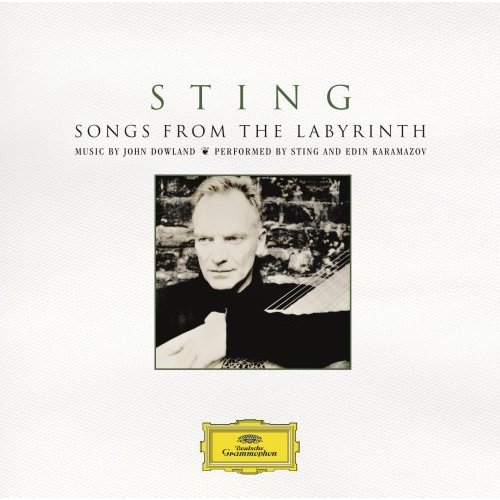
Sting and Edin Karamazov: Songs from the Labyrinth (Deutsche Grammophon, 2006)


Reviewed by Rachel Wifall

“Sting Goes Renaissance”

In Songs From The Labyrinth, Sting and Bosnian lutenist Edin Karamazov pay homage to the English Renaissance musician and composer John Dowland. Upon release in October, the album entered the UK Official Top 75 Albums Chart at number 24 and The Billboard 200 at number 37, rising the following week to number 25. It debuted at #1 on Billboard's Traditional Classical Chart and Classical Overall Chart, where it has remained for thirteen weeks.

Fifteen of the album’s sixteen songs were composed and originally performed on the lute by Dowland, a court musician in the late 16th and early 17th centuries; one (“Have you seen the bright lily grow”) was composed by Dowland’s younger contemporary, Robert Johnson, to lyrics written by playwright and poet Ben Jonson. Interspersed among the songs are readings from a letter which Dowland wrote to Sir Robert Cecil, Secretary of State and spymaster to Queen Elizabeth I, in 1595; in this letter Dowland defends his career choices, which took him to serve foreign patrons, and offers intelligence on possible foes to the queen, including his allegation that “men say that the Kinge of Spain is making gret preparation to com for England this next somer.”

Dowland went to Paris in 1580, where he served the ambassador to the French court. During this time he became a Roman Catholic, which conversion he claimed kept him from a post in Elizabeth I's fiercely Protestant court. In his letter he confides that he “gest that my relygion was my hinderance. Whearupon, my mynde being trobled, I desired to get beyond the seas”; after going abroad, Dowland worked instead for many years at the court of Christian IV of Denmark. After returning to England in 1606 he finally secured a post as one of James I's lutenists, in 1612.

Many of Dowland’s songs display the Renaissance vogue for melancholy; Sting relates to this, claiming that Dowland was “perhaps the first example of an archetype with which we have become familiar, that of the alienated singer-songwriter—something that gives him an acutely modern resonance.” Some of his tunes are upbeat, such as “Fine Knacks for Ladies,” which abounds in alliteration, metaphor and wit as it contrasts shallow materialism with amorous constancy: “Great gifts are guiles and look for gifts again./My trifles come as treasures from my mind./It is a precious jewel to be plain./Sometimes in shell the orient’s pearls we find.” However, even Dowland’s more uplifting love songs have a shadowy side: his famous rollicking “Come again” is an appeal a courtly lover makes to his mistress, full of sexual innuendo (“To see, to hear, to touch, to kiss, to die,/with thee again in sweetest sympathy”—“to die” metaphorical at this time for orgasm). While the original song encompasses six stanzas, Sting chooses to cut it off in the middle of the fourth, ending the number abruptly, yet effectively, on a decidedly lamenting note: “All the night, my sleeps are full of dreams,/My eyes are full of streams, my heart takes no delight.”

Edin Karamazov is one of Europe’s foremost lutenists, whose expertise is evident in his skilled and feeling interpretations of these complex works. Sting, who is studying the lute under Karamazov’s tutelage, plays briefly on track 15, after reading an excerpt of Dowland’s letter “…And from thence I had great desire to see Italy,” and in a duet with Karamazov (“My Lord Willoughby’s Welcome Home”). While on his website Sting claims “I'm not a trained singer for this repertoire,” the 16-time Grammy winner also says, “but I'm hoping that I can bring some freshness to these songs that perhaps a more experienced singer wouldn't give. For me they are pop songs written around 1600 and I relate to them in that way: beautiful melodies, fantastic lyrics, and great accompaniments.” While Sting has never displayed a great vocal range, his distinctive raspy and plaintive voice and his straightforward renditions are appropriate to this genre, rendering fresh and heartfelt Elizabethan and Jacobean popular music.

The name of the album comes from Sting’s fascination with labyrinths, a pattern of which is carved into the center of the soundboard of a lute which was given to him as a gift; in his informative and reflective introduction to the album, Sting also writes of his garden labyrinth, in which he and Karamazov became acquainted. He further relates the image of the labyrinth to his fascination with Dowland’s music:
Related to the Arabic ‘ud, the lute is close enough to the guitar for a modern guitarist to feel relatively familiar with it, but different enough in tuning and fingering to force a brain-teasing restructuring of synapses. Slowly and surely, I began to be drawn into the labyrinthine complexities of this ancient instrument and its beguiling music.

Sting and Karamazov have recorded a program entitled Sting: Songs From the Labyrinth, which was filmed at Sting's 16th-century manor house in Wiltshire, in the ancient gardens of Il Palagio (his home in Italy), and before a live audience at St. Luke's Church in London. It will air on Monday, February 26 at 10 p.m. (ET) on PBS Channel Thirteen/WNET. This Great Performances program will also be released as part of a special DVD/CD package entitled The Journey & the Labyrinth: The Music of John Dowland. Sting and Karamazov have also announced a European tour, which will begin in February. Tour dates are available at www.sting.com/news/index.php.

Digg This
Del.icio.us

Cesaria Evora, Rogamar (RCA Victor, 2006)


Reviewed by Rachel Wifall

I love Cesaria Evora, and have for some time. Although she has had quite a long musical career and has been prolific, releasing sixteen albums so far, her music was first introduced to the United States only ten years ago. Nominated six times for a Grammy Award, she finally won one for her 2003 album Voz D'Amor, under the category of Best Contemporary World Music Album. Her latest effort Rogamar was released in March of 2006, selections of which can be heard at http://www.myspace.com/cesariaevora.

Evora hails from Cape Verde, a group of islands off the coast of West Africa, settled by the Portuguese in the late 16th century and used as a center for the African slave trade. The country, populated by a mix of people who speak a Portuguese Creole, gained its independence in 1975. Its traditional music accordingly takes its influences from various sources. A typical Cesaria Evora album consists of various morna interspersed with a couple of upbeat dance numbers. Morna are moody and sensuous songs of a style related to Portuguese fado, Brazilian modinha, Argentinian tango, and Angolan lament. It is usually sung in Cape Verdean Creole and its instrumentation often includes cavaquinho (a small guitar-like the ukulele), clarinet, accordion, violin, and guitar. It is often compared to the blues, and one theory behind the word “morna” is that it comes from the English word “to mourn.”

As with many seaside communities, the music of Cape Verde is preoccupied with the ocean and all its implications: beauty, travel, parting, danger. The songs Evora chooses to sing, composed by multiple songwriters, are largely concerned with the water as well, and this is reflected even in the titles of her albums: Rogamar means “praise the sea”; Mar Azul, or “Blue Sea” is the title of Evora’s 1991 album; and her 1999 release is entitled Café Atlantico . While her sultry music often deals with hardship and longing and her vocals are rich, her singing is notably understated, making her songs simultaneously pensive and enjoyable. In order to feel the full effect of her songs, one should read the translations of her lyrics.

Evora grew up in poverty and only achieved widespread artistic recognition after she began recording in Paris in the late 1980’s, when she was in her late 40’s. In her days of singing at Cape Verdean bars she acquired a reputation for loving cognac and cigars; she is also known as the “barefoot diva” because of her propensity to appear on stage in her bare feet in support of the homeless and poor women and children of Africa. Although she’s in her 60’s, she still performs on tour; while it’s not every day that Cesaria comes around, one can still hope. Information about her musical releases and tours can be acquired at www.cesaria-evora.com.
Digg This
Del.icio.us

12.29.2006

Our International Audience...


I'm simply amazed at the international audience we have with our blog. Believe it or not, this is just in the last week! We've got every continent except Antarctica with people looking at this. They have internet access down there...no?

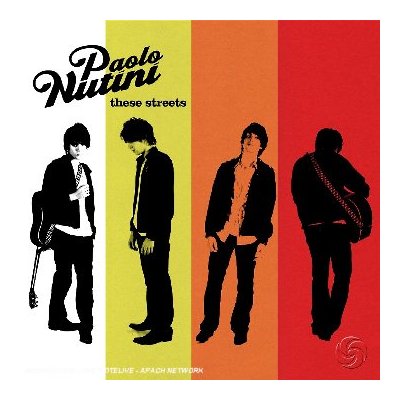
Paolo Nutini, These Streets (Atlantic, 2006)


He won't even be twenty until January 9, but Scottish singer Paolo Nutini is already building a reputation for himself on the musical scene thanks to his debut CD These Streets. A native of the Glasgow suburb of Paisley (but, as his name rather obviously indicates, of Italian descent on his father's side), Nutini has a husky voice very well suited for blue-eyed soul. These Streets mixes tempos, with rockers like the opening song "Jenny Don't Be Hasty" (a plea to a girlfriend who's decided he's too young for her), ballads like "Last Request," and fun groove-oriented songs like "New Shoes." Nutini's Scottish accent frequently emerges in the vocals, even when he's trying to channel soul singers like Al Green.

My one complaint with the album is that there's too much focus on the softer material. I would have really preferred more songs like "Jenny Don't Be Hasty" and "New Shoes." Nutini does sometimes come across as the teenager he is in his lyrics, and maybe tries a bit too hard to sound grown up, but it comes across as an honest reflection of his personality, and will not turn off older listeners. Basically, he's a good kid with plenty of talent, and with some luck a bright future in music. These Streets isn't outstanding, but there are enough good songs on this album to justify giving it a listen, and to remember the name Paolo Nutini.

Overall grade: B
Digg This
Del.icio.us

Johnny Clegg, One Life (Marabi, 2006)


The South African singer Johnny Clegg has had a long and storied career, promoting interracialism and multiculturalism at the height of apartheid as the white half of the legendary duo Juluka and as the leader of Johnny Clegg & Savuka. He has continued to perform regularly, for a stretch as part of a reunited Juluka but primarily as a solo artist, since the last Savuka album Heat Dust and Dreams came out in 1993. He has entered the recording studio less frequently lately, though, and his new album One Life is only his third studio album since Heat Dust and Dreams. Happily, the new CD is on the same level as much of his best work.

With apartheid now in South Africa's past, Clegg's lyrics have reached for broader themes. The album opens with "Daughter of Eden," a tribute to the eternal feminine in its many forms, and follows with "Jongosi," a Zulu song about young athletes/warriors taking a stand together. One Life also addresses many issues facing Africa as a whole. "The Revolution Will Eat Its Children," already on my short list of all-time favorite song titles, deals with the cycle of revolutions and takeovers too often resulting in new leaders who wind up needing to be overthrown themselves. The subtile "Anthem For Uncle Bob" suggests that the song is aimed in particular at Zimbabwe's president, Robert Mugabe. In a similar vein, "Boy Soldier" looks at the common habit throughout Africa of impressing teenage boys into service in armies or revolutionary groups. As usual, Clegg alternates between singing in English and Zulu, often on the same song, but he expands his linguistic horizons on One Life by including songs in Afrikaans ("Thamela - Die Son Drink Water") and French ("Faut Pas Baisser Les Bras").

Musically, other than the Latin feel of "Daughter Of Eden," there aren't any big surprises here. Clegg has always combined Western rock and folk with Zulu traditions and township jive, and he also keeps up with current musical trends. While heavy-duty electronics got in the way a bit on his previous album New World Survivor, One World sounds very fresh and not forced. Almost all the music on One Life is upbeat, and the disc as a whole just simmers with energy. My favorite element of Clegg's sound over the years has been the multi-voiced Zulu choruses. The distinctly African modal harmonies have this power to them that very few vocal traditions on the planet can match. Happily, One Life is full of these choruses, to a significantly greater degree than on most of his post-Juluka work. The chorus of "Jongosi" in particular hits with a force reminiscent of Clegg's best work.

One Life finds Johnny Clegg back in his prime, bounding with vibrant energy while remaining thoughtful and thought-provoking with his lyrics. Clegg has been one of the most important figures in the world of music for close to thirty years, and with his new album he remains as vital as ever.

Overall grade: A

Digg This
Del.icio.us

12.28.2006

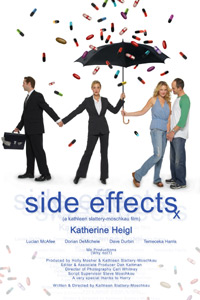
Side Effects (2005)

Side Effects is a comedy that comments on the current state of physician advertising via the so called pharmaceutical reps. While far from a documentary, it does impart a fair amount of information along the way, like that there is one pharmaceutical rep for every four doctors in the country.

The film stars Katherine Heigl, better known as “Izzie” from Gray’s Anatomy. She hangs up her white coat for this Side Effects, and sees how the other half lives. She decides to become a pharmaceutical rep, and the film starts with her recruitment. With the offer of a free company car, she is hooked on this new career path.

As time goes on, she is less sure of her career choice. She questions why they are selling these expensive drugs to the physicians, and presenting sales pitches that leave out essential facts. She also realizes how little she really knows about the products she is pushing. When a romance develops, she is convinced that she must get out of the business. She sets a 6 month countdown, and decides to tell the truth to the doctors in her territory. While this is rather humorous, for the sake of the film, her sales actually increase!

This film is both entertaining, and disturbing at the same time. While the pharmaceutical industry does do a lot of research, and brings drugs to market, it is clear that they are far more motivated by profit, than helping mankind. After all, when they have invested so much money in a drug, they aren’t going to shelve it when the bad results start appearing if they can make billions before anyone else figures this out (eg: Vioxx causing heart attacks). The DVD adds a documentary that delves into these issues a little more.

While Side Effects is entertaining, the overall theme is enraging. What holds this film back from a higher grade is that the low budget nature of the film comes through at several points, with scenes that don’t quite make sense, or strange camera movements that made me feel like I was watching a senior film thesis, and not a Hollywood film. Still, the message is worth wading through this, and I was both entertained and informed- always a good combination, especially when it’s natural and I don’t feel like I’m being preached to.

Overall Grade: B+

Digg This
Del.icio.us

Accepted (2006)

Back in the glory days of Saturday Night Live (translation: it was actually funny!), they had this skit about this fake college. The idea was that your parents paid this outrageous tuition and then they gave you half of it. The entire campus was a bunch of facades, and you only showed up one day a year, Parent’s Day. After four years they gave you your degree.

Accepted is a film that takes the idea of a fake school and updates it for the current generation. Justin Long plays Bartelby, who gets rejected by every school he applies to. With an overbearing father, he is under some severe pressure to get into an institution of higher education. We’re not talking about a specific school, but any school that will take him. He decides to have his friend build a web site for a fictitious school- South Harmon Institute of Technology (yes, those initials do stand for what you think they do). He writes himself a letter of acceptance, and his father is quite pleased.

Faster than we can say matriculate, some of his friends, also with college rejection problems decide to jump on board. Along the way, with their parent’s tuition checks in hand, they decide to legitimize their school. There is humor along the way, whether they are renovating a condemned psych hospital for their campus, or finding a more than washed up shoe salesman, with some seriously radical views, to become their new dean.

While on the surface this is all fun and games, there is a little bit of a deeper commentary about the current state of college education. Those looking for a comedy that is simultaneously silly, but with a social conscience, than take a look at Accepted.

Overall Grade: B
Digg This
Del.icio.us

12.27.2006

James Brown, 1933-2006


James Brown, the "Godfather of Soul," passed away on Christmas morning at the age of 73. Born in Depression-era South Carolina, Brown cut his musical teeth singing gospel music. Idolizing Little Richard, Brown then veered into R&B and early rock and roll, getting his first hit in 1956 with "Please, Please, Please." It wasn't until the sixties, though, that Brown created his trademark sound, eschewing standard chord progressions for rhythm-heavy tracks full of syncopated bass and drum lines, lots of horns, and ad-libbed vocals. His style has influenced every black musical development since then, from funk to disco to hip-hop; indeed, it is hard to imagine any facet of contemporary R&B without Brown's indelible stamp on it.

Brown had a number of hit singles, most notably "Papa's Got A Brand New Bag," "I've Got You (I Feel Good)," and the immortally titled "Get Up I Feel Like Being A Sex Machine (Part 1)." His strength, though, was not really as a song craftsman or a recording artist, and in the category of soul artists you can make the argument that Otis Redding and Smokey Robinson were both superior as singers and songwriters. Instead, James Brown's legendary status comes from his reputation as a showman and a bandleader. His concerts were spectacles, driven by Brown's non-stop energy, rapid fire footwork, and over-the-top antics. The 1963 LP Live At The Apollo is regarded by many as the greatest live album in the history of rock. His demands as a bandleader were very simple: to be the best, night in and night out. He wasn't considered the easiest guy to work for, but he got results. Nor was he any less demanding on himself; he easily earned the title "the hardest-working man in show business."

Regrettably, Brown spent much of the latter part of his life dealing with multiple run-ins with the law, but his status in the music world remained untarnished. He continued to tour regularly, and was even booked to play at B.B. King's club near Times Square this coming weekend. The end came quickly, however, in the form of a very severe case of pneumonia. James Brown is an American cultural icon, much like Johnny Cash. He and Cash both transcended their respective musical genres, earning the respect and admiration of people well beyond their target audiences. Likewise, he will be no less lamented or missed than Cash is.

Digg This
Del.icio.us

12.22.2006

Eden's Gate (2001)

Eden’s Gate is a novel by author David Hagberg, who is well known for international thrillers. This one fits into the Bill Lane series of novels, which is his lesser known series. Bill Lane is a hero type that works for an undercover agency that is able to cut through the red tape around Washington, and answers directly to the President, something akin to Brad Thor’s hero- Scott Harvath.

The plot centers around a horrible secret. The Nazi’s had a secret lab, which was destroyed at the end of the war. The idea is that their secret is quite powerful, and now some Germans living in Montana of all places decide to go after it. The Montana Germans are really ex-East Germans from the secret police force known as Stasi. With this secret, they can hold the American superpower hostage, extort megabucks from the US, and have their plan for world domination, etc., etc., etc. If this starts to sound like the plot from Dr. Evil in an Austin Power’s movie, then you’re starting to get the idea. The whole thing has been overdone way too many times before, and there’s little new here in the overall plot.

There are some neat parts to the novel. This includes diving into a flooded Nazis bunker, and a skirmish on the high seas aboard a freighter. Hagberg also does an admirable job of keeping the true nature of the Nazis secret known for most of the novel. Truthfully, this was one of the few things that kept me reading on, and kept me from guessing the rest of the novel (and no, I’m not going to tell it to you here).

Still, overall, this plot, which is five years old, still felt quite tired to me. Cussler’s Black Wind, albeit written more recently, is along the same lines of a lost WW II secret, but kept my interest a lot better. Eden’s Gate had several passages that I had to read more than once to even comprehend what was happening, something I almost never have to do which points to some confusing writing. Combine that with a global cast of characters, and settings around the globe, and it appears that there was too much plot to develop in a mere 300 page book. Something simply isn’t working here, and the novel feels a little half baked at times.

While I’ve enjoyed this author before, Eden’s Gate simply isn’t Hagberg at the top of his game. On the other hand though, it is a little prophetic as it was written before 9/11, and the issues developed have certainly been a concern ever since. Oh, in case you’re wondering, Eden refers to the Cuban beach that they plan to retire to after they’ve made more dough than they know what to do with. In case you’re planning a trip to a warm tropical beach, I’d suggest bringing something other than Eden’s Gate to pass the time in the sun and sand.

Overall Grade: B-

Digg This
Del.icio.us


Also reviewed by Hagberg:
Joshua's Hammer
By Dawn's Early Light